• Fri frakt över 249 kr
  • •
  • Snabba leveranser
  • •
  • Billiga böcker
Kundservice

Du är på sajten för privatpersoner.

Företag, bibliotek eller offentlig verksamhet?

Du handlar på classic.bokus.com, där alla dina funktioner finns intakta.
Till classic.bokus.com
Bokus logotyp. Gå till startsidan.
  • Erbjudanden
  • Nyheter
  • Student
  • Topplistor
  • Barn & ungdom
  • Bokus Play
  • E-böcker
  • Pocketböcker
  • Spel & pussel

10% rabatt på allt med kod: NYSTART10 →

Sidfot

Mina sidor

    Hjälp

    • Kundservice
    • Vanliga frågor och svar
    • Frakt och leverans
    • Retur vid ångerrätt
    • Reklamera vara
    • Betalning
    • Köpvillkor
    • Allmänna villkor
    • Information om webbplatsens tillgänglighet

    Om Bokus

    • Om oss
    • Pressrum
    • För studenter
    • För företag
    • För bibliotek och offentlig verksamhet
    • För leverantörer
    • Hållbarhet

    Populärt

    • Aktuella erbjudanden
    • Presentkort
    • Studentlitteratur
    • Nya böcker
    • Topplistor
    • Signerade böcker
    • Engelska böcker

    Inspiration

    • Boktips
    • BookTok
    • Populära bokserier
    • Barnbokskaraktärer
    • Populära författare
    Logotyp för Bokus
    Följ oss på Facebook (extern länk)Följ oss på Instagram (extern länk)Följ oss på YouTube (extern länk)Följ oss på TikTok (extern länk)
    bokus @ CookiesAnpassa cookiesIntegritetspolicyKöpvillkor
    Till Citymail hemsida (extern länk)Till Budbee hemsida (extern länk)Till Postnord hemsida (extern länk)Till Schenker hemsida (extern länk)Till Early Bird hemsida (extern länk)Till Walleys hemsida (extern länk)
    1. Psykologi och pedagogik
    2. Pedagogik
    3. Pedagogisk teori och filosofi

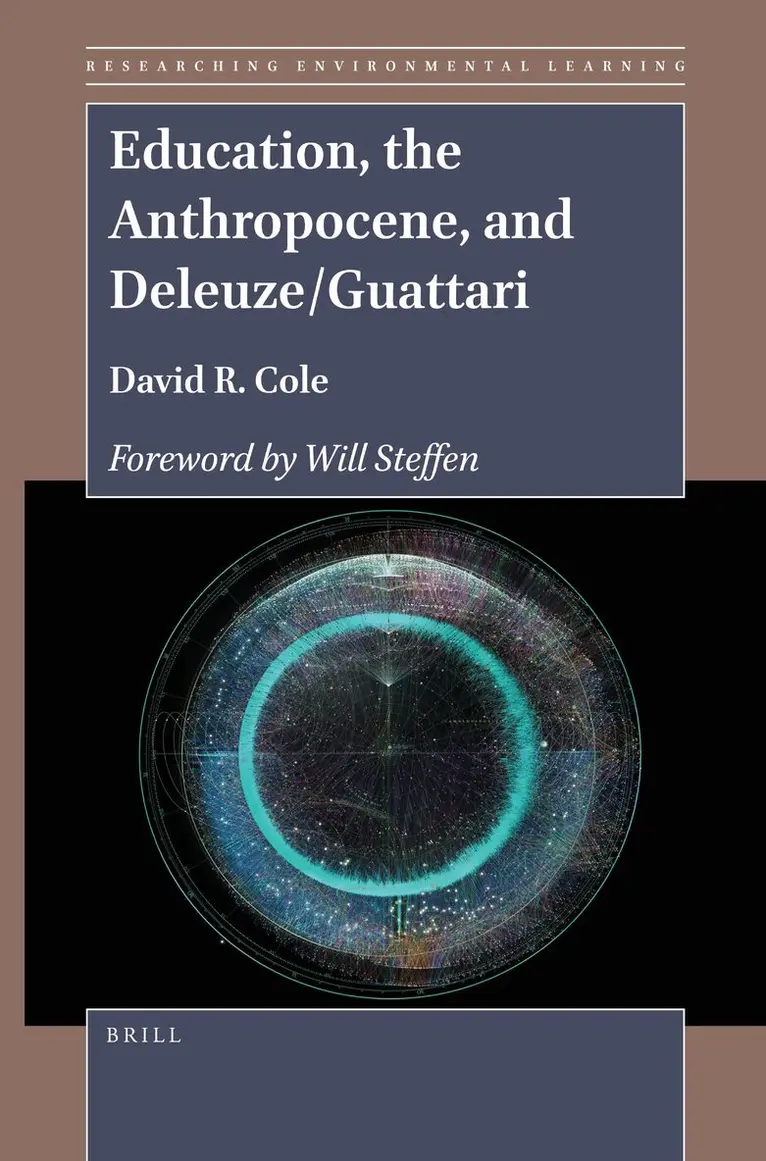
    Education, the Anthropocene, and Deleuze/Guattari

    AvDavid R. Cole

    Häftad, Engelska, 2021

    Del 5 i serien Researching Environmental Learning

    640 kr

    Beställningsvara. Skickas inom 5-8 vardagar. Fri frakt över 249 kr.

    Fler format och utgåvor

    Inbunden

    1 805 kr

    Beskrivning

    Human civilisation stands at an unimaginable precipice. The human past, leading up to today, has seen society develop under the conditions of the Holocene since 10000 BC. However – we are now in the Anthropocene, what Deleuze/Guattari term as the future rupturing the present. This book analyses the Anthropocene given four dimensions: ‘tool-enhancement’; ‘carbon trail’; ‘the phallocene’; and ‘atomic-time’. A mode of education and social change lies parallel to this mapping that tackles degrowth, changing consciousness, a Green Utopia, and building a critical-immanent model to realign current practices in the light of globalisation. This is the first book to put the philosophy of Deleuze/Guattari to work for the future, and our collective existence as a differentiated educational practice in the Anthropocene.

    Produktinformation

    • Utgivningsdatum:2021-09-30
    • Mått:155 x 235 x 11 mm
    • Vikt:341 g
    • Format:Häftad
    • Språk:Engelska
    • Serie:Researching Environmental Learning
    • Antal sidor:182
    • Förlag:Brill
    • ISBN:9789004505957

    Utforska kategorier

    • Pedagogisk teori och filosofi inom Psykologi och pedagogik

    Mer om författaren

    David R. Cole, Ph.D. (2003), University of Warwick, UK, is Associate Professor of Education at Western Sydney University. He has published 15 books in the field, and more than 100 other significant articles and book chapters. His latest book is Principles of Transversality in Globalization and Education (with Joff P. N. Bradley, Springer, 2018). He has instigated an interdisciplinary research web site for the Anthropocene (https://iiraorg.com).

    Recensioner i media

    “Anyone still in doubt about the political and ethical significance of environmental education needs to read David R. Cole’s exceptional Education, the Anthropocene, and Deleuze/Guattari. Cole demonstrates with perfect clarity and keen detail how a radical rethinking about the environment rests with also rethinking educational praxis by understanding unconscious drives and desires that perpetuate the Anthropocene and which complicate traditional educational efforts. This is a remarkable and incisive book, that captures the contemporary moment eloquently, and also provides readers with an outstanding website full of contributions and resources from interdisciplinary researchers engaged in rethinking the Anthropocentric moment.” – P. Taylor Webb, Associate Professor, Faculty of Education, The University of British Columbia“David R. Cole’s new book provides a critical reading of education, through the matrix of Deleuze/Guattari theory, examining the problem of the future and how we might escape the Anthropocene, to find what Guattari called ‘the joy of living’. An optimistic and positive view based on the idea that we can change.” – Michael A. Peters, Distinguished Professor, Faculty of Education, Beijing Normal University“While collective human-more-than-human earthly entities are paused in a temporal limbo of precarity; education needs room to breathe. The speculative and gestural possibilities for living within a new mode of humanity depend on it. The planet deserves it. This book by David R. Cole finds new spaces, a place to inhale, as he invites a host of others onto a stage we humans thought we occupied alone.” – Karen Malone, Professor of Education, Director of Research, Swinburne University, Melbourne“Cole’s original and unique book directly speaks to those educators seeking to escape the nightmare of the Anthropocene. It offers an incisive, Deleuze-Guattarian analysis of dominant, yet barely acknowledged drivers of the Anthropocene, and follows these through to stimulating expositions of new ways of learning, teaching and doing pedagogy. In doing so, it offers alternative understandings of how we could practice education that can provide escape routes from the Anthropocene that are not about escapism. It does this in a no-nonsense, hard-hitting style that is entirely appropriate to the urgency of the overwhelming planetary crisis. The book is thus also a demonstration of how to produce original and significant knowledge in ways that can help rejuvenate and re-imagine transformative practices for education. It is a must-read for anyone interested in combining contemporary theory, research and educational practice in ways that can usher in utopian futures.” – Esther Priyadharshini, Associate Professor in Education, University of East Anglia, UK“A brilliant and incredibly timely book. Cole not only provides an original analysis of the trends that have led to our contemporary crises, but more importantly, he shows how Deleuze and Guattari’s work can provide a model for ‘thinking and learning differently’ in the Anthropocene.” – Daniel W. Smith, Professor of Philosophy, Department of Philosophy, Purdue University, USA“In this erudite and carefully crafted conceptual book, with many entry and exit points, David R. Cole challenges the reader to think how education and educational practice can enact a feasible way out from the effects of end-of-world narratives and provide an escape from the entrapment of the Anthropocene.” – Juan Francisco Salazar Sutil, Professor of Anthropology, Institute of Culture and Society, Western Sydney University “Congratulations to David R. Cole for producing a much needed and timely contribution in response to a key question of our time: What does it mean to be learning in the Anthropocene? While reading this book, I was reminded of an assertion by Albert Einstein in a letter, dated 21 March 1955, written four weeks before his death, that 'the separation between past, present and future has only the importance of an admittedly tenacious illusion.' The past is still with us and the future is within us, but we live in the now. We cannot undo the past through linear extrapolation from what went wrong to an idealized future that will save us from perishing in the sixth mass extinction. What we can and must do – and keep doing – is, according to Cole, 'to try and figure out the patterns, tendencies, rhythms, repetitions, forces, and drives that have ... gone to make up the present.' Non-linear analysis of the drives that throughout human history have brought us the Anthropocene allows us to continually reinvent the now as an expanded time dimension and elucidate practices and opportunities for learning in the Anthropocene. One seldom comes across a book that, right from the beginning, is at the same time intoxicating to read but also impossible to put down as soon as one has started reading. With every page one reads and – if not immediately grasped, rereads – one becomes more and more convinced that there is a treasure hidden within, but that it takes hard work to dig it up.” – Jan Visser, President & Sr. Researcher, Learning Development Institute, Professor Extraordinary, University of Stellenbosch, South Africa

    Innehållsförteckning

    • ForewordWill SteffenPrefaceAcknowledgmentsList of Figures and Tables1 Overview: The Problem of the Future1 Introduction2 What Is the Position of the Future?3 Why ‘Deleuze/Guattari’? – An Analysis4 Education, Social Change, and the Future5 The Future of the Anthropocene2 Tool-Enhancement1 Introduction2 Prehistory3 The Beginnings of Civilisation: Agriculture4 Metallurgy5 Global Trade6 World Machine3 Carbon Trail1 Introduction2 The Discovery of Fire3 Fire, Light, and Society4 The ‘Energy-Life’ Threshold5 Furnaces, Mining, and Individual Energy Exchange6 Steam Engines7 Fossil Fuel Capitalism4 The Phallocene1 Introduction2 The Phallic God-Heads3 One Phallus-God4 Establishment of Phallus-Worship5 The Working Phallic-Week6 Digital Phallic-Endeavour5 Atomic-Time1 Introduction2 A Universe of Atoms3 Atomic Theory4 Electricity5 Quantum Mechanics6 The Atomic Bomb6 Teaching and Learning Differently in the Anthropocene1 Introduction2 Attending to the ‘Forces of Control’ at the Local Level3 A Global Thinking Matrix4 What Is Pedagogy of/in the Anthropocene?7 Incremental Movements towards a New Society1 Introduction2 The Great Leap Forward – A Green Utopia?3 Changing Society at the Micro-Level4 How Can the Minor Societal Changes Be Augmented?8 Conclusion: The Double Bind1 Introduction2 What Is the Double Bind?3 The Double Bind of the Future4 The Role of Politics in the Double Bind5 Realism and ‘Fabulation’…6 This Is the End of the ‘End-Times’ReferencesIndex