• Fri frakt över 249 kr
  • •
  • Snabba leveranser
  • •
  • Billiga böcker
Kundservice

Du är på sajten för privatpersoner.

Företag, bibliotek eller offentlig verksamhet?

Du handlar på classic.bokus.com, där alla dina funktioner finns intakta.
Till classic.bokus.com
Bokus logotyp. Gå till startsidan.
  • Erbjudanden
  • Nyheter
  • Student
  • Topplistor
  • Barn & ungdom
  • Bokus Play
  • E-böcker
  • Pocketböcker
  • Spel & pussel

10% rabatt på allt med kod: NYSTART10 →

Sidfot

Mina sidor

    Hjälp

    • Kundservice
    • Vanliga frågor och svar
    • Frakt och leverans
    • Retur vid ångerrätt
    • Reklamera vara
    • Betalning
    • Köpvillkor
    • Allmänna villkor
    • Information om webbplatsens tillgänglighet

    Om Bokus

    • Om oss
    • Pressrum
    • För studenter
    • För företag
    • För bibliotek och offentlig verksamhet
    • För leverantörer
    • Hållbarhet

    Populärt

    • Aktuella erbjudanden
    • Presentkort
    • Studentlitteratur
    • Nya böcker
    • Topplistor
    • Signerade böcker
    • Engelska böcker

    Inspiration

    • Boktips
    • BookTok
    • Populära bokserier
    • Barnbokskaraktärer
    • Populära författare
    Logotyp för Bokus
    Följ oss på Facebook (extern länk)Följ oss på Instagram (extern länk)Följ oss på YouTube (extern länk)Följ oss på TikTok (extern länk)
    bokus @ CookiesAnpassa cookiesIntegritetspolicyKöpvillkor
    Till Citymail hemsida (extern länk)Till Budbee hemsida (extern länk)Till Postnord hemsida (extern länk)Till Schenker hemsida (extern länk)Till Early Bird hemsida (extern länk)Till Walleys hemsida (extern länk)
    1. Juridik
    2. Internationell rätt

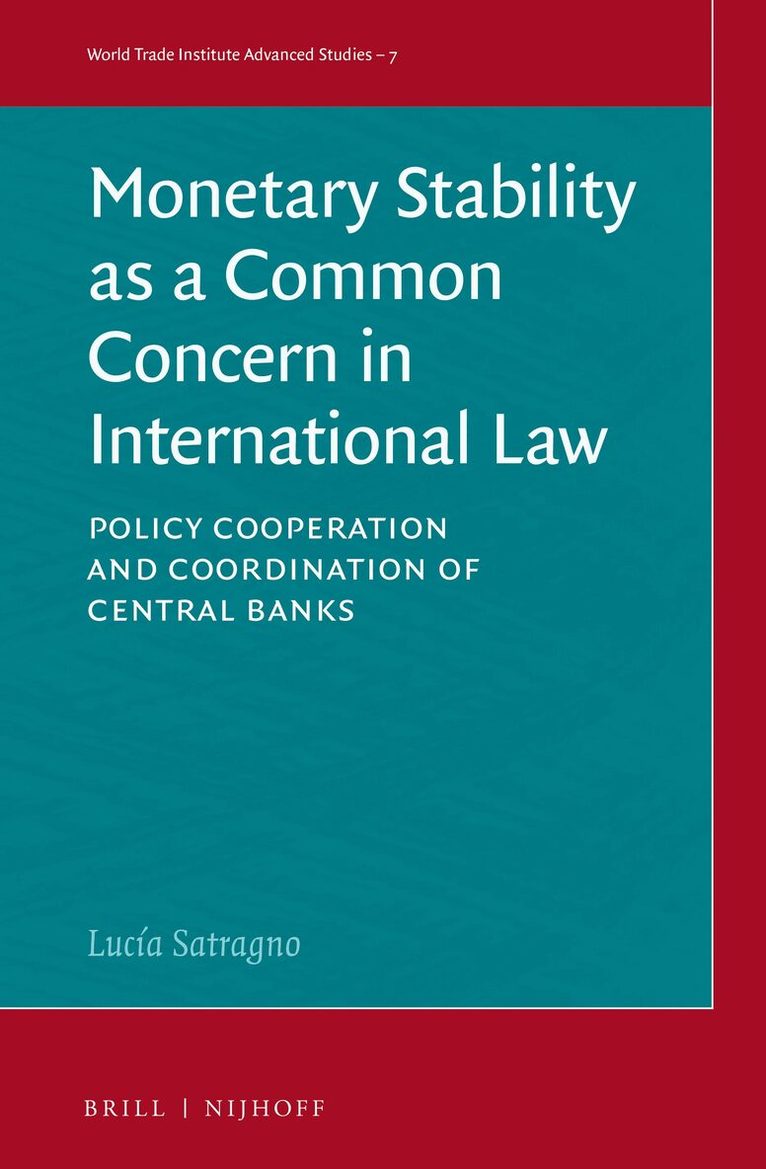
    Monetary Stability as a Common Concern in International Law

    Policy Cooperation and Coordination of Central Banks

    AvLucía Satragno

    Inbunden, Engelska, 2022

    Del 7 i serien World Trade Institute Advanced Studies

    1 883 kr

    Beställningsvara. Skickas inom 5-8 vardagar. Fri frakt över 249 kr.

    Beskrivning

    The open access publication of this book has been published with the support of the Swiss National Science Foundation.In Monetary Stability as a Common Concern in International Law, Lucía Satragno argues that monetary stability is a global public good that must be promoted and protected at all levels of governance. In doing so, the book accomplishes two tasks. On one hand, it provides an up to date analysis of the role of law and institutions in the international monetary field since the collapse of the Bretton Woods system. On the other hand, it applies the methodological approach proposed by the novel doctrine of Common Concern of Humankind to monetary stability as a case study. Accordingly, the book examines not only the status quo of the international monetary system, but also looks at the ‘new and different realism’ that would be envisaged in monetary affairs in the case of a fully-fledged principle of Common Concern.

    Produktinformation

    • Utgivningsdatum:2022-02-10
    • Mått:155 x 235 x 19 mm
    • Vikt:505 g
    • Format:Inbunden
    • Språk:Engelska
    • Serie:World Trade Institute Advanced Studies
    • Antal sidor:210
    • Förlag:Brill
    • ISBN:9789004508729

    Utforska kategorier

    • Internationell rätt inom Juridik
    • Folkrätt inom Juridik

    Mer om författaren

    Lucía Satragno, Ph.D. (2020), University of Bern, is a Research Fellow at the CBFL, National University of Singapore. She has published book chapters and journal articles, including ‘International Monetary Stability as a Common Concern of Humankind’ in Thomas Cottier (ed), The Prospects of Common Concern of Humankind in International Law (2021).

    Innehållsförteckning

    • AcknowledgmentsAbbreviations and AcronymsTable of Cases and LegislationIntroduction1 The International Monetary System in the Post-Crisis Era1 Definition and Purpose of the International Monetary System2 The Global Financial Crisis and the Fragility of the International Monetary System3 Key Aspects of the Core Elements of the International Monetary System3.1 First Element – Exchange Rates3.2 Second and Third Elements – International Payment System and International Capital Movements3.3 Fourth Element – Monetary Reserves and Access to Liquidity4 Conclusion2 Monetary Stability Competing Policy Objectives and Trade-Offs1 Monetary Sovereignty Today2 A Revision of the Concept of Monetary Stability at the Different Levels of Governance2.1 Domestic Monetary Stability2.2 International Monetary Stability3 International Spillovers of Monetary Policy and Their Impact on Monetary Stability4 Conclusion3 A Common Concern of Humankind Approach to Monetary Stability1 Monetary Stability as a Global Public Good2 Common Concern of Humankind – Review of Literature and Evolution of the Principle2.1 Expression in Treaties and Scholarly Work2.2 Foundations and Evolution of the Principle3 Common Concern of Humankind – Process of Claims and Responses3.1 The Duty to Cooperate3.2 Obligation to Do Homework3.3 Securing Compliance3.4 Arguments in Support of the Principle of Common Concern of Humankind4 Monetary Stability as a Common Concern of Humankind – A Preliminary Assessment5 Conclusion4 The Duty To Cooperate – The Fund’s Role and Cooperation among States1 Top-Down Approach – International Level of Governance1.1 The International Financial Architecture – Governance Aspects1.2 The Fund’s Role1.3 International Standard-Setting and Soft Law2 Bottom-Up Approach – Central Banking Cooperation2.1 The Evolution of Central Banking Cooperation2.2 Diplomacy and Coordination2.3 Responses to the gfc and Its Aftermath3 Common Concern as a Guide to Enhanced Cooperation in Monetary Affairs3.1 imf Mandatory Based Surveillance3.2 Improved gfsn3.3 Harness the Commitments Assumed at the Government Networks4 Conclusion5 Domestic Obligations Concerning Monetary Stability The Special Role of Central Banks1 Domestic Obligations – The Special Role of Central Banks1.1 Internal Dimension of Monetary Stability – Price Stability1.1.1 Institution of a State1.1.2 Issuance of Money1.1.3 Privately Issued Virtual Currencies and Central Bank Issued Virtual Currencies1.1.4 Conduct of National Monetary Policy1.2 External Dimension of Monetary Stability – Exchange Rate Stability1.2.1 Administration of a System of Exchange Control1.2.2 Management of a Country’s Foreign Reserves2 Conclusion6 Domestic Obligations Concerning Monetary Stability Unilateral Reactions and Securing Compliance1 Domestic Obligations – Unilateral Reactions1.1 Exchange Restrictions1.2 Capital Controls1.3 Exchange Rate Manipulation1.4 Other Reactions2 Securing Compliance – Monetary Stability Considerations3 ConclusionConclusionsBibliographyIndex