• Fri frakt över 249 kr
  • •
  • Snabba leveranser
  • •
  • Billiga böcker
Kundservice

Du är på sajten för privatpersoner.

Företag, bibliotek eller offentlig verksamhet?

Du handlar på classic.bokus.com, där alla dina funktioner finns intakta.
Till classic.bokus.com
Bokus logotyp. Gå till startsidan.
  • Erbjudanden
  • Nyheter
  • Student
  • Topplistor
  • Barn & ungdom
  • Bokus Play
  • E-böcker
  • Pocketböcker
  • Spel & pussel

10% rabatt på allt med kod: NYSTART10 →

Sidfot

Mina sidor

    Hjälp

    • Kundservice
    • Vanliga frågor och svar
    • Frakt och leverans
    • Retur vid ångerrätt
    • Reklamera vara
    • Betalning
    • Köpvillkor
    • Allmänna villkor
    • Information om webbplatsens tillgänglighet

    Om Bokus

    • Om oss
    • Pressrum
    • För studenter
    • För företag
    • För bibliotek och offentlig verksamhet
    • För leverantörer
    • Hållbarhet

    Populärt

    • Aktuella erbjudanden
    • Presentkort
    • Studentlitteratur
    • Nya böcker
    • Topplistor
    • Signerade böcker
    • Engelska böcker

    Inspiration

    • Boktips
    • BookTok
    • Populära bokserier
    • Barnbokskaraktärer
    • Populära författare
    Logotyp för Bokus
    Följ oss på Facebook (extern länk)Följ oss på Instagram (extern länk)Följ oss på YouTube (extern länk)Följ oss på TikTok (extern länk)
    bokus @ CookiesAnpassa cookiesIntegritetspolicyKöpvillkor
    Till Citymail hemsida (extern länk)Till Budbee hemsida (extern länk)Till Postnord hemsida (extern länk)Till Schenker hemsida (extern länk)Till Early Bird hemsida (extern länk)Till Walleys hemsida (extern länk)
    1. Juridik
    2. Internationell rätt
    3. Folkrätt

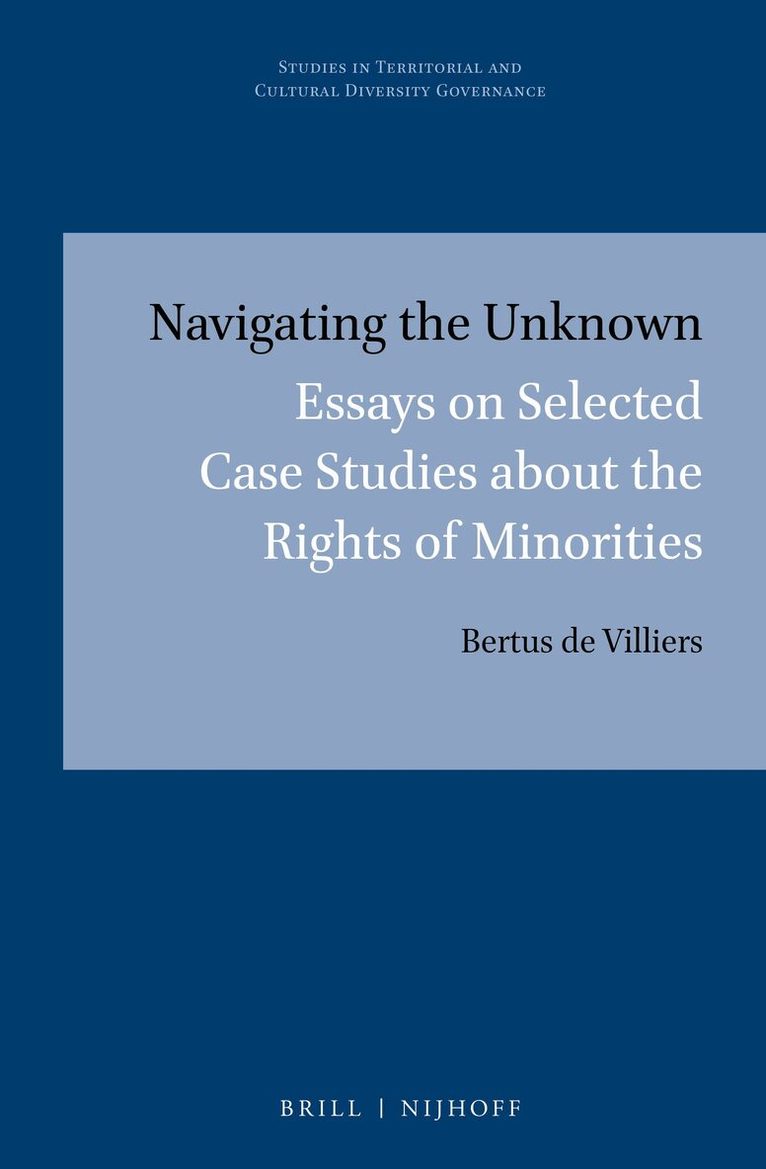
    Navigating the Unknown

    Essays on Selected Case Studies about the Rights of Minorities

    AvBertus de Villiers

    Inbunden, Engelska, 2022

    Del 15 i serien Studies in Territorial and Cultural Diversity Governance

    2 986 kr

    Beställningsvara. Skickas inom 5-8 vardagar. Fri frakt över 249 kr.

    Beskrivning

    In this book, Bertus de Villiers offers unique insights into institutional design aimed at the protection of minority rights. He reflects on several case studies to highlight various aspects of the complexity of contemporary constitution drafting and how creative solutions have been found to secure the rights of minorities. The respective chapters drill down to a practical level to assist constitutional scholars, legal scientists, the judiciary and practitioners to better comprehend the dynamics of minority rights in the country under discussion; to be informed by the jurisprudence that have arisen; and to gain insights from the adjustments that had to be made to more effectively protect the rights of minorities.

    Produktinformation

    • Utgivningsdatum:2022-04-07
    • Mått:155 x 235 x 25 mm
    • Vikt:653 g
    • Format:Inbunden
    • Språk:Engelska
    • Serie:Studies in Territorial and Cultural Diversity Governance
    • Antal sidor:302
    • Förlag:Brill
    • ISBN:9789004512108

    Utforska kategorier

    • Folkrätt inom Juridik
    • Internationell rätt inom Juridik

    Mer om författaren

    Bertus de Villiers (LL.D. 1989), University of Johannesburg, is a Visiting Professor at this university and a member of the judiciary in Australia. He has published extensively and given advice in several countries on the topic of human and minority rights, decentralisation and federalism and land reform. Most recently he co-edited Litigating the Rights of Minorities and Indigenous Peoples in Domestic and International Courts (Brill/Nijhoff, 2021).

    Innehållsförteckning

    • Preface1 The Design of Institutions in Response to Diversity A Shot in the Dark or a Fine Art?1 Introduction2 To Accommodate, Integrate or Assimilate – That is the Question3 Guidance to Institutional Design from International Law3.1 Inconsistency is the Name of the Game3.2 Selected International Legal Instruments: United Nations3.3 Regional Legal Instrument: European Framework Convention for the Protection of National Minorities3.4 From Theory to Practice: The (Non-binding) Lund Recommendations and Ljubljana Guidelines in Europe4 Conclusion: Designing Institutions in Response to Diversity: A Shot in the Dark or a Fine Art?2 A Promise Not to Keep? Lessons from Central and Eastern Europe to Establish Cultural Councils and Relevance to the Afrikaans Community of South Africa1 Introduction2 The Advent of Cultural Councils in Central and Eastern Europe3 The Promise of Cultural Councils in the 1996 Constitution of South Africa4 The Origin of the Cultural Council-debate in South Africa5 Contemporary Cultural Councils in Estonia, Hungary and the Russian Federation5.1 Legal Framework of the Cultural Councils5.2 Power and Functions of the Cultural Councils5.3 Observations of the Respective Cultural Councils6 Lessons to be Drawn by the Afrikaans (and Other) Community7 Conclusion3 Non-territorial Self-government and Socio-economic Empowerment The Roma of Hungary1 Introduction2 Hungary: An Overview of Nationality Self-government2.1 Population Composition2.2 Establishment of Nationality Self-governments2.3 Election of Nationality Self-governments2.4 Nationality Self-governing Non-territorial Institutions2.5 Nationality Self-government Functions3 The Roma and Non-territorial Self-government3.1 Who Are the Roma?3.2 Nationality Self-governments for the Roma3.3 Outcomes of Roma Self-government3.3.1 Criteria to Assess Success or Failure of Self-government3.3.2 Competing Philosophies between Roma and Other Nationalities3.3.3 The 2011-Reforms3.3.4 Varied Experiences of Self-governments3.3.5 Integration or Accommodation or Both?3.3.6 Who is Responsible for Socio-economic Improvement of the Roma?4 Summary4 Using Control Over Access to Land to Achieve Cultural Self-government (of Some Sort) Reflecting on the Experiences of Aboriginal People with the Right to Negotiate in Australia1 Introduction2 Characteristics of the Right to Negotiate3 Aboriginal People of Australia – A Brief Overview4 Recognition of Native Title5 Incorporating Aboriginal Communities: A Legal Basis to Exercise Collective Rights6 Right to Negotiate: Its Meaning and Effect6.1 How Does the Right to Negotiate Come into Existence?6.2 What Does the Right to Negotiate Entail?6.3 Support for Aboriginal People in “Good Faith” Negotiations6.4 Option for Indigenous Land Use Agreements as an Alternative to Right to Negotiate6.5 Compensation for Loss or Diminution of Native Title7 The Right to Negotiate and Its Contribution to Aboriginal Self-determination5 Breaking New Ground for Indigenous Non-territorial, Cultural Self-government – the Noongar Settlement in Australia1 Introduction2 An ilua – a Publicly Registered Treatise for Land Access and Cultural Self-government3 The Noongar People – Trailblazers for Community Self-government4 The Road to Settlement: From Litigation to Negotiation5 Essential Principles of the Noongar Settlement6 Main Elements of the Noongar Compensation Package7 The Noongar Settlement – a Proper Classification8 The Noongar Settlement – Principles of Relevance to the Theory and Practice of Protection of Minority and Indigenous Rights9 Conclusion6 Does a Constitution Have a Soul? The Role of Bundestreue in the Germany and Ubuntu in South Africa to Give Life and Identity to a Constitutional Text1 Introduction2 Introduction to the Term Bundestreue3 Bundestreue and its Relevance to the Conduct of Intergovernmental Relations4 The Origin of Bundestreue5 Bundestreue in Its Practical Application6 Ubuntu – An Implied Term of Dignity, Fairness and Humanity6.1 Origin and Meaning of Ubuntu6.2 Reliance on Ubuntu by the Constitutional Court7 Summary of Comparisons between Bundestreue and Ubuntu8 Conclusion7 Flying a Flag for Freedom of Expression When Does a Historic Symbol of a Minority Turn into Hate Speech? The Case of the Old Flag of South Africa1 Introduction2 Background to the Flag Dispute3 Events Leading to the Dispute about the Old Flag4 Background to the Old Flag5 Legal Framework6 Judgment: Does the Display of the Old Flag Constitute Hate Speech?7 Five Questions about Symbols and Hate Speech – Comparative Experiences7.1 General Comments on the Judgment7.2 Foreign Comparative and International Law7.2.1 A Flag as Hate Speech7.2.2 Universal Definition of Hate Speech7.2.3 Can Hate Speech Be Influenced by Effluxion of Time?7.2.4 Test for Hate Speech: Intention or Perception?7.2.5 Balance between Freedom of Speech and Protection Against Hate Speech8 Summary8 Concluding ObservationsBibliographyIndex