• Fri frakt över 249 kr
  • •
  • Snabba leveranser
  • •
  • Billiga böcker
Kundservice

Du är på sajten för privatpersoner.

Företag, bibliotek eller offentlig verksamhet?

Du handlar på classic.bokus.com, där alla dina funktioner finns intakta.
Till classic.bokus.com
Bokus logotyp. Gå till startsidan.
  • Erbjudanden
  • Nyheter
  • Student
  • Topplistor
  • Barn & ungdom
  • Bokus Play
  • E-böcker
  • Pocketböcker
  • Spel & pussel

10% rabatt på allt med kod NYSTART10 →

Sidfot

Mina sidor

    Hjälp

    • Kundservice
    • Vanliga frågor och svar
    • Frakt och leverans
    • Retur vid ångerrätt
    • Reklamera vara
    • Betalning
    • Köpvillkor
    • Allmänna villkor
    • Information om webbplatsens tillgänglighet

    Om Bokus

    • Om oss
    • Pressrum
    • För studenter
    • För företag
    • För bibliotek och offentlig verksamhet
    • För leverantörer
    • Hållbarhet

    Populärt

    • Aktuella erbjudanden
    • Presentkort
    • Studentlitteratur
    • Nya böcker
    • Topplistor
    • Signerade böcker
    • Engelska böcker

    Inspiration

    • Boktips
    • BookTok
    • Populära bokserier
    • Barnbokskaraktärer
    • Populära författare
    Logotyp för Bokus
    Följ oss på Facebook (extern länk)Följ oss på Instagram (extern länk)Följ oss på YouTube (extern länk)Följ oss på TikTok (extern länk)
    bokus @ CookiesAnpassa cookiesIntegritetspolicyKöpvillkor
    Till Citymail hemsida (extern länk)Till Budbee hemsida (extern länk)Till Postnord hemsida (extern länk)Till Schenker hemsida (extern länk)Till Early Bird hemsida (extern länk)Till Walleys hemsida (extern länk)
    1. Juridik
    2. Internationell rätt
    3. Folkrätt

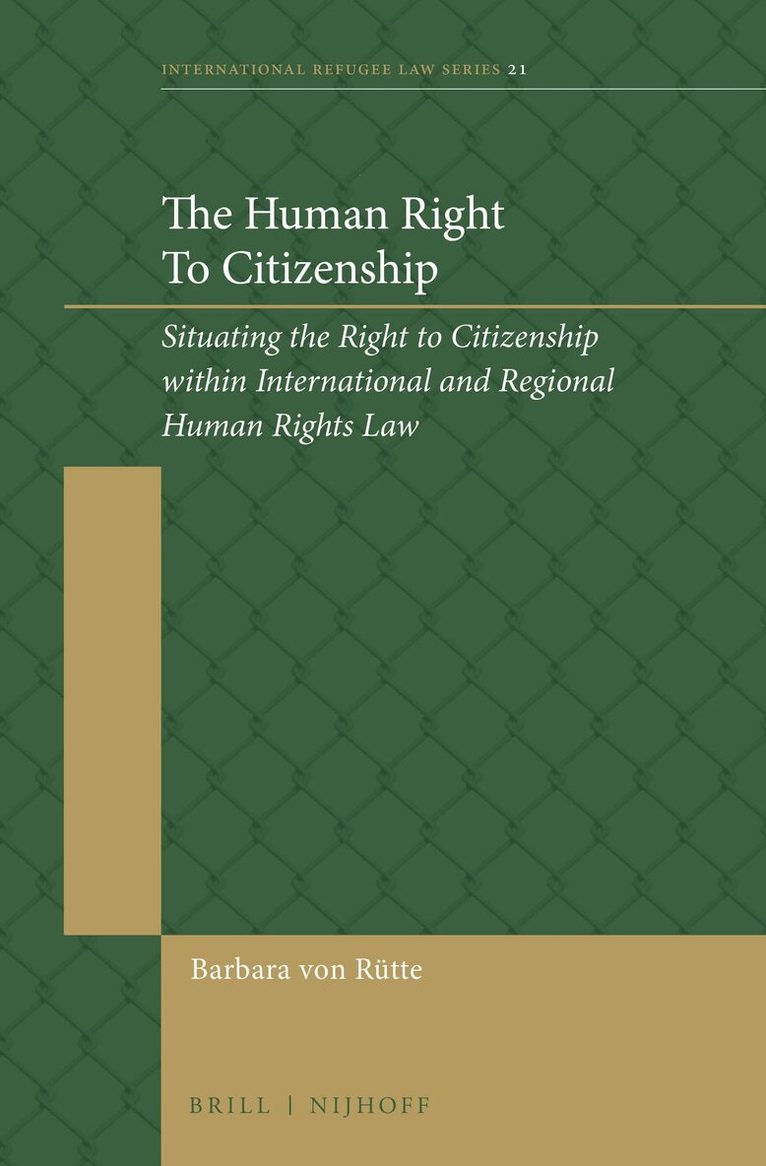
    Human Right to Citizenship

    Situating the Right to Citizenship within International and Regional Human Rights Law

    AvBarbara von Rütte

    Inbunden, Engelska, 2022

    Del 21 i serien International Refugee Law Series

    2 750 kr

    Beställningsvara. Skickas inom 5-8 vardagar. Fri frakt över 249 kr.

    Beskrivning

    The open access publication of this book has been published with the support of the Swiss National Science Foundation.This book offers a comprehensive analysis of the right to citizenship in international and regional human rights law. It critically reflects on the limitations of state sovereignty in nationality matters and situates the right to citizenship within the existing human rights framework. It identifies the scope and content of the right to citizenship by looking not only at statelessness, deprivation of citizenship or dual citizenship, but more broadly at acquisition, loss and enjoyment of citizenship in a migration context. Exploring the intersection of international migration, human rights law and belonging, the book provides a timely argument for recognizing a right to the citizenship of a specific state on the basis of one’s effective connections to that state according to the principle of jus nexi.

    Produktinformation

    • Utgivningsdatum:2022-12-22
    • Mått:155 x 235 x 36 mm
    • Vikt:920 g
    • Format:Inbunden
    • Språk:Engelska
    • Serie:International Refugee Law Series
    • Antal sidor:464
    • Förlag:Brill
    • ISBN:9789004517516

    Utforska kategorier

    • Folkrätt inom Juridik

    Mer om författaren

    Barbara von Rütte, Dr.iur. (2020), University of Bern, LL.M., Leiden, is currently a postdoc at the University of Basel. Her work focuses on citizenship, nationality, statelessness and belonging, as well as international human rights and Swiss migration law.

    Recensioner i media

    "What makes this book stand out is the range of interrelated topics that it covers, from statelessness, deprivation of citizenship, and multiple citizenship, to more general themes on the acquisition, enjoyment, and loss of citizenship in the migration context. Ultimately, the book is a key contribution to the field of citizenship studies in that it provides readers with a fresh understanding of the right of individuals to acquire citizenship. It also shows us how to navigate the protection gaps that leave individuals at risk of violations of their right to citizenship, through the identification of those rights and obligations that can be derived from the right to citizenship as enshrined in international legal standards."Abdullah Omar Yassan, GLOBALCIT, 2023."In summary, von Rütte’s book not only contributes significantly to the scholarship on citizenship but also invites readers to contemplate the profound implications of this right in our contemporary world. Her meticulous research and persuasive arguments make this book a valuable addition to the discourse surrounding human rights and citizenship for academics and practitioners alike."Monika Plozza, European Journal of Migration and Law, 25 (3), pp. 380-383. "Citizenship (or nationality) remains a slippery concept in our times and this study provides ways of strengthening the right to a nationality and realising effective nationality, especially for persons with a clear nexus with a state/states and yet facing the risk of arbitrary deprivation of nationality."A. Yadav, The Statelessness & Citizenship Review, (2023) 5(2), 245-251.

    Innehållsförteckning

    • AcknowledgmentsList of TablesList of Abbreviations1 Introductioni Citizenship and International Migration – Setting the Problemii Objective, Scope and Delimitationiii Approach and Outlook2 Citizenship and Nationality Terms, Concepts and Rightsi Citizenship or Nationality? A Note on Terminologyii The Concept of Citizenship1 Historical Traces of the Concept of Citizenship2 Theoretical Conceptualizations of Citizenship3 Citizenship as a Legal Status3.1 The Concept of Citizenship in International Law3.2 Acquisition and Loss of Citizenship3.3 Functions of Citizenshipiii Citizenship as a Human Right1 Citizenship as Access to (Human) Rights2 Citizenship as a Moral Human Right2.1 Hannah Arendt’s Right to Have Rights2.2 Seyla Benhabib’s Cosmopolitan Right to Membership2.3 Ruth Rubio-Marín’s Jus Domicilii2.4 Joseph Caren’s Theory of Social Membership2.5 Ayelet Shachar’s Jus Nexi2.6 David Owen’s Right to a Nationality3 Citizenship as a Legal Human Right3 Domaine Réservé? Statehood, Sovereignty and Nationalityi Statehood and Sovereignty in International Law1 Elements of Statehood2 Statehood and Sovereignty3 State Sovereignty and the Doctrine of Domaine Réservéii The Traditional Perception of Nationality as a Domaine Réservé and its Developmentiii A Historical Perspective on the Regulation of Nationality in International Law1 Early Multilateral Regulation: Avoiding Conflicts2 Internationalization and Specialization: The 1930 Hague Convention3 The After-War Period: The Rise of Individual Rights4 The Parallel Development: The Indirect Regulation of Nationalityiv Conclusion: Growing International Support4 Beyond Sovereignty The Right to Nationality in International Lawi Article 15 Universal Declaration of Human Rights1 The Drafting History of Article 15 udhr2 The Scope and Content of Article 15 udhr3 The Customary Nature of Article 15 udhrii The Right to Nationality in International Law1 The Right to Nationality at Universal Level1.1 The UN Core Human Rights Treaties1.2 The Statelessness Conventions and the Refugee Convention1.3 Soft Law Instruments at Universal Level2 The Right to Nationality at Regional Level2.1 The Americas2.2 Europe2.3 Africa2.4 Middle East and North Africa2.5 Asia and Pacific2.6 Interim Conclusioniii The Right to Nationality as Customary International Law?iv Conclusion: The Body of International Human Rights Law5 Defining the Right to Nationality Rights and Obligationsi Qualifying the Right to Nationalityii The Scope of the Right to Nationality1 Personal Scope of Application1.1 Everyone1.2 Instruments with a Limited Personal Scope1.3 Legal Persons?2 Substantive Scope of Application2.1 Nationality2.2 Acquisition, Change and Loss of Nationality3 Territorial Scope of Application4 Temporal Scope of Applicationiii Rights and Obligations Derived from the Right to Nationality1 Negative and Positive Obligations2 Transversal Obligations2.1 Prohibition of Discrimination2.2 The Prohibition of Arbitrariness and the Question of Proportionality2.3 The Duty to Prevent and Reduce Statelessness3 Obligations Regarding the Acquisition of Nationality3.1 Right of the Child to Acquire a Nationality3.2 Acquisition of Nationality by Stateless Persons and Refugees3.3 Acquisition in Situations of State Succession3.4 Prohibition of Extraterritorial Naturalizations3.5 Prohibition of Forced Naturalization3.6 Right to Naturalization4 Obligations Regarding the Effective Enjoyment of Nationality5 Obligations Regarding Change of Nationality5.1 The Right to Change One’s Nationality5.2 The Right to Renounce One’s Nationality5.3 A Right to Dual or Multiple Nationality?6 Obligations Regarding Involuntary Loss of Nationality6.1 The Prohibition of Arbitrary Deprivation of Nationality6.2 Prohibition of Deprivation of Nationality of Children6.3 Prohibition of Mass Deprivation of Nationality7 Obligations Regarding the Procedure7.1 Access to the Procedure7.2 Due Process7.3 Right to Reviewiv Lawful Interference with the Right to Nationality?1 Legality of Interference2 Legitimacy of Interference3 Balancing of the Interestsv Enforceability and Implementation of the Right to Nationalityvi Conclusion: Identifiable and Predictable Rights and Obligations6 An Individual Right Realizing the Right to Citizenshipi The Need to Strengthen the Right to Citizenship1 The Limitations of Birthright-Based Modes of Citizenship Acquisition2 The Claim for Political Participation and Representation3 The Exclusionary Effects of Citizenship4 The Individual Rights’ Dimensionii Jus Nexi – a Genuine-Connection Principle for Citizenship Acquisition1 Theoretical Foundations of the Concept of Jus Nexi2 From ‘Private Life’ and ‘One’s Own Country’ to Jus Nexi2.1 The Right to Private Life and the Concept of Social Identity2.2 The Right to Enter One’s Own Country3 Connecting Factors for a Jus Nexi3.1 Territorial Ties3.2 Familial Ties3.3 Social, Professional, Cultural or Political Ties4 A Dynamic and Non-exclusive Conceptiii Linking Jus Nexi and the Right to Citizenshipiv The Implications of a Jus Nexi-Based Right to Citizenship1 Scope of a Jus Nexi-Based Right to Citizenship2 Content of a Jus Nexi-Based Right to Citizenship2.1 The Right to Acquire Citizenship at Birth2.2 The Right to the Citizenship of a Specific State2.3 The Right to Dual and Multiple Citizenship2.4 Limitations upon Involuntary Loss of Citizenship3 Legitimate Interferences — Balancing a Jus Nexi-Based Right to Citizenshipv Conclusion: Strengthening the Right to Citizenship7 ConclusionBibliographyTable of Other MaterialsTable of CasesIndex