• Fri frakt över 249 kr
  • •
  • Snabba leveranser
  • •
  • Billiga böcker
Kundservice

Du är på sajten för privatpersoner.

Företag, bibliotek eller offentlig verksamhet?

Du handlar på classic.bokus.com, där alla dina funktioner finns intakta.
Till classic.bokus.com
Bokus logotyp. Gå till startsidan.
  • Erbjudanden
  • Nyheter
  • Student
  • Topplistor
  • Barn & ungdom
  • Bokus Play
  • E-böcker
  • Pocketböcker
  • Spel & pussel

10% rabatt på allt med kod: NYSTART10 →

Sidfot

Mina sidor

    Hjälp

    • Kundservice
    • Vanliga frågor och svar
    • Frakt och leverans
    • Retur vid ångerrätt
    • Reklamera vara
    • Betalning
    • Köpvillkor
    • Allmänna villkor
    • Information om webbplatsens tillgänglighet

    Om Bokus

    • Om oss
    • Pressrum
    • För studenter
    • För företag
    • För bibliotek och offentlig verksamhet
    • För leverantörer
    • Hållbarhet

    Populärt

    • Aktuella erbjudanden
    • Presentkort
    • Studentlitteratur
    • Nya böcker
    • Topplistor
    • Signerade böcker
    • Engelska böcker

    Inspiration

    • Boktips
    • BookTok
    • Populära bokserier
    • Barnbokskaraktärer
    • Populära författare
    Logotyp för Bokus
    Följ oss på Facebook (extern länk)Följ oss på Instagram (extern länk)Följ oss på YouTube (extern länk)Följ oss på TikTok (extern länk)
    bokus @ CookiesAnpassa cookiesIntegritetspolicyKöpvillkor
    Till Citymail hemsida (extern länk)Till Budbee hemsida (extern länk)Till Postnord hemsida (extern länk)Till Schenker hemsida (extern länk)Till Early Bird hemsida (extern länk)Till Walleys hemsida (extern länk)
    1. Historia och arkeologi
    2. Historia
    3. Europas historia

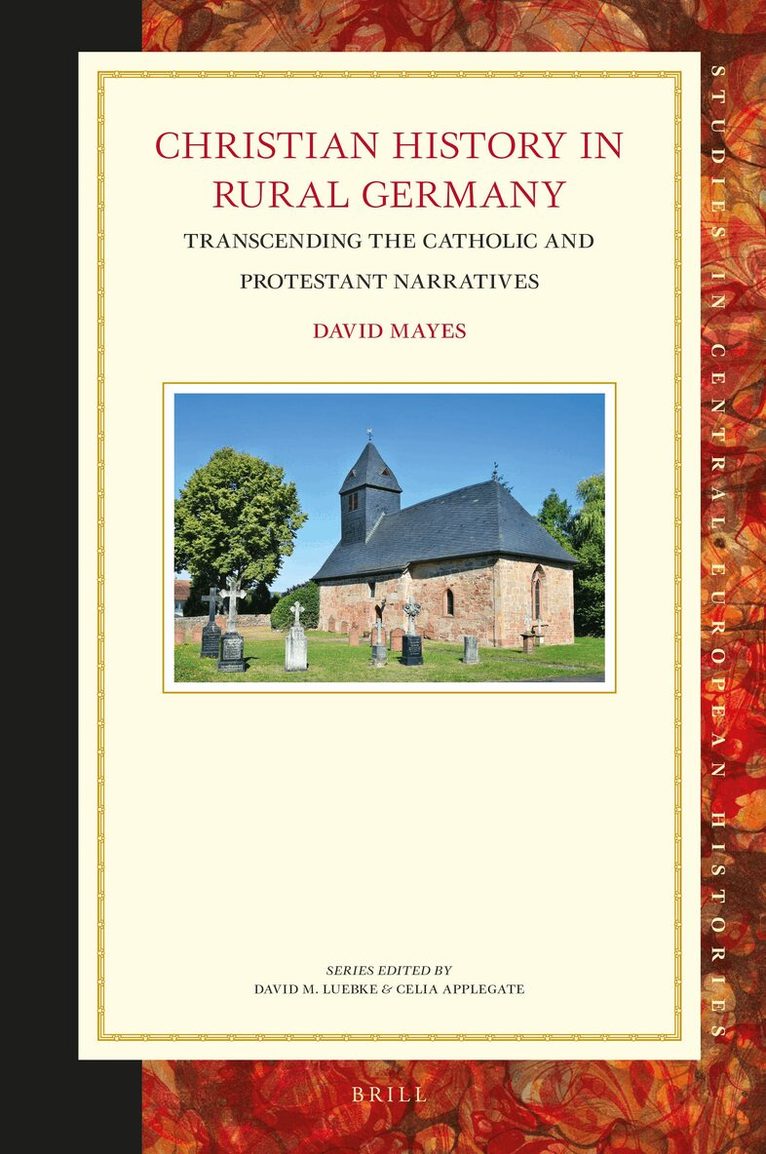
    Christian History in Rural Germany

    Transcending the Catholic and Protestant Narratives

    AvDavid Mayes

    Inbunden, Engelska, 2022

    Del 72 i serien Studies in Central European Histories

    2 047 kr

    Beställningsvara. Skickas inom 5-8 vardagar. Fri frakt över 249 kr.

    Beskrivning

    Surely, Christian history in Germany principally followed the outlines of a Catholic and Protestant narrative, right? On the contrary, for Hesse, Hanau, and Fulda this dominant framework largely obscures the historical experience of most Christians, specifically rural Christians. The rural Christian narrative, animated for more than a millennium by agricultural and communal forces, principally followed an indigenous path characterized by long-term surges and setbacks. This path eventually bifurcated not in the 1517-1648 period but rather in the wake of the 1648 Peace of Westphalia, and it did so not into Catholic and Protestant storylines but rather into those Christian corpora (Gemeinden) which maintained their local civil-sacred unity into the twentieth century and those which lost that unity after succumbing to Westphalia's divisive effects.

    Produktinformation

    • Utgivningsdatum:2022-11-17
    • Mått:155 x 235 x 36 mm
    • Vikt:930 g
    • Format:Inbunden
    • Språk:Engelska
    • Serie:Studies in Central European Histories
    • Antal sidor:464
    • Förlag:Brill
    • ISBN:9789004526488

    Utforska kategorier

    • Europas historia inom Historia och arkeologi
    • Kristendom inom Filosofi och religion

    Mer om författaren

    David Mayes, Ph.D. (2002), University of Wisconsin-Madison, is Associate Professor of History at Sam Houston State University. His publications include Communal Christianity: The Life and Loss of a Peasant Vision in Early Modern Germany (Brill, 2004) and recent articles on rural communities, names and naming, and toleration.

    Innehållsförteckning

    • ContentsAcknowledgementsNote on the TranslationList of Figures and MapsIntroductionPart 1: Surges: The Civil and the Sacred UnitedIntroduction to Part 11 The Animating Forces of Christian History in Rural Germany, to 16482 Rural Gemeinden in an Age of Pluralization, 1517–16481 Scales of Corpus Christianum, and How Each Fared in the Sixteenth Century2 The Christian Confessions and the Imperial Territories3 Rural Gemeinden Navigate through Pluralization3 Mounting Another Surge, 1648–1800s1 Betterment by Localizing2 Maintenance of Custom and Status4 Characteristics of Rural Christian Culture, 1648–1900s1 Crafting the Perspective2 Ordering the Church3 Repurposing the Particulars4 Sacralizing the Local5 Localizing the Cemetery6 Inscribing the Culture5 Surging toward Crescendo, 1648–1900s1 Betterment by Switching2 Betterment by DevolvingConclusion to Part 1Part 2: Divergence: The Civil and the Sacred Disunited, 1648–Introduction to Part 26 The Division of Local Sacred Communities, 1648–18171 Alleviating Disunity and Priming Disunity2 The Empire’s Birthing of Catholics, Lutherans, and Reformed as Triplets in 16483 The Onset of Anachronistic History and Its Early Local Effects7 Ministerial Conflict, 1648–18171 Alleged Encroachments2 Financial Interests3 Personal Honor and Dignity4 State Authority and Order5 Persons of the Tertiary Denomination8 Toleration Transformed, 1648–18171 Emigration and Exile2 Auslauf3 House Churches4 New Church Buildings5 Simultaneum6 Freedom of Conscience7 Rural Collaborations and Unifications9 Rural Fulda amid the Evangelical Union, 1817–1850s1 The Evangelical Union2 Sacred Communities Divided Anew in Rural Fulda10 Rural Hanau amid the Evangelical Union, 1817–1860s1 Sacred Communities United and the Gemeinde Restored2 Authorities’ Anxiety about the Use of Multiple Churches3 A Switch in Strategy11 Rural Upper Hesse amid the Evangelical Union, 1817–1900s1 The Union’s Inauspicious Start in the Region2 The Union Attempted in Frankenberg3 Collaborations and Unifications Continue in Rural Upper Hesse4 The Union Thwarted in Frankenberg5 Collaborations and Unifications Thwarted in Rural Upper HesseConclusion to Part 2EpilogueBibliographyIndex