• Fri frakt över 249 kr
  • •
  • Snabba leveranser
  • •
  • Billiga böcker
Kundservice

Du är på sajten för privatpersoner.

Företag, bibliotek eller offentlig verksamhet?

Du handlar på classic.bokus.com, där alla dina funktioner finns intakta.
Till classic.bokus.com
Bokus logotyp. Gå till startsidan.
  • Erbjudanden
  • Nyheter
  • Student
  • Topplistor
  • Barn & ungdom
  • Bokus Play
  • E-böcker
  • Pocketböcker
  • Spel & pussel

10% rabatt på allt med kod NYSTART10 →

Sidfot

Mina sidor

    Hjälp

    • Kundservice
    • Vanliga frågor och svar
    • Frakt och leverans
    • Retur vid ångerrätt
    • Reklamera vara
    • Betalning
    • Köpvillkor
    • Allmänna villkor
    • Information om webbplatsens tillgänglighet

    Om Bokus

    • Om oss
    • Pressrum
    • För studenter
    • För företag
    • För bibliotek och offentlig verksamhet
    • För leverantörer
    • Hållbarhet

    Populärt

    • Aktuella erbjudanden
    • Presentkort
    • Studentlitteratur
    • Nya böcker
    • Topplistor
    • Signerade böcker
    • Engelska böcker

    Inspiration

    • Boktips
    • BookTok
    • Populära bokserier
    • Barnbokskaraktärer
    • Populära författare
    Logotyp för Bokus
    Följ oss på Facebook (extern länk)Följ oss på Instagram (extern länk)Följ oss på YouTube (extern länk)Följ oss på TikTok (extern länk)
    bokus @ CookiesAnpassa cookiesIntegritetspolicyKöpvillkor
    Till Citymail hemsida (extern länk)Till Budbee hemsida (extern länk)Till Postnord hemsida (extern länk)Till Schenker hemsida (extern länk)Till Early Bird hemsida (extern länk)Till Walleys hemsida (extern länk)
    1. Språk och ordböcker
    2. Språkvetenskap och lingvistik

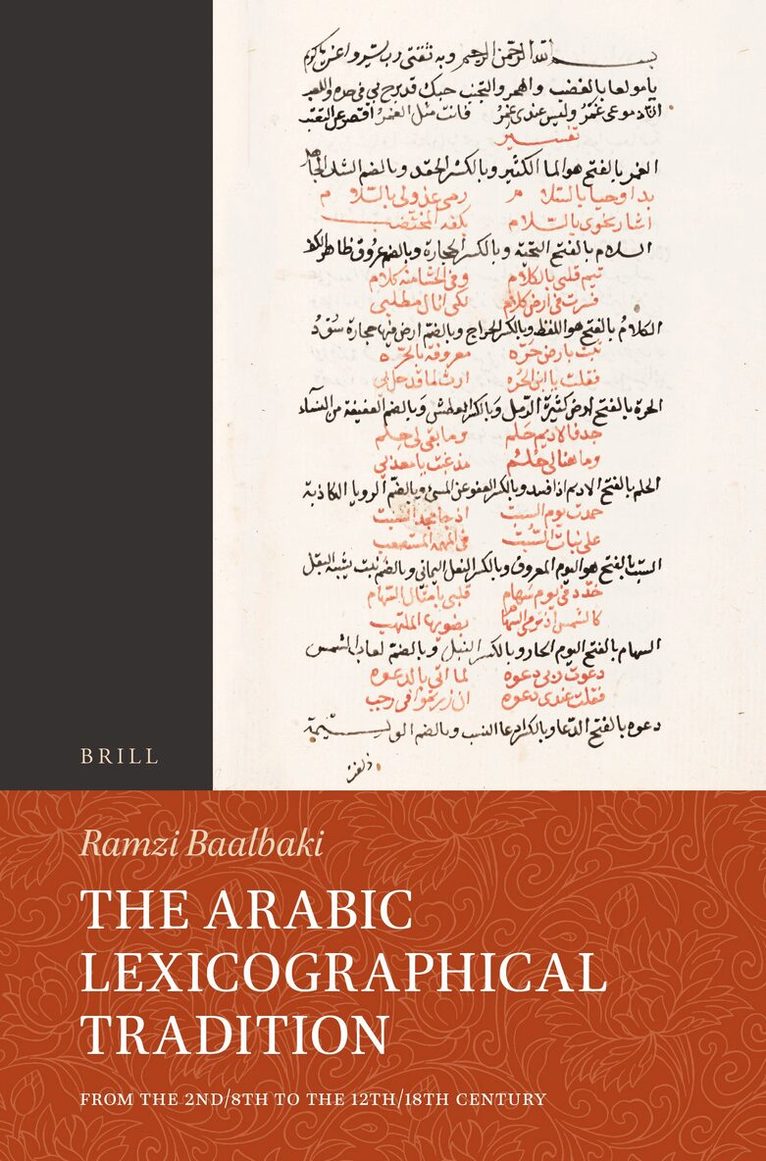
    Arabic Lexicographical Tradition

    From the 2nd/8th to the 12th/18th Century

    AvRamzi Baalbaki

    Häftad, Engelska, 2024

    823 kr

    Beställningsvara. Skickas inom 5-8 vardagar. Fri frakt över 249 kr.

    Fler format och utgåvor

    Inbunden

    3 954 kr

    Beskrivning

    A comprehensive and methodologically sophisticated history of Arabic lexicography, this book fills a serious gap in modern scholarship. Besides meticulously examining the factors that led to the emergence of lexicographical writing as of the second/eighth century, the work comprises detailed discussions of the aims, range, and approaches of the most important writings and writers of lexica specialized in specific topics and multi thematic thesauri, and the lexica arranged according to roots. The organisation of the book and the lists of works cited in the various genres make it easy for the reader to find his way through an enormous amount of material. From a broader perspective, the book highlights the relationship between Arabic lexicography and other areas of linguistic study, grammar in particular, and the centrality of Qurʾan and poetry to lexicographical writing.

    Produktinformation

    • Utgivningsdatum:2024-03-28
    • Mått:155 x 235 x 29 mm
    • Vikt:840 g
    • Format:Häftad
    • Språk:Engelska
    • Antal sidor:490
    • Förlag:Brill
    • ISBN:9789004696020

    Utforska kategorier

    • Språkvetenskap och lingvistik inom Språk och ordböcker

    Mer om författaren

    Ramzi Baalbaki, Ph.D. (1978), University of London, is the Margaret Weyerhaeuser Jewett Professor of Arabic at the American University of Beirut. He is also the Chair of the Academic Council of the Doha Arabic Historical Dictionary project. He has published extensively both in English and Arabic on the history of the Arabic grammatical and lexicographical traditions.

    Recensioner i media

    "Be that Baalbaki’s study on Mugannas, on Semasiological Lexica (from sign to meaning) and the contradiction with the mubawwab lexica (from meaning to sign) or the development of the Arabic language as a result of the conquests, readership of this a book naturally includes sociologists of language, anthropologists, ethnologists and theologians."Stavros Nikolaidis in Journal of Oriental and African Studies 28 (2019)"...eine willkommene und fundierte Ergänzung der Literatur über die arabische Lexikographie". Vivian Strotmann in Die Welt des Islams 57 (2017) 227-229. "This work will be extremely helpful for specialists, but it is also accessible to non-specialists, and does a wonderful job of expressing why Arabic lexicography is relevant and interesting even for those who do not speak Arabic. It allows readers to challenge their preconceptions about dictionaries and the kind of work that dictionaries do."David Lennington in Al-Abhath 64 (2016)"Ramzi Baalbaki, the very renowned researcher on the history of Arabic Language and Linguistics, after long years of extensive publication in the field, provides the reader with this seminal work on the Lexicographical Arabic tradition. It is indeed a milestone in the history of studies on the extremely rich tradition of Arabic Lexical works, as well as a good reference for everybody interested in discovering the subtleties and intricacies of the Arabic language. [...] This is definitely a solid piece of research, an impressive work that provides an invaluable service to researchers in the field of Arabic lexicography."Ignacio Ferrando, Wiener Zeitschrift für die Kunde des Morgenlandes 105 (2015), 433-434."Obwohl der Inhalt dieser gehaltvollen Studie nur rudimentär dargestelt werden konnte, wird dem Leser nicht verborgen geblieben sein, dass B. ein grundlegendes Werk zu einem Teilbereich der arabischen Literaturgeschichte geschaffen hat, das hinsichtlich Klarheit der Darstellung, Materialreichtum und Zuverlässigkeit der Angaben nichts zu wünschen übrig lässt. Man darf es getrost als Jahrhundertwerk bezeichnen, denn die mannigfachen Beobachtungen und neuen Erkenntnisse, die der Autor für uns parat hält, werden auch in Jahrzehnten kaum überholt sein. Kurzum, die Leistung Baalbakis is gar nicht hoch genug zu schätzen und sollte uns allen ein Vorbild sein und gleichzeitig als Anspron dienen, die Erforschung der Geschichte der arabischen Lexikographie voranzutreiben". Reinhart Weipert in Orientalistische Literaturzeitung, 110, 4/5 (2015).

    Innehållsförteckning

    • PrefaceChapter One: Early Lexicographical Activity1. The Background of Linguistic Study2. The Speech of the Bedouins (Aʿrāb)3. The Collection of Data4. The Epochs of Reliable Usage (ʿUṣūr al-iḥtiǧāǧ)5. The Role of Ġarīb6. The Compilation of Lexica7. Remarks on Contemporary Scholarship and the Originality of Arabic LexicographyChapter Two: Mubawwab (Onomasiological) and Specialized Lexica1. Introduction2. al-Ġarīb (Strange Usage) and al-Nawādir (Rare Usage)3. al-Amṯāl (Proverbs)4. al-Nabāt (Plants), al-Ḥayawān (Animals), Ḫalq al-insān (Human Body), etc.5. al-Muʿarrab (Arabized Words)6. Laḥn al-ʿāmma (Solecism)7. al-Aḍdād (Words with Two Contradictory Meanings)8. al-Muštarak (Homonyms) and al-Mutarādif (Synonyms)9. al-Ḥurūf/al-Aṣwāt (Particles/Letters)10. al-Abniya (Morphological Patterns)11. Multithematic WorksChapter Three: Muǧannas (Semasiological) Lexica1. Introduction2. The Phonetic-Permutative System3. The Alphabetical System4. The Rhyme SystemEpilogueBibliographical ReferencesIndices