• Fri frakt över 249 kr
  • •
  • Snabba leveranser
  • •
  • Billiga böcker
Kundservice

Du är på sajten för privatpersoner.

Företag, bibliotek eller offentlig verksamhet?

Du handlar på classic.bokus.com, där alla dina funktioner finns intakta.
Till classic.bokus.com
Bokus logotyp. Gå till startsidan.
  • Erbjudanden
  • Nyheter
  • Student
  • Topplistor
  • Barn & ungdom
  • Bokus Play
  • E-böcker
  • Pocketböcker
  • Spel & pussel

10% rabatt på allt med kod: NYSTART10 →

Sidfot

Mina sidor

    Hjälp

    • Kundservice
    • Vanliga frågor och svar
    • Frakt och leverans
    • Retur vid ångerrätt
    • Reklamera vara
    • Betalning
    • Köpvillkor
    • Allmänna villkor
    • Information om webbplatsens tillgänglighet

    Om Bokus

    • Om oss
    • Pressrum
    • För studenter
    • För företag
    • För bibliotek och offentlig verksamhet
    • För leverantörer
    • Hållbarhet

    Populärt

    • Aktuella erbjudanden
    • Presentkort
    • Studentlitteratur
    • Nya böcker
    • Topplistor
    • Signerade böcker
    • Engelska böcker

    Inspiration

    • Boktips
    • BookTok
    • Populära bokserier
    • Barnbokskaraktärer
    • Populära författare
    Logotyp för Bokus
    Följ oss på Facebook (extern länk)Följ oss på Instagram (extern länk)Följ oss på YouTube (extern länk)Följ oss på TikTok (extern länk)
    bokus @ CookiesAnpassa cookiesIntegritetspolicyKöpvillkor
    Till Citymail hemsida (extern länk)Till Budbee hemsida (extern länk)Till Postnord hemsida (extern länk)Till Schenker hemsida (extern länk)Till Early Bird hemsida (extern länk)Till Walleys hemsida (extern länk)
    1. Kultur
    2. Scenkonst och film
    3. Dansböcker

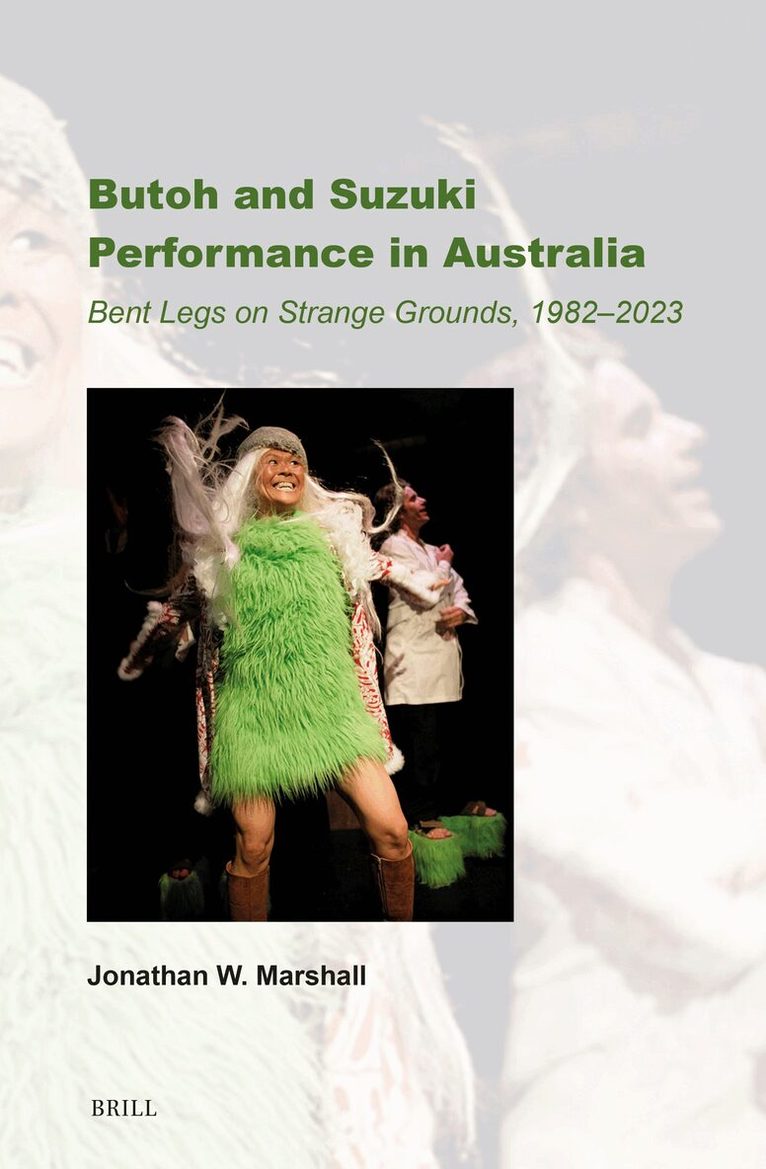
    Butoh and Suzuki Performance in Australia

    Bent Legs on Strange Grounds, 1982–2023

    AvJonathan W. Marshall

    Inbunden, Engelska, 2024

    Del 20 i serien Australian Playwrights

    2 167 kr

    Beställningsvara. Skickas inom 3-6 vardagar. Fri frakt över 249 kr.

    Beskrivning

    In Butoh and Suzuki Performance in Australia: Bent Legs on Strange Grounds, 1982-2023, Marshall considers how the originally Japanese forms of butoh dance and Suzuki’s theatre reconfigure historical lineages to find ancient yet transcultural ancestors within Australia and beyond. Marshall argues that artists working in Australia with butoh and Suzuki techniques develop conflicted yet compelling diasporic, multicultural, spiritually and corporeally compelling interpretations of theatrical practice. Marshall puts at the centre of butoh historiography the work of Tess de Quincey, Yumi Umiumare, Tony Yap, Lynne Bradley, Simon Woods, Frances Barbe, and Australian Suzuki practitioners Jacqui Carroll and John Nobbs.Jonathan W. Marshall’s Bent Legs on Strange Grounds is an important contribution to the body of literature on butoh, as well as to studies of dance in Australia that will be valuable to practitioners and scholars alike. Detailed discussions of Australian butoh artists open up consideration of how global and local histories, migrations, and landscapes not only were key to butoh’s formation in Japan, but also to its continued development around the world. Attention to butoh’s emplacement in Australia, Marshall convincingly argues, reveals insights about national identity, race, power, and more that are relevant well beyond the Australian performance context.— Rosemary Candelario, Texas Woman’s University, co-editor, Routledge Companion to Butoh Performance (2018)Marshall’s Bent Legs on Strange Grounds explores the remarkable transformative era of Australia’s reconsideration of its place in the region. A definitive study of Australian experiments in butoh and the theatrical vision of Suzuki Tadashi, the book shows how new corporeal and spatial dramaturgies of the Japanese avant-garde fundamentally changed Australian performance. Expansively researched and annotated, this impressive study connects Australian performance after the New Wave with globalization, postmodern dance, Indigeneity, and subcultures, and it details the work of leading Australian/Asian artists. Bent Legs on Strange Grounds speaks about the development of embodied knowledge and the consequential refiguration of Australia’s sense of being in the world. It is also a study of butoh and Suzuki’s legacy in global terms, wherein Australian experimental performance also becomes something larger than itself.— Peter Eckersall, The Graduate Center, CUNY, author of Performativity and Event in 1960s Japan (2013).

    Produktinformation

    • Utgivningsdatum:2024-12-19
    • Mått:155 x 235 x 27 mm
    • Vikt:699 g
    • Format:Inbunden
    • Språk:Engelska
    • Serie:Australian Playwrights
    • Antal sidor:330
    • Förlag:Brill
    • ISBN:9789004712300

    Utforska kategorier

    • Dansböcker inom Kultur
    • Övrig scenkonst inom Kultur

    Mer om författaren

    Jonathan W. Marshall has written about butoh and Suzuki since 1995, and published extensively on the relationship between the hysteria diagnosis and performance. He is associate professor and postgraduate coordinator, Western Australian Academy of Performing Arts, Edith Cowan Australia. https://edithcowan.academia.edu/JonathanWMarshall

    Innehållsförteckning

    • AcknowlegementsList of Figures1 Bodies Possessed by History: an Introduction to Butoh and Suzuki1 Introduction2 Butoh, Suzuki and the Move to Australia3 Primal Scenes of Butoh Encounter4 What is Butoh?5 Suzuki Technique and the Way of Stomping6 Lineages of Descent Ancient and Modern in Butoh and Suzuki7 Butoh and Suzuki Technique in Other National Contexts8 Criticism and Reception of Japanese Performance in Australia9 Emptiness and Possession10 Primary Sources and Thick Description11 Overview and Book Structure2 Butoh and the Australian Context: Dancing the Landscape While Dancing Global Relations1 Introduction2 Consolidation in Japan and Movement to Australia3 Tanaka’s “Map of History through Dancing” in the Contested Lands of Australia4 Corpus Nullius: Moving beyond the Emptiness of the Butoh Body5 Expressive Japanese Performance as a Counter to the Postmodern “Performance of Absence”6 Bodies in Opposition to the Australian Legend: Butoh, Suzuki and Grotowski7 Troubled Relations between Australia and Asia Prior to the Japan Theatre Boom8 The Japanese Theatrical Boom in Australia, 1982–19943 De Quincey Takes Body Weather Inland: Lake Mungo and Alice Springs1 Introduction2 De Quincey’s Butoh Encounter and Position Within Australian Dance3 Tanaka Min and Body Weather4 De Quincey’s Development from Postwar Britain to Australia5 De Quincey’s First Solos in Australia6 Body Weather as an Uncanny Project: Tracing an “Interactive History of the Senses” on Australia’s Colonised Lands7 De Quincey’s Lake Mungo Workshops, 1991–92, and beyond8 Lake Mungo Performance Works and on to Alice Springs9 Triple Alice, 1999–200110 Triple Alice Performances and Dictionary of Atmospheres (2005)4 Body Weather Comes Back from the Desert: De Quincey’s Urban Works, the Hysterical Body, and Other Body Weather Performers in Australia1 Introduction2 De Quincey’s Urban and Industrial Site-Specific Works: Compression  100 (1996), City to City (2000), The Stirring (2007), Run (2009)3 A Masterpiece of Hysterio-Choreography: Nerve  9 (2001–05)4 Other Bodyweather Artists in Australia5 Heywood and Humanimal Body Weather6 European Tanztheater Meets Australian Body Weather: Martin Del Amo7 Post-Colonial Butoh and Rejecting the Empty Body: Gretel Taylor8 Evidence of Bodily Emergences9 Fragmented and Dialectical Bodies5 Diasporic Austral-Asian Fusions 1: Early Works by Umiumare and Yap1 Introduction2 Umiumare’s and Yap’s Butoh Encounters3 Umiumare and Yap within the Context Butoh4 Maro and Dairakudakan5 Umiumare: From Regional Japan to Urban Australia5 Tony Ding Chai Yap: From Melakan Trance to Australian Physical Theatre6 Theatre of Sacrifice and Redemption: Yap in IRAA, 1988–947 Mixed Company and Tony Yap Company, 1993-Present8 Umiumare and Yap in Love Suicides (1998), Miss Tanaka (2001), and Meat Party (2000)9 Kagome (1996–98)10 Sunrise at Midnight (2001): a Sequel to De Quincey’s Mungo Workshops11 Duets by Umiumare and Yap: How Could You Even Begin to Understand? (1996–2007), In-Compatibility (2003) and Zero Zero (2010–14)12 Umiumare’s Fleeting Moments (1998)13 Yap’s Decay of the Angel (1999)14 Conclusion6 Diasporic Austral-Asian Fusions 2: Yap’s Trance Dance and Umiumare’s Butoh Cabaret, Character Dances and First Nations Collaborations1 Introduction2 Butoh Cabaret and Hystericised Character Dances: Umiumare’s DasSHOKU Series (1999–2015) and Entrance (2009–12)3 Umiumare’s First Nations Collaborations: Marrugeku’s Burning Daylight (2006–09) and Big Hart’s Ngapartji Ngapartji (2007–12)4 Yap and Trance Dance; Umiumare and Jujutsu5 Yap’s Eulogy for the Living (2009–17), Rasa Sayang (2010), and Liminal City (2021–22)6 A Trance Dance Masterpiece: Yap’s Animal/God: the Great Square (2021)7 Conclusion: Yap’s Map Fest (2008-Present) and Umiumare’s ButohOUT! (2017-Present)7 Stomping Downunder: Suzuki and Frank Theatre1 Introduction2 Carroll’s and Nobbs’ Encounters with Suzuki3 Suzuki Tadashi in Japan and Australia4 The Australian Production of Chronicle of Macbeth (1992)5 Foundation of Frank Theatre6 Larrikin Orientalism: Frank Theatre’s Early Works7 Universalism, Localism and Racial Hierarchies8 Nobbs Suzuki Praxis (NSP)9 Butoh Incursions, the Hysterical Body, and Emptiness10 Frank’s Doll Seventeen (2002–03)11 Conclusion: the Way Forward is Mixed8 Butoh in the Southern Tropics: Zen Zen Zo and Associates1 Introduction2 Bradley’s and Woods’ Encounters with Japanese Performance3 Zen Zen Zo’s Foundation and the Development of Its Aesthetic, 1992–984 Zen Zen Zo’s Early Work and Brisbane Physical Theatre5 Zen Zen Zo, Frank and Reworking Japanese Aesthetics6 Zen Zen Zo’s Early Butoh Productions and Butoh Choruses7 Fusing Butoh with Suzuki: Zen Zen Zo’s Cult of Dionysus (1994–96)8 Frances Barbe’s Tōhoku Australis9 Butoh Diffusions9 Conclusion: Two Closing Scenes from Australian Adaptations of Butoh and Suzuki1 NYID S the Dispossessed (2008) and Hunt’s Copper Promises (2016)BibliographyIndex