• Fri frakt över 249 kr
  • •
  • Snabba leveranser
  • •
  • Billiga böcker
Kundservice

Du är på sajten för privatpersoner.

Företag, bibliotek eller offentlig verksamhet?

Du handlar på classic.bokus.com, där alla dina funktioner finns intakta.
Till classic.bokus.com
Bokus logotyp. Gå till startsidan.
  • Erbjudanden
  • Nyheter
  • Student
  • Topplistor
  • Barn & ungdom
  • Bokus Play
  • E-böcker
  • Pocketböcker
  • Spel & pussel

10% studentrabatt med kod TERM26

Sidfot

Mina sidor

    Hjälp

    • Kundservice
    • Vanliga frågor och svar
    • Frakt och leverans
    • Retur vid ångerrätt
    • Reklamera vara
    • Betalning
    • Köpvillkor
    • Allmänna villkor
    • Information om webbplatsens tillgänglighet

    Om Bokus

    • Om oss
    • Pressrum
    • För studenter
    • För företag
    • För bibliotek och offentlig verksamhet
    • För leverantörer
    • Hållbarhet

    Populärt

    • Aktuella erbjudanden
    • Presentkort
    • Studentlitteratur
    • Nya böcker
    • Topplistor
    • Signerade böcker
    • Engelska böcker

    Inspiration

    • Boktips
    • BookTok
    • Populära bokserier
    • Barnbokskaraktärer
    • Populära författare
    Logotyp för Bokus
    Följ oss på Facebook (extern länk)Följ oss på Instagram (extern länk)Följ oss på YouTube (extern länk)Följ oss på TikTok (extern länk)
    bokus @ CookiesAnpassa cookiesIntegritetspolicyKöpvillkor
    Till Citymail hemsida (extern länk)Till Budbee hemsida (extern länk)Till Postnord hemsida (extern länk)Till Schenker hemsida (extern länk)Till Early Bird hemsida (extern länk)Till Walleys hemsida (extern länk)
    1. Filosofi och religion
    2. Filosofi
    3. Filosofiska discipliner

    Stocks or Stakeholders: The Benefits of Considering Animal Interests

    AvMichael D. Briscoe

    Inbunden, Engelska, 2025

    Del 28 i serien Human-Animal Studies

    2 495 kr

    Beställningsvara. Skickas inom 3-6 vardagar. Fri frakt över 249 kr.

    Beskrivning

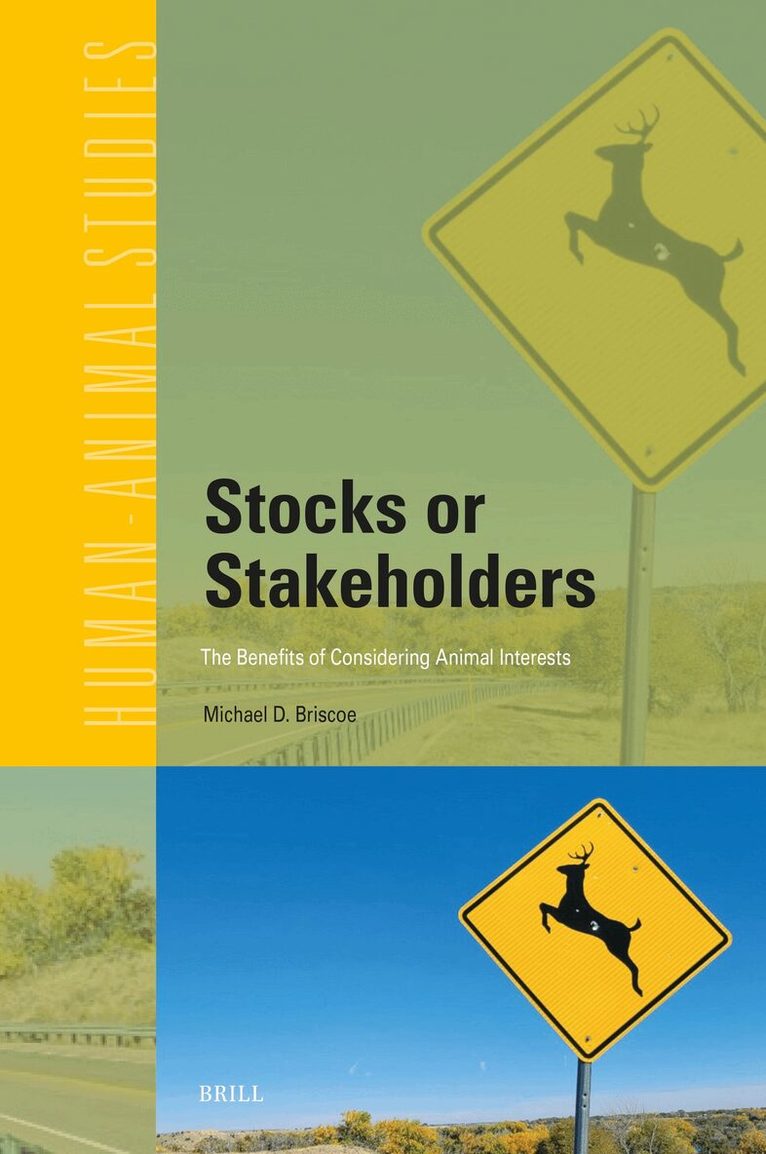
    Animals are typically treated as property in modern societies. Stocks or Stakeholders extends stakeholder theories to animals, arguing that full consideration of their interests will benefit humans. For example, one analysis in the book shows that more protected land is associated with fewer animal-vehicle collisions—events that currently cost millions of dollars each year and injure both humans and animals. Regardless of how readers personally feel about animals, Stocks or Stakeholders makes a compelling case for seriously considering their interests.2026 Winner of the American Sociological Association's Animals and Society’s Distinguished Book Award

    Produktinformation

    • Utgivningsdatum:2025-07-10
    • Mått:155 x 235 x 19 mm
    • Vikt:501 g
    • Format:Inbunden
    • Språk:Engelska
    • Serie:Human-Animal Studies
    • Antal sidor:214
    • Förlag:Brill
    • ISBN:9789004722330

    Utforska kategorier

    • Filosofiska discipliner inom Filosofi och religion
    • Samhälle och kultur inom Samhälle och politik
    • Sociala och etiska frågor inom Samhälle och politik

    Mer om författaren

    Michael D. Briscoe is an Assistant Professor of Sociology at Colorado State University Pueblo. He received his Ph.D. in sociology from Utah State University with an emphasis on environment and community. His research focuses on the intersection of human, animal, and environmental well-being. He teaches courses on sociological theory, environmental sociology, and One Welfare.

    Innehållsförteckning

    • 1 How We Value Animals1 Introduction2 How Humans Value Animals3 The Nature/Society Divide4 Anthropocentrism, Anthropomorphism, and Anthropodenial5 Sociology, Structure, and Agency6 Critical Environmental Justice7 The One Welfare Framework8 Stakeholder Theory9 Stocks or StakeholdersReferences2 What (and Who) is a Stakeholder?1 Introduction2 A Brief History of Stakeholder Theory3 Who Counts as a Stakeholder?4 Coal Power and Stakeholder Interest, an Example5 The Nature-Society Divide and Stakeholder Status6 Animals and the Environment as Stakeholders7 Weighing Stakeholder Interests8 Stakeholders and Sustainability9 ConclusionReferences3 Why the Chicken Couldn’t Cross the Road: Animal Movement, Collisions, and Barriers1 Introduction2 Animal Movement3 Animal-Vehicle Collisions4 Structural Factors Influencing Collision5 Washington as a Case Study6 Insects and Oceans7 Walls and Barriers8 Changing Times?References4 Transboundary Issues in Energy Production1 Introduction2 Salmon and Dams3 Birds and Windmills4 Fossil Fuels, Animal Death, and Energy Efficiency5 ConclusionReferences5 Animal Agriculture and Zoonotic Disease1 Introduction2 COVID-193 Bovine Spongiform Encephalopathy (BSE), or Mad Cow Disease 4 Avian Influenza, Bird Flu 5 Swine Flu6 Methicillin-Resistant Staphylococcus Aureus, or MRSA7 Moving Forward8 ConclusionReferences6 Humans and Animals in Disaster1 Introduction2 Animals Caught in the Crossfire – Ukraine3 Left behind in Ukraine4 Natural Disasters and Companion Animal Rescue5 Farm Animals6 Trauma7 Progress or Procrastination? the PETS Act8 Planning, Response, and RecoveryReferences7 Wildlife Extermination: Stakeholder Interests and Entangled Destinies1 Introduction2 American Bison and Native American Extermination3 Biodiversity and the 6th Great Extinction4 Wolves: from Regional Extinction to Reintroduction5 The Precautionary Principle6 ConclusionReferences8 Animals in Laboratory Research1 Introduction2 Extrapolation from Animal to Human3 Tragedy of Thalidomide4 Public Opinion on Animal Testing5 Additional Issues and Alternatives to Animal Testing6 ConclusionReferences9 The Elephant in the Movement: Animal Welfare and Total Liberation1 Introduction2 Welfarist/Reform Perspective3 Liberation/Abolition Perspective4 Empiricism and Ideology4.1 Empirical Support for the Welfarist Perspective4.2 Empirical Support for the Liberation Perspective5 The Stakeholder Perspective Revisited6 Outcomes vs Process7 ConclusionReferences10 Including Animals as Stakeholders1 Introduction2 Counterintuitive Capitalism3 The Tragedy of the Commons 4 Transparency and Stakeholders5 The Compassionate Conservation Model6 Including Animals as Stakeholders7 Participatory Action Research & Community Field Theory8 ConclusionReferencesAppendix A: Overpass Survey MethodologyAppendix B: Animal Collision MethodologyIndex