• Fri frakt över 249 kr
  • •
  • Snabba leveranser
  • •
  • Billiga böcker
Kundservice

Du är på sajten för privatpersoner.

Företag, bibliotek eller offentlig verksamhet?

Du handlar på classic.bokus.com, där alla dina funktioner finns intakta.
Till classic.bokus.com
Bokus logotyp. Gå till startsidan.
  • Erbjudanden
  • Nyheter
  • Student
  • Topplistor
  • Barn & ungdom
  • Bokus Play
  • E-böcker
  • Pocketböcker
  • Spel & pussel

10% rabatt på allt med kod: NYSTART10 →

Sidfot

Mina sidor

    Hjälp

    • Kundservice
    • Vanliga frågor och svar
    • Frakt och leverans
    • Retur vid ångerrätt
    • Reklamera vara
    • Betalning
    • Köpvillkor
    • Allmänna villkor
    • Information om webbplatsens tillgänglighet

    Om Bokus

    • Om oss
    • Pressrum
    • För studenter
    • För företag
    • För bibliotek och offentlig verksamhet
    • För leverantörer
    • Hållbarhet

    Populärt

    • Aktuella erbjudanden
    • Presentkort
    • Studentlitteratur
    • Nya böcker
    • Topplistor
    • Signerade böcker
    • Engelska böcker

    Inspiration

    • Boktips
    • BookTok
    • Populära bokserier
    • Barnbokskaraktärer
    • Populära författare
    Logotyp för Bokus
    Följ oss på Facebook (extern länk)Följ oss på Instagram (extern länk)Följ oss på YouTube (extern länk)Följ oss på TikTok (extern länk)
    bokus @ CookiesAnpassa cookiesIntegritetspolicyKöpvillkor
    Till Citymail hemsida (extern länk)Till Budbee hemsida (extern länk)Till Postnord hemsida (extern länk)Till Schenker hemsida (extern länk)Till Early Bird hemsida (extern länk)Till Walleys hemsida (extern länk)
    1. Filosofi och religion
    2. Filosofi
    3. Filosofiska discipliner

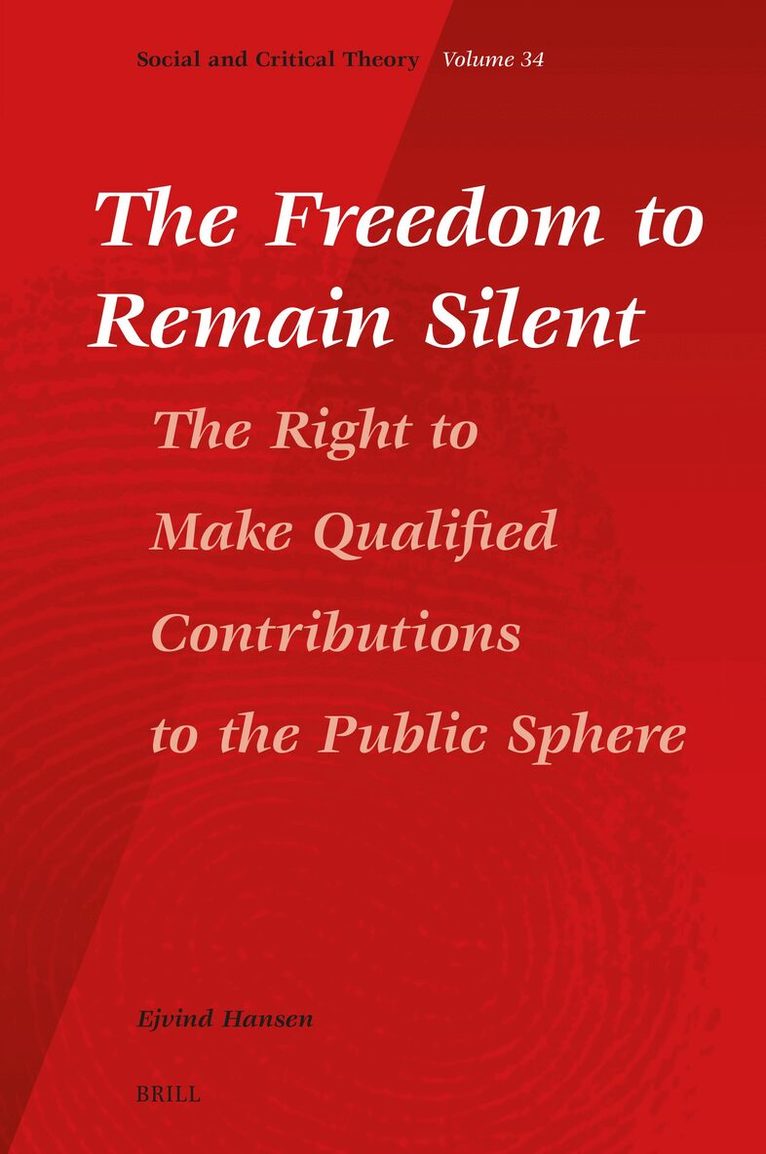
    Freedom to Remain Silent

    The Right to Make Qualified Contributions to the Public Sphere

    AvEjvind Hansen

    Inbunden, Engelska, 2026

    Del 34 i serien Social and Critical Theory

    2 733 kr

    Beställningsvara. Skickas inom 3-6 vardagar. Fri frakt över 249 kr.

    Beskrivning

    The role of silence in democratic settings should be rehabilitated. Democratic theories are concerned with mechanisms and institutions that counteract silence in society. As a supplement to this, it is first demonstrated that we must not forget how silence determines the significance and meanings of utterances made. Secondly, that silence can be used as a critical tool to get better listening, more open conversations, and greater thoughtfulness in the public sphere. The widely recognized freedom of expression should thus be supplemented with a freedom of silence, a freedom to let silence disturb the discursive relevance criteria.

    Produktinformation

    • Utgivningsdatum:2026-01-29
    • Mått:155 x 235 x 38 mm
    • Vikt:976 g
    • Format:Inbunden
    • Språk:Engelska
    • Serie:Social and Critical Theory
    • Antal sidor:498
    • Förlag:Brill
    • ISBN:9789004744370

    Utforska kategorier

    • Filosofiska discipliner inom Filosofi och religion
    • Samhälle och kultur inom Samhälle och politik

    Mer om författaren

    Ejvind Hansen, Ph.D., Dr.Phil., is Senior Associate Professor at the Danish School of Media and Journalism. He publishes intensively in the intersections between democracy, public sphere, communication technology and philosophy.

    Innehållsförteckning

    • ForewordList of Illustrations1 Introduction1 The Main Argument2 Practical Challenges and Theoretical Clarifications2.1 Language and Silence2.2 Democracy and the Public Sphere2.3 Linguistic Abstractions and Paradoxes2.4 Continuity and Change2 Abstractions in the Public Sphere and Individual Freedom1 Abstractions in the Public Sphere1.1 Immanuel Kant1.2 Georg Wilhelm Friedrich Hegel1.3 The Sceptics – Karl Marx, Friedrich Nietzsche and Søren Aabye Kierkegaard2 The Liberal Tradition2.1 James Madison2.2 John Stuart Mill2.3 Joseph Aloïs Schumpeter2.4 Walter Lippmann3 John Dewey’s Rethinking of Reason and Individuality4 Summary3 Individuality and Community in the Public Sphere1 Hannah Arendt2 Jürgen Habermas2.1 Habermas’ Theory of Communicative Action2.2 Habermas and the Democratic Public Sphere3 The Demand for Transcendence4 The Linguistic Focus of Communicative Exchanges1 The Legacy of Hermeneutics2 Communicative Decoupling of Critical Reflection2.1 Prerequisites for Communicative Exchanges2.2 Language as a Negotiation of Relevance2.3 Invisible Relevance Criteria2.4 Decoupling from Rationality3 Silence as a Path into and out of Communicative Exchanges5 Silence as a Prerequisite for Communicative Exchange1 The Many Faces of Silence1.1 Silence as Lack of Sound1.2 The Possibility of Thinking beyond Language1.3 Contradictory Themes of Silence2 Unity of Silence3 Art and Religion Brought to Silence4 The Philosophical Opening of the Field of Silence6 The Peal of Silence – Martin Heidegger1 Why Heidegger?2 Silence in Sein und Zeit3 Late Heidegger3.1 Silence in Beiträge zur Philosophie3.2 Silence as the Grounding/Abyss for Rest and Movement3.3 Language That Speaks as the Peal of Silence4 Heidegger in Reflections on the Democratic Public Sphere4.1 The Absent Awareness of the Sign7 Writing the Unsayable – Jacques Derrida1 Challenging the Dominance of the Voice2 The Role of Expression in Meaning Formation2.1 Iterability of Signs via Différance2.2 Silence, Blankness and Mime3 The Role of the Other in Meaning Formation3.1 Meaning Is Not Determined Solely by Expressive Intentions3.2 The Silent Greeting from the Absent3.3 The Silence of Hospitality3.4 The Silence between Friend and Foe4 The Foundation of Deliberation in the Aporias of Silence8 Abstract Silence as a Concrete Phenomenon1 The Relevance of Philosophical Silence to Political Processes2 The Rehabilitation of Silence as Democratically Productive3 Reflective Approaches to Democratic Publicity9 The Importance of Silence for Listening and Openness1 What Does It Mean to Listen?1.1 Aesthetic Listening1.2 Listening and Democracy2 The Challenge3 Listening for Silence3.1 Initial Reflections3.2 Legitimacy3.3 Trust3.4 Understanding3.5 Disagreement3.6 Concluding Comments4 Listening for Silence and Openness10 Isolation and Thoughtfulness1 The Silence of Thoughtfulness – Patience1.1 The Silent Foundation of the Question2 Breaks: What Is Gained by Silence in the Public Sphere2.1 Deleuze on Silence as a Prerequisite for Creativity2.2 Abraham’s Isolation from the Public Sphere Compared to the Loneliness of the Merman2.3 Dialling Down Intensity in the Public Sphere3 Liberation from the Expectations of the Public Sphere3.1 Slowness in the Public Sphere3.2 Breaks from the Public Sphere3.3 Breaks from the Public Sphere in the Public Sphere4 Back to the Deliberation4.1 Back to Habermas4.2 Thoughtfulness through Isolation11 Silence as the Path to a Better Public Sphere1 The Argumentative Challenge of the Argument1.1 Analysis of the Unavoidability of Silence1.2 Critical Analysis of Structures for Silence1.3 Silence as Breaks from Participation in the Public Sphere2 Let Silence Come to Light – a ParadoxBibliographyIndexIndexIndex