• Fri frakt över 249 kr
  • •
  • Snabba leveranser
  • •
  • Billiga böcker
Kundservice

Du är på sajten för privatpersoner.

Företag, bibliotek eller offentlig verksamhet?

Du handlar på classic.bokus.com, där alla dina funktioner finns intakta.
Till classic.bokus.com
Bokus logotyp. Gå till startsidan.
  • Erbjudanden
  • Nyheter
  • Student
  • Topplistor
  • Barn & ungdom
  • Bokus Play
  • E-böcker
  • Pocketböcker
  • Spel & pussel

10% rabatt på allt med kod: NYSTART10 →

Sidfot

Mina sidor

    Hjälp

    • Kundservice
    • Vanliga frågor och svar
    • Frakt och leverans
    • Retur vid ångerrätt
    • Reklamera vara
    • Betalning
    • Köpvillkor
    • Allmänna villkor
    • Information om webbplatsens tillgänglighet

    Om Bokus

    • Om oss
    • Pressrum
    • För studenter
    • För företag
    • För bibliotek och offentlig verksamhet
    • För leverantörer
    • Hållbarhet

    Populärt

    • Aktuella erbjudanden
    • Presentkort
    • Studentlitteratur
    • Nya böcker
    • Topplistor
    • Signerade böcker
    • Engelska böcker

    Inspiration

    • Boktips
    • BookTok
    • Populära bokserier
    • Barnbokskaraktärer
    • Populära författare
    Logotyp för Bokus
    Följ oss på Facebook (extern länk)Följ oss på Instagram (extern länk)Följ oss på YouTube (extern länk)Följ oss på TikTok (extern länk)
    bokus @ CookiesAnpassa cookiesIntegritetspolicyKöpvillkor
    Till Citymail hemsida (extern länk)Till Budbee hemsida (extern länk)Till Postnord hemsida (extern länk)Till Schenker hemsida (extern länk)Till Early Bird hemsida (extern länk)Till Walleys hemsida (extern länk)
    1. Filosofi och religion
    2. Filosofi
    3. Filosofiska discipliner

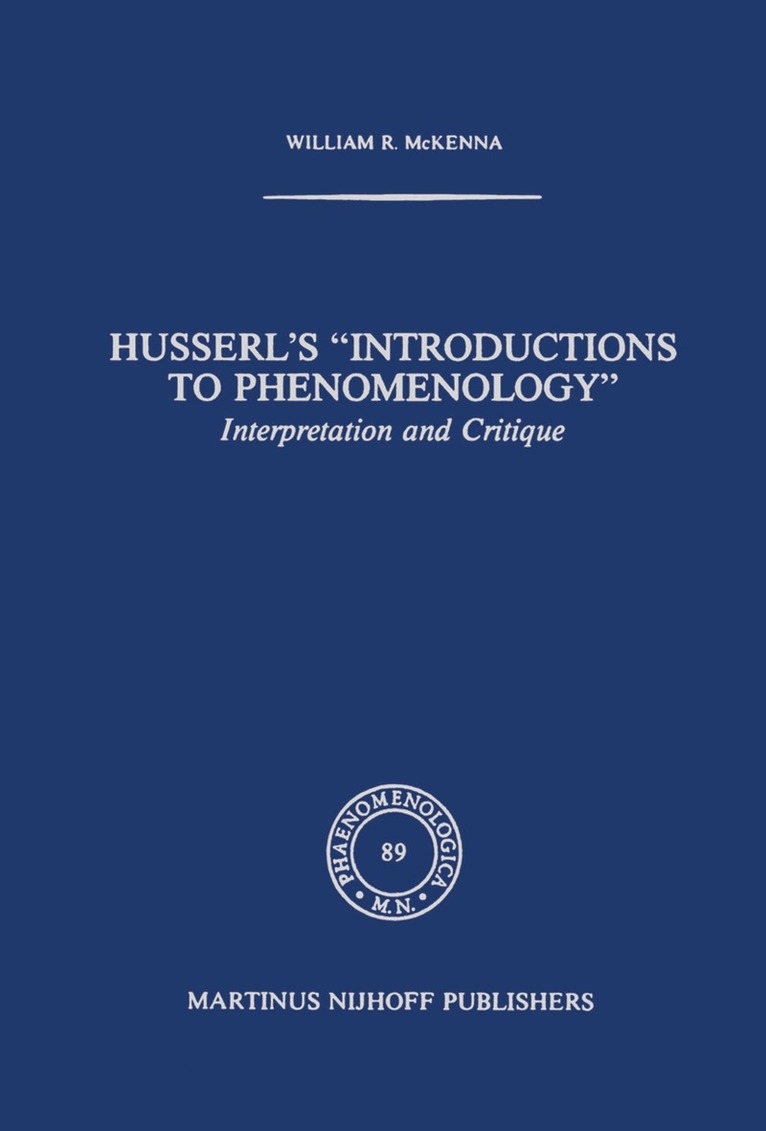
    Husserl’s “Introductions to Phenomenology”

    Interpretation and Critique

    AvW. Mckenna

    Inbunden, Engelska, 1982

    Del 89 i serien Phaenomenologica

    1 086 kr

    Beställningsvara. Skickas inom 10-15 vardagar. Fri frakt över 249 kr.

    Fler format och utgåvor

    Häftad

    1 086 kr

    Beskrivning

    There is a remarkable unity to the work of Edmund Husserl, but there are also many difficulties in it. The unity is the result of a single personal and philo­ sophical quest working itself out in concrete phenomenological analyses; the difficulties are due to the inadequacy of initial conceptions which becomes felt as those analyses become progressively deeper and more extensive. ! Anyone who has followed the course of Husserl's work is struck by the constant reemergence of the same problems and by the insightfulness of the inquiries which press toward their solution. However one also becomes aware of Husserl's own dissatisfaction with his work, once so movingly expressed in a 2 personal note. It is the purpose of the present work to examine and revive one of the issues which gave Husserl difficulty, namely, the problem of an intro­ duction to phenomenology. Several of Husserl's writings published after Logical Investigations were either subtitled or referred to by him as "introductions to phenomenology. "3 These works serve to acquaint the reader with the specific character of Husserl's transcendental phenomenology and with the problems to which it is to provide the solution. They include discussions and analyses which pertain to what has come to be known as "ways" into transcendental phenomenology. 4 The issue here is the proper access to transcendental phenomenology.

    Produktinformation

    • Utgivningsdatum:1982-11-30
    • Mått:155 x 235 x 19 mm
    • Vikt:550 g
    • Format:Inbunden
    • Språk:Engelska
    • Serie:Phaenomenologica
    • Antal sidor:240
    • Förlag:Springer
    • ISBN:9789024726653

    Utforska kategorier

    • Filosofiska discipliner inom Filosofi och religion

    Recensioner i media

    '...a major achievement, indispensable for any research library ... a significant work of Husserlian scholarship.' The Review of Metaphysics (September 1985)

    Innehållsförteckning

    • 1. Introduction.- 2. Husserl’s Thesis that Consciousness Is World-Constitutive and Its Demonstration.- A. Husserl’s Thesis.- B. The Idea of a Demonstration of the Thesis.- 3. The Motivating Problem.- 4. Acquiring the Idea of Pure Transcendental Consciousness.- A. The Thesis of the Natural Attitude.- B. The Psychological Investigation of Consciousness and the Argument that Consciousness Constitutes the World.- 5. The Entry into the Transcendental Realm.- A. The Phenomenological Epoche and Reduction.- B. Constitution and Constitutive Analysis.- C. Summary.- 6. Transcendental Illusion.- A. The Meaning of “Transcendental Illusion”.- B. Realism and Idealism in Husserl’s Philosophy.- C. Husserl’s Demonstration of the Existence of the Possibility of Transcendental Illusion.- 7. Conclusion: Toward a New Introduction to Phenomenology.