• Fri frakt över 249 kr
  • •
  • Snabba leveranser
  • •
  • Billiga böcker
Kundservice

Du är på sajten för privatpersoner.

Företag, bibliotek eller offentlig verksamhet?

Du handlar på classic.bokus.com, där alla dina funktioner finns intakta.
Till classic.bokus.com
Bokus logotyp. Gå till startsidan.
  • Erbjudanden
  • Nyheter
  • Student
  • Topplistor
  • Barn & ungdom
  • Bokus Play
  • E-böcker
  • Pocketböcker
  • Spel & pussel

10% rabatt på allt med kod: NYSTART10 →

Sidfot

Mina sidor

    Hjälp

    • Kundservice
    • Vanliga frågor och svar
    • Frakt och leverans
    • Retur vid ångerrätt
    • Reklamera vara
    • Betalning
    • Köpvillkor
    • Allmänna villkor
    • Information om webbplatsens tillgänglighet

    Om Bokus

    • Om oss
    • Pressrum
    • För studenter
    • För företag
    • För bibliotek och offentlig verksamhet
    • För leverantörer
    • Hållbarhet

    Populärt

    • Aktuella erbjudanden
    • Presentkort
    • Studentlitteratur
    • Nya böcker
    • Topplistor
    • Signerade böcker
    • Engelska böcker

    Inspiration

    • Boktips
    • BookTok
    • Populära bokserier
    • Barnbokskaraktärer
    • Populära författare
    Logotyp för Bokus
    Följ oss på Facebook (extern länk)Följ oss på Instagram (extern länk)Följ oss på YouTube (extern länk)Följ oss på TikTok (extern länk)
    bokus @ CookiesAnpassa cookiesIntegritetspolicyKöpvillkor
    Till Citymail hemsida (extern länk)Till Budbee hemsida (extern länk)Till Postnord hemsida (extern länk)Till Schenker hemsida (extern länk)Till Early Bird hemsida (extern länk)Till Walleys hemsida (extern länk)
    1. Naturvetenskap och teknik
    2. Matematik och naturvetenskap
    3. Fysik
    4. Tillämpad fysik

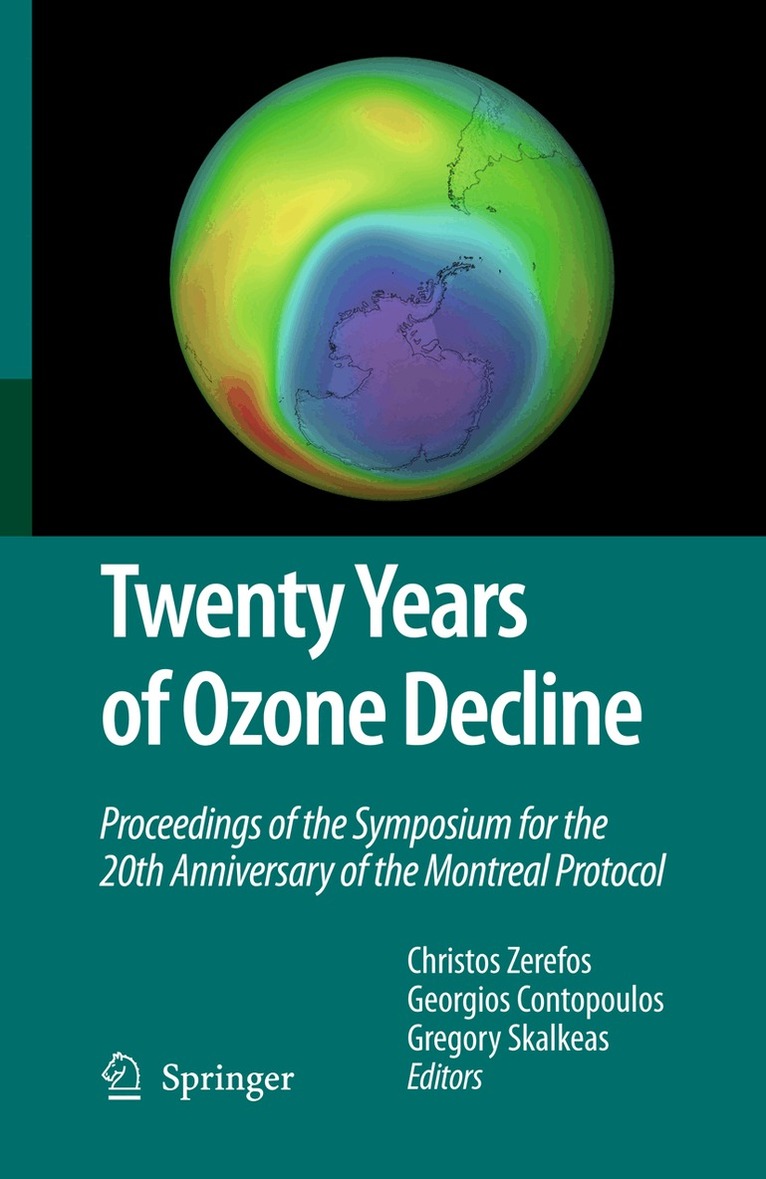
    Twenty Years of Ozone Decline

    Proceedings of the Symposium for the 20th Anniversary of the Montreal Protocol

    AvChristos Zerefos,G. Contopoulos

    Inbunden, Engelska, 2009

    2 165 kr

    Beställningsvara. Skickas inom 10-15 vardagar. Fri frakt över 249 kr.

    Beskrivning

    Homer speaks of lightning bolts after which ‘a grim reek of sulphur bursts forth’ and the air was ‘?lled with reeking brimstone’. (Homer 3000 BC). The odour was not actually the smell of sulphur dioxide associated with burning sulphur, but rather was the ?rst recorded detection of the presence of another strong odour, that of ozone (O ) in Earth’s atmosphere. These molecules were formed by the passage of 3 lightning through the air, created by splitting the abundant molecular oxygen (O ) 2 molecules into two, followed by the addition of each of the free O atoms to another O to form the triatomic product. In fact, most of the ozone molecules present 2 in the atmosphere at any time have been made by this same two-step splitti- plus-combination process, although the initiating cause usually begins with very energetic solar ultraviolet (UV) radiation rather than lightning. Many thousands of years later, the modern history of ozone began with its synthesis in the laboratory of H. F. Schonbein in 1840 (Nolte 1999), although the positive con?rmation of its three-oxygen atom chemical formula came along sometime later. Scienti?c interest in high-altitude stratospheric ozone dates back to 1881 when Hartley measured the spectrum of ozone in the laboratory and found that its ability to absorb UV light extended only to 293nm at the long wavelength end (Hartley 1881a).

    Produktinformation

    • Utgivningsdatum:2009-06-02
    • Mått:155 x 235 x 27 mm
    • Vikt:852 g
    • Format:Inbunden
    • Språk:Engelska
    • Antal sidor:470
    • Upplaga:2009
    • Förlag:Springer
    • ISBN:9789048124688

    Utforska kategorier

    • Tillämpad fysik inom Naturvetenskap och teknik
    • Miljövetenskap och miljöpolitik inom Naturvetenskap och teknik
    • Kemi inom Naturvetenskap och teknik

    Innehållsförteckning

    • Opening Ceremony.- Welcome Address.- Statement from the Executive Secretary for the Vienna Convention and the Montreal Protocol.- Opening Address.- Science Inspiring Diplomacy: The Improbable Montreal Protocol.- Keynote Speeches.- Stratospheric Ozone Depletion.- Atmospheric N2O Releases from Biofuel Production Systems: A Major Factor Against “CO2 Emission Savings”: A Global View.- The Long History of Ozone Measurements and the Early Search for Signs of a Trend.- The History of Total Ozone Measurements; the Early Search for Signs of a Trend and an Update.- The Long History of Ozone: Analyses of Recent Measurements.- The Long History of Ozone Measurements: Climatological Information Derived from Long Ozone Records.- Ozone Measurements.- International Multi-Instruments Ground-Based Networks: Recent Developments Within the Network for the Detection of Atmospheric Composition Changes.- International Balloon Measurements for Ozone Research.- The Role of Airborne Science in the Study of Polar Ozone.- Role of Satellite Measurements in the Discovery of Stratospheric Ozone Depletion.- Estimating When the Antarctic Ozone Hole will Recover.- The European Arctic Ozone Campaigns.- Operational Monitoring of the Antarctic Ozone Hole: Transition from GOME and SCIAMACHY to GOME-2.- An Overview of Strategic Ozone Sounding Networks: Insights into Ozone Budgets, UT/LS Processes and Tropical Climate Signatures.- Global Observations—The Key to Model Development and Improved Assessments.- Ozone and Climate-Dynamics.- The Rise and Fall of Dynamical Theories of the Ozone Hole.- Investigations of Climate–Ozone Connections with Coupled Climate–Chemistry Models (CCMs): Another Step Forward.- Stratospheric Ozone Depletion and Tropospheric Chemistry.- Tropospheric Ozone Climate–ChemistryInteraction: Aspects of Climate Changes.- Metrics for Ozone and Climate: Three-Dimensional Modeling Studies of Ozone Depletion Potentials and Indirect Global Warming Potentials.- Stratosphere—Troposphere Interactions in a Chemistry-Climate Model.- Winter Ozone Transport Variations and the Montreal Protocol Impact as Revealed by the Total Ozone Ground-Based Measurements over the Russian Territory in 1973–2005.- Solar Ultraviolet Measurements and Effects.- Solar UV: Measurements and Trends.- Ozone and Ultraviolet Radiation: Informing the Public.- A Contemporary Strategy for Sun Exposure.- Initiatives – Recent Reports.- Findings from the 2006 Ozone Scientific Assessment for the Montreal Protocol.- SPARC Science Supporting the Montreal Protocol.- Industry and the Importance of Science to Business.- How Science Guides Industry Choice of Alternatives to Ozone-Depleting Substances.- The Importance of Chemical Substitutes to Chlorofluorocarbons (CFCs).- Perspectives on the Roles of Science, Scientific Assessments, the Science/Policy Interface and Industry.- The Role of Financial Assistance by the Multilateral Fund in Technology Change to Protect the Ozone Layer.- Conclusion.- Athens Statement.