• Fri frakt över 249 kr
  • •
  • Snabba leveranser
  • •
  • Billiga böcker
Kundservice

Du är på sajten för privatpersoner.

Företag, bibliotek eller offentlig verksamhet?

Du handlar på classic.bokus.com, där alla dina funktioner finns intakta.
Till classic.bokus.com
Bokus logotyp. Gå till startsidan.
  • Erbjudanden
  • Nyheter
  • Student
  • Topplistor
  • Barn & ungdom
  • Bokus Play
  • E-böcker
  • Pocketböcker
  • Spel & pussel

10% rabatt på allt med kod: NYSTART10 →

Sidfot

Mina sidor

    Hjälp

    • Kundservice
    • Vanliga frågor och svar
    • Frakt och leverans
    • Retur vid ångerrätt
    • Reklamera vara
    • Betalning
    • Köpvillkor
    • Allmänna villkor
    • Information om webbplatsens tillgänglighet

    Om Bokus

    • Om oss
    • Pressrum
    • För studenter
    • För företag
    • För bibliotek och offentlig verksamhet
    • För leverantörer
    • Hållbarhet

    Populärt

    • Aktuella erbjudanden
    • Presentkort
    • Studentlitteratur
    • Nya böcker
    • Topplistor
    • Signerade böcker
    • Engelska böcker

    Inspiration

    • Boktips
    • BookTok
    • Populära bokserier
    • Barnbokskaraktärer
    • Populära författare
    Logotyp för Bokus
    Följ oss på Facebook (extern länk)Följ oss på Instagram (extern länk)Följ oss på YouTube (extern länk)Följ oss på TikTok (extern länk)
    bokus @ CookiesAnpassa cookiesIntegritetspolicyKöpvillkor
    Till Citymail hemsida (extern länk)Till Budbee hemsida (extern länk)Till Postnord hemsida (extern länk)Till Schenker hemsida (extern länk)Till Early Bird hemsida (extern länk)Till Walleys hemsida (extern länk)
    1. Ekonomi och Ledarskap
    2. Nationalekonomi
    3. Miljöekonomi

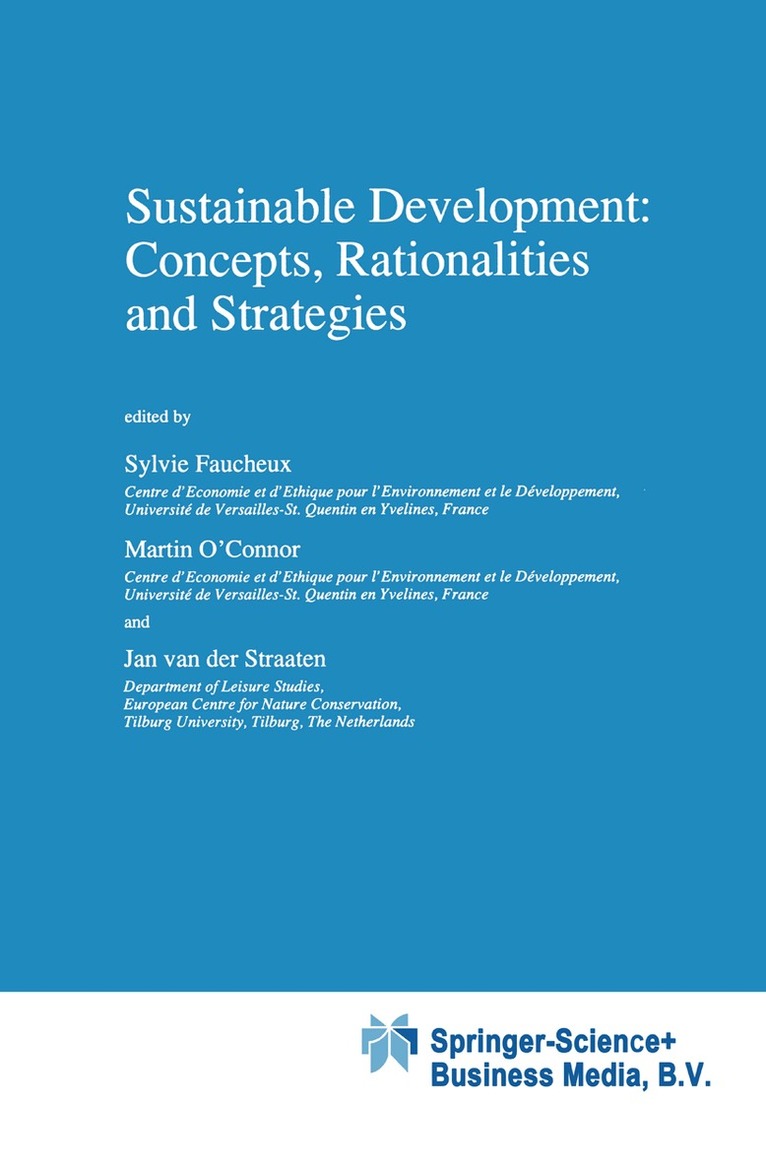
    Sustainable Development: Concepts, Rationalities and Strategies

    AvSylvie Faucheux,Martin O'Connor

    Häftad, Engelska, 2010

    Del i serien Economy & Environment

    1 673 kr

    Beställningsvara. Skickas inom 10-15 vardagar. Fri frakt över 249 kr.

    Beskrivning

    3 decision support techniques that do not depend exclusively on market incentives and monetary valuation. The World Conservation Strategy published by the mCN (1980) recognised the full dimensions of these problems, and introduced the concept of sustainable development, placing the emphasis on the exploitation of natural systems and the use of biological natural resources within limits so that the availability of these resources for use by future generations would not be jeopardised by the current use of them. At this time, the imposition of quotas and the definition of critical loads and environmental standards were suggested as the sorts of instruments necessary to cope with the problems of limited availability of environmental resources. Although the mCN publication did not obtain a high international profile, the idea of policy norms to respect critical loads has become quite widely accepted in the environmental policymaking of Western countries. This has often put the policy agencies in difficult situations. Polluting industries are inclined to argue that the critical loads are defined too restrictively. The complexity and time lags of ecological effects makes it hard to say exactly what constitutes a critical load beyond which there will be irreversible damage, and lobbying interests can play on these uncertainties to try and weaken the environmental standards. In addition, polluting industries can use the argument of negative impacts on "the economy" (particularly as regards employment and export prospects) to blackmail governments, regulatory agencies and the general public.

    Produktinformation

    • Utgivningsdatum:2010-12-04
    • Mått:155 x 235 x 19 mm
    • Vikt:511 g
    • Format:Häftad
    • Språk:Engelska
    • Serie:Economy & Environment
    • Antal sidor:326
    • Förlag:Springer
    • ISBN:9789048149704

    Utforska kategorier

    • Miljöekonomi inom Ekonomi och Ledarskap

    Innehållsförteckning

    • Editors’ Introduction.- The Implications of Environmental Sustainability for Economic Growth.- Ecological Distribution and Distributed Sustainability.- Bioeconomic Conceptions and the Concept of Sustainable Development.- Sustainable Development and Public Policy.- The Political Economics of Sustainability.- Rational Assumptions in Energy Scenarios.- Short-run and Long-run Adjustment to Environmental Policy: a Neo-Austrian Approach.- Sustainability and Structural Change.- Sustainability Concepts and Total Economic Valuation.- A Practical Sustainability Criterion when there is International Trade.- How Strong is Weak Sustainability?.- Sustainability Principles and Depreciation Estimates of Natural Capital in Brazil.- Environmental Decision Making-a Comparison between Cost-Benefit Analysis and Multicriteria Decision Aid.- Sustainability, Uncertainty and Intergenerational Fairness.- Sustainable Development, Rationality and Time.- Towards a Decision-making Framework to Address Sustainable Development Issues.- Sustainable Development and the Process of Justifying Choices in a Controversial Universe.