• Fri frakt över 249 kr
  • •
  • Snabba leveranser
  • •
  • Billiga böcker
Kundservice

Du är på sajten för privatpersoner.

Företag, bibliotek eller offentlig verksamhet?

Du handlar på classic.bokus.com, där alla dina funktioner finns intakta.
Till classic.bokus.com
Bokus logotyp. Gå till startsidan.
  • Erbjudanden
  • Nyheter
  • Student
  • Topplistor
  • Barn & ungdom
  • Bokus Play
  • E-böcker
  • Pocketböcker
  • Spel & pussel

10% rabatt på allt med kod: NYSTART10 →

Sidfot

Mina sidor

    Hjälp

    • Kundservice
    • Vanliga frågor och svar
    • Frakt och leverans
    • Retur vid ångerrätt
    • Reklamera vara
    • Betalning
    • Köpvillkor
    • Allmänna villkor
    • Information om webbplatsens tillgänglighet

    Om Bokus

    • Om oss
    • Pressrum
    • För studenter
    • För företag
    • För bibliotek och offentlig verksamhet
    • För leverantörer
    • Hållbarhet

    Populärt

    • Aktuella erbjudanden
    • Presentkort
    • Studentlitteratur
    • Nya böcker
    • Topplistor
    • Signerade böcker
    • Engelska böcker

    Inspiration

    • Boktips
    • BookTok
    • Populära bokserier
    • Barnbokskaraktärer
    • Populära författare
    Logotyp för Bokus
    Följ oss på Facebook (extern länk)Följ oss på Instagram (extern länk)Följ oss på YouTube (extern länk)Följ oss på TikTok (extern länk)
    bokus @ CookiesAnpassa cookiesIntegritetspolicyKöpvillkor
    Till Citymail hemsida (extern länk)Till Budbee hemsida (extern länk)Till Postnord hemsida (extern länk)Till Schenker hemsida (extern länk)Till Early Bird hemsida (extern länk)Till Walleys hemsida (extern länk)
    1. Filosofi och religion
    2. Filosofi
    3. Filosofiska discipliner

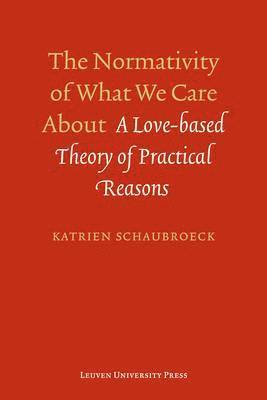
    Normativity of What We Care About

    A Love-Based Theory of Practical Reasons

    AvKatrien Schaubroeck

    Häftad, Engelska, 2013

    546 kr

    Tillfälligt slut

    Beskrivning

    A love-based reason theory as a new perspective in the debate on practical reasonsReasons and obligations pervade our lives. The alarm clock gives us a reason to get up in the morning, the expectations of colleagues or clients give us a reason to do our jobs well, the misery in developing countries gives us a reason to donate money to Oxfam, a headache gives us a reason to take an aspirin. Looking for unity in variety, philosophers wonder why a consideration counts as a reason to do something. The nature and source of practical reasons have been debated intensively over the last three decades in analytical philosophy. This book discusses the three most influential theories referred to as the desire-based, the value-based, and the rationality-based theories of practical reasons. The author argues that all three are defective because they overlook the role of what agents care about. In the end it is our being concerned about other people, leading a meaningful life and being healthy (among other things) that gives us reasons to do certain things rather than others. Drawing on insights from Harry Frankfurt, the author presents a love-based reason theory as a new and promising perspective in the debate on practical reasons. This publication is GPRC-labeled (Guaranteed Peer-Reviewed Content).

    Produktinformation

    • Utgivningsdatum:2013-03-04
    • Mått:160 x 239 x 11 mm
    • Vikt:454 g
    • Format:Häftad
    • Språk:Engelska
    • Antal sidor:208
    • Förlag:Leuven University Press
    • ISBN:9789058679055

    Utforska kategorier

    • Filosofiska discipliner inom Filosofi och religion

    Mer om författaren

    Katrien Schaubroeck is postdoctoral researcher at Utrecht University. She studied philosophy at KU Leuven where she completed her PhD in 2008.

    Innehållsförteckning

    • PrefaceIntroductionChapter 1Internalism and externalism: some terminology 1.1 Introduction1.2 Falk and Frankena1.3 The internalist position modified1.4 The externalist position elaborated1.5 Judgment internalism/externalism versus existence internalism/externalism1.6 Other kinds of internalism and externalism1.7 Varieties of existence internalism and externalism1.8 ConclusionChapter 2Bernard Williams on practical reasons2.1 Introduction2.2 The internal reason theory2.3 Refining the sub-Humean model2.4 Objections to external reasons2.4.1 The no-explanatory-force objection2.4.2 The no-motivational-fuel objection2.4.3 The obscurity objection2.5 The Tess case: an objection to Williams' internal reason theory2.6 ConclusionChapter 3Michael Smith on practical reasons3.1 Introduction3.2 The moral problem3.3 Cognitivism, internalism and Humean motivation3.3.1 The objectivity of moral obligations3.3.2 The practicality of moral judgements3.3.3 The Humean theory of motivation3.4 The conceptual analysis of normative reasons3.4.1 Platitudes about normative reasons3.4.2 The advice model (as opposed to the example model)3.4.3 The 'if fully rational' condition: Smith versus Williams3.4.4 The analysis captures the platitudes3.5 Moral rationalism: the solution to the moral problem3.6 Smith's analysis of normative reasons evaluated3.6.1 The analysis trivializes convergence3.6.2 Why do reasons have to be objective?3.6.3 The analysis does not guarantee practicality3.6.4 The analysis rests on a false platitude3.6.5 Normative reasons and what I would desire if I were fully rational3.6.6 The advice model is inconsistent with the convergence thesis3.7 ConclusionChapter 4Derek Parfit on practical reasons 4.1 Introduction4.2 Parfit's externalism4.2.1 The obscurity objection rejected4.2.2 The no-explanatory-force objection rejected4.2.3 The no-motivational-fuel objection rejected4.3 Parfit's value-based reason theory4.3.1 Internalism and the desire-based reason theory4.3.2 Parfit's argument against reductive desire-based reason views4.3.3 Parfit's argument against non-reductive desire-based reason views4.3.4 Arguments in favour of the value-based reason theory4.4 Parfit's normative non-naturalism4.4.1 Korsgaard's criticism of realism4.4.2 Korsgaard's constructivism4.4.3 Parfit's criticism of constructivism4.4.4 The non-naturalist account of normativity evaluated4.5 Conclusion 142Chapter 5Harry Frankfurt on practical reasons5.1 Introduction5.2. Frankfurt's theory of care and love5.2.1 The hierarchical model5.2.2 Care5.2.3 Love5.3 The love-based reason theory5.4 The love-based reason theory evaluated5.4.1 Love and desire: both motivating, both natural5.4.2 The groundlessness objection5.4.3 The authority of love5.4.4 The objection of normative triviality5.4.5 The Tess case5.4.6 The love-based reason theory and morality5.5 ConclusionConcluding remarksBibliography