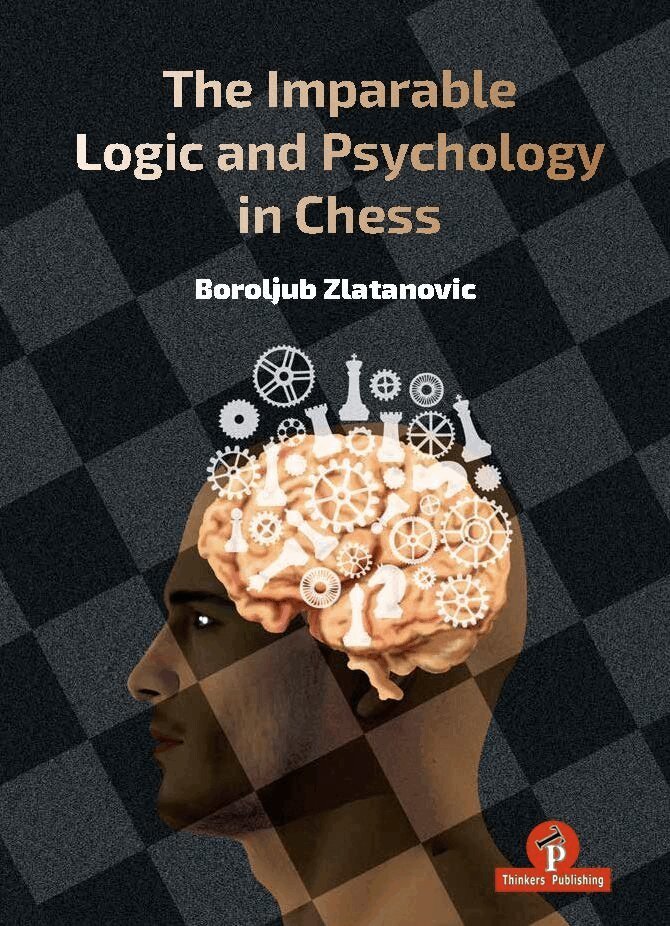
Inbunden, Engelska, 2024
Imparable Logic and Psychology in Chess
Av Zlatanovic
397 kr
Tillfälligt slut
Beskrivning
Produktinformation
- Utgivningsdatum: 2024-07-25
- Mått: 170 x 234 x 26 mm
- Vikt: 742 g
- Format: Inbunden
- Språk: Engelska
- Antal sidor: 310
- Förlag: Thinkers Publishing
- ISBN: 9789083429021
Utforska kategorier
Mer om författaren
Boroljub Zlatanovic was born in Cuprija, Serbia, in August 1977. He was introduced to chess at the age of four while watching his father and uncle play. By seven, he had joined his first chess club, Radnički Ćuprija, marking the beginning of a lifelong dedication to the game. He earned the FIDE Master (FM) title in 1994 (officially recognized in 1998) and became Serbian Youth Champion in 1995. During his university years, he won the Belgrade University Championship in both 2001 and 2002. Over the course of his career, he has claimed multiple Serbian Team Championship titles, including in youth competitions. He was awarded the International Master (IM) title in 2014 and the FIDE Trainer (FT) title in 2015. A consistent tournament performer, he has won numerous open, rapid, blitz, and online events. With more than fifteen years of experience as a professional coach, he has trained players of various levels and continues to contribute actively to the chess world. Since 2019, he has been an author and contributor to American Chess Magazine. This is his seventh book for Thinkers Publishing.
Recensioner i media
'Much has been written in chess about specific openings, players and tournaments. From experience, those are not easy books to write (because you need to be analytically laser-sharp), but at least you know what you’re signing up for. By contrast, books like the one you currently hold might be laxer on the minutiae, but as a whole can be harder to conceive and transform into finished reality. While not requiring using cloud engines on depth-56 to find a novelty, they are instead (so to speak) “painted with a broader brush.”'Two examples of what I mean are Vukovic’s The Art of Attack in Chess and the famous classic, Nimzowitsch’s My System. In each, the author is a professional who brings across nothing more nor less than their philosophy of how the game should be played, and the degree of emotional energy they pour into it manifests in a work that rightly reflects the status of our game, not merely as an academic endeavor but as a cultural one. The current book is a fitting, if not overdue, addition to that genre. 'As a cultural phenomenon, chess exists somewhere on the spectrum between natural philosophy (by which I mean science in its traditional form) and fine art. Viewed statically from the outside, it combines elements of both. Viewed dynamically from the inside, that same ambiguity which the game of chess straddles can be viewed as being that between logic and psychology. On the one hand, the classical game of chess is a brutal arena of intense psychological competition, where human beings sit opposite each other and test whose brain is better using a set of weighted pieces and an oddly patterned square game board. Having a more resilient brain clearly helps in this context; you want one which does not dwell on the past and which remains alert to possibilities, processing both sides’ options with roughly equal weight despite the wishes of the ego and the visual reinforcement that the ego gets from seeing the board ‘your way up.’ 'On the other hand, the game is supremely logical. We have, as a collective, been obsessed with codifying the ‘right’ way to play chess; partly this stems from an actual desire to be better at it, and partly (I think) from a wish to use the codes thus established as scapegoats, should our own brains prove inadequate in the heat of battle. From the time of Dr. Tarrasch, through the aforementioned System of Nimzowitsch and the pedagogical structure of Botvinnik and Petrosian, and into our present-day use of Stockfish and AlphaZero as oracles, the scientific, almost mathematical study of chess has proceeded at pace with the increase in competitive capacity of its gladiators. It goes without saying that a successful player these days should have a gameplan which doesn’t reside fully in the logical camp (think: “I’ll always play the same opening, because the engine says it’s the best”) nor fully in the psychological one (think: “I’ll play occasional random moves while staring at the stars, to throw the opponent off!.”) It’s important to develop an understanding of how those two elements interact.'This can be done, as in my case, by tedious and oftentimes painful tournament practice. It can also be done, potentially, by the right textbook. Such a textbook is not something a young upstart such as myself should write, and it’s also a task best suited for either a professional coach or ex-professional player. Boroljub being a professional coach, I was eager to see what he made of the subject matter, and I am happy to say he did not disappoint. He picks apart the way the greats (as well as more approachable mere mortals) apply the diverse range of areas in their brains, and not just the bean-counting parts! 'Speaking of beans, the author’s native Serbia, where I’ve also been many times, has a deep-rooted and profound coffee culture. It is through this that I first made the acquaintance of Boroljub; in such towns as Ruma, Paracin, and Novi Sad where we have found ourselves concurrently, the long mornings before classical chess games very much lent themselves to intellectual discourse and an espresso or two while our opponents drive themselves to distraction preparing for us. 'The things we discussed included history, language, and of course writing. His conversational style, like his chess style, is passionate and decisive, and I believe this comes across in his work as well. I urge you to see this book as not just one among many, but as a labor of love from a lover of the game. I wish all the readers success, enrichment, and above all, enjoyment.'—GM Daniel Fernandez, May 2024'The Imparable Logic and Psychology in Chess by Boroljub Zlatanovic deals with a topic in chess that has not been traditionally well-covered. The author, a well-known chess pedagogue, offers a wide range of advice, but one point he makes will bring great benefit to a new generation of players introduced to the game by online play and fast time controls is: “Understanding and logic are everything you need with static positions on the board.” This observation can be translated in various ways, but one is that in many positions trying to calculate long and sharp variations is counterproductive and judgment is more important.'—IM John Donaldson, August 2024
Betyg & recensioner
0 recensioner
Inga recensioner tillgängliga.