• Fri frakt över 249 kr
  • •
  • Snabba leveranser
  • •
  • Billiga böcker
Kundservice

Du är på sajten för privatpersoner.

Företag, bibliotek eller offentlig verksamhet?

Du handlar på classic.bokus.com, där alla dina funktioner finns intakta.
Till classic.bokus.com
Bokus logotyp. Gå till startsidan.
  • Erbjudanden
  • Student
  • Topplistor
  • Barn & ungdom
  • Bokus Play
  • E-böcker
  • Ljudböcker
  • Pocketböcker
  • Spel och pussel

5% studentrabatt – använd koden KURSBOK27 →

Sidfot

Mina sidor

    Hjälp

    • Kundservice
    • Vanliga frågor och svar
    • Frakt och leverans
    • Retur vid ångerrätt
    • Reklamera vara
    • Betalning
    • Köpvillkor
    • Allmänna villkor
    • Information om webbplatsens tillgänglighet

    Om Bokus

    • Om oss
    • Pressrum
    • För studenter
    • För företag
    • För bibliotek och offentlig verksamhet
    • För leverantörer
    • Hållbarhet

    Populärt

    • Aktuella erbjudanden
    • Presentkort
    • Studentlitteratur
    • Nya böcker
    • Topplistor
    • Signerade böcker
    • Engelska böcker

    Inspiration

    • Boktips
    • BookTok
    • Barnbokskaraktärer
    • Populära författare
    Logotyp för Bokus
    Följ oss på Facebook (extern länk)Följ oss på Instagram (extern länk)Följ oss på YouTube (extern länk)Följ oss på TikTok (extern länk)
    bokus @ CookiesAnpassa cookiesIntegritetspolicyKöpvillkor
    Till Citymail hemsida (extern länk)Till Budbee hemsida (extern länk)Till Postnord hemsida (extern länk)Till Schenker hemsida (extern länk)Till Early Bird hemsida (extern länk)Till Walleys hemsida (extern länk)
    1. Filosofi och religion
    2. Filosofi
    3. Filosofiska discipliner

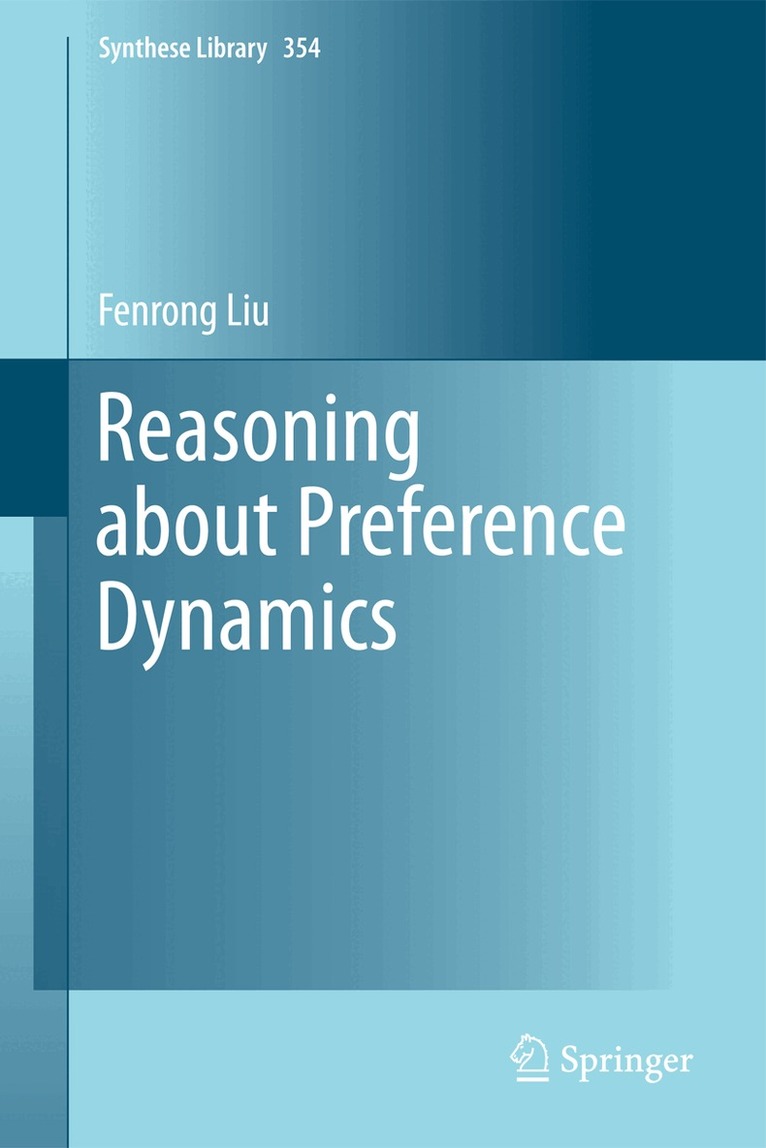
    Reasoning about Preference Dynamics

    AvFenrong Liu

    Inbunden, Engelska, 2011

    Del 354 i serien Synthese Library

    1 078 kr

    Beställningsvara. Skickas inom 10-15 vardagar. Fri frakt över 249 kr.

    Fler format och utgåvor

    E-bok

    1 413 kr

    Häftad

    1 078 kr

    Beskrivning

    Our preferences determine how we act and think, but exactly what the mechanics are and how they work is a central cause of concern in many disciplines. This book uses techniques from modern logics of information flow and action to develop a unified new theory of what preference is and how it changes. The theory emphasizes reasons for preference, as well as its entanglement with our beliefs. Moreover, the book provides dynamic logical systems which describe the explicit triggers driving preference change, including new information, suggestions, and commands. In sum, the book creates new bridges between many fields, from philosophy and computer science to economics, linguistics, and psychology. For the experienced scholar access to a large body of recent literature is provided and the novice gets a thorough introduction to the action and techniques of dynamic logic.

    Produktinformation

    • Utgivningsdatum:2011-06-01
    • Mått:155 x 235 x 19 mm
    • Vikt:492 g
    • Format:Inbunden
    • Språk:Engelska
    • Serie:Synthese Library
    • Antal sidor:204
    • Upplaga:2011
    • Förlag:Springer
    • ISBN:9789400713437

    Utforska kategorier

    • Filosofiska discipliner inom Filosofi och religion

    Mer om författaren

    Fenrong Liu is an associate professor at Tsinghua University, Beijing, one of the most prestigious universities in China. She received her first Ph.D degree in Philosophy at the Chinese Academy of Social Sciences in 2001 on default reasoning, a topic linking philosophy with Artificial Intelligence. From 2003-2008, she worked at the Institute for Logic, Language and Computation (ILLC) at the University of Amsterdam, where she obtained a second Ph.D degree in Science on dynamic logics of preference. She has published some  40 papers, and has organized many events, including a new Chinese conferences series on Logic,Rationality, and Intelligent Interaction (LORI). Her research is aimed at understanding how information changes guide rational agency in terms of beliefs and preference, and in modelling similarities and differences between agents, making room for agent diversity in logic. In addition, she pursues an active program in Chinese Ancient Logic, reading Chinese old texts by modern logical theories.

    Recensioner i media

    "This is an excellent book. It offers a clear and concise overview of dynamic preference logic and logics that can reason about both beliefs and preferences. Fenrong has managed to provide an accessible and comprehensive overview of recent work in this area, including very interesting connections with deontic logic and game theory. I highly recommend this book for anyone interested in using logical models to reason about rational agents." Eric Pacuit, Tilburg Center for Logic and Philosophy of Science, The Netherlands "Reasoning about Preference Dynamics is an innovative and unusually well-written account of human preferences and how they change. It is a must for anyone interested in the dynamics of preferences." Sven Ove Hansson, KTH Royal Institute of Technology, Sweden "This nice book presents a survey of preference logics and preference dynamics, very much state-of-the-art, and Fenrong Liu is extremely well-informed about the relevant literature. She has a remarkable talent on how to restrict herself to the essentials, in order to convey the message and produce something very readable." Hans van Ditmarsch, University of Sevilla, Spain

    Innehållsförteckning

    • Preface.- Part I Introduction.- 1. Introduction.- Part II Dynamics of Information.- 2. Dynamic Epistemic Logic.- Part III Preference over Worlds.- 3. Preference over Worlds: Static Logic.- 4. Preference over Worlds: Dynamic Logic.- 5. Entanglement of Preference, Knowledge and Belief.- 6. Intermezzo: A Quantitative Approach.- Part IV Preference from Priorities.- 7. Preference from Priorities: Static Logic.- 8. Belief-based Preference.- 9. Preference from Priorities: Dynamic Logic.- Part V A Two-Level Perspective on Preference.- 10. A Two-Level Perspective on Preference.- Part VI Applications and Discussions.- 11. Deontic Reasoning.- 12. Games and Actions.- Part VII Finale.- 13. Conclusion.- References.- Index.