• Fri frakt över 249 kr
  • •
  • Snabba leveranser
  • •
  • Billiga böcker
Kundservice

Du är på sajten för privatpersoner.

Företag, bibliotek eller offentlig verksamhet?

Du handlar på classic.bokus.com, där alla dina funktioner finns intakta.
Till classic.bokus.com
Bokus logotyp. Gå till startsidan.
  • Erbjudanden
  • Nyheter
  • Student
  • Topplistor
  • Barn & ungdom
  • Bokus Play
  • E-böcker
  • Pocketböcker
  • Spel & pussel

10% rabatt på allt med kod: NYSTART10 →

Sidfot

Mina sidor

    Hjälp

    • Kundservice
    • Vanliga frågor och svar
    • Frakt och leverans
    • Retur vid ångerrätt
    • Reklamera vara
    • Betalning
    • Köpvillkor
    • Allmänna villkor
    • Information om webbplatsens tillgänglighet

    Om Bokus

    • Om oss
    • Pressrum
    • För studenter
    • För företag
    • För bibliotek och offentlig verksamhet
    • För leverantörer
    • Hållbarhet

    Populärt

    • Aktuella erbjudanden
    • Presentkort
    • Studentlitteratur
    • Nya böcker
    • Topplistor
    • Signerade böcker
    • Engelska böcker

    Inspiration

    • Boktips
    • BookTok
    • Populära bokserier
    • Barnbokskaraktärer
    • Populära författare
    Logotyp för Bokus
    Följ oss på Facebook (extern länk)Följ oss på Instagram (extern länk)Följ oss på YouTube (extern länk)Följ oss på TikTok (extern länk)
    bokus @ CookiesAnpassa cookiesIntegritetspolicyKöpvillkor
    Till Citymail hemsida (extern länk)Till Budbee hemsida (extern länk)Till Postnord hemsida (extern länk)Till Schenker hemsida (extern länk)Till Early Bird hemsida (extern länk)Till Walleys hemsida (extern länk)
    1. Medicin
    2. Medicin: allmänt

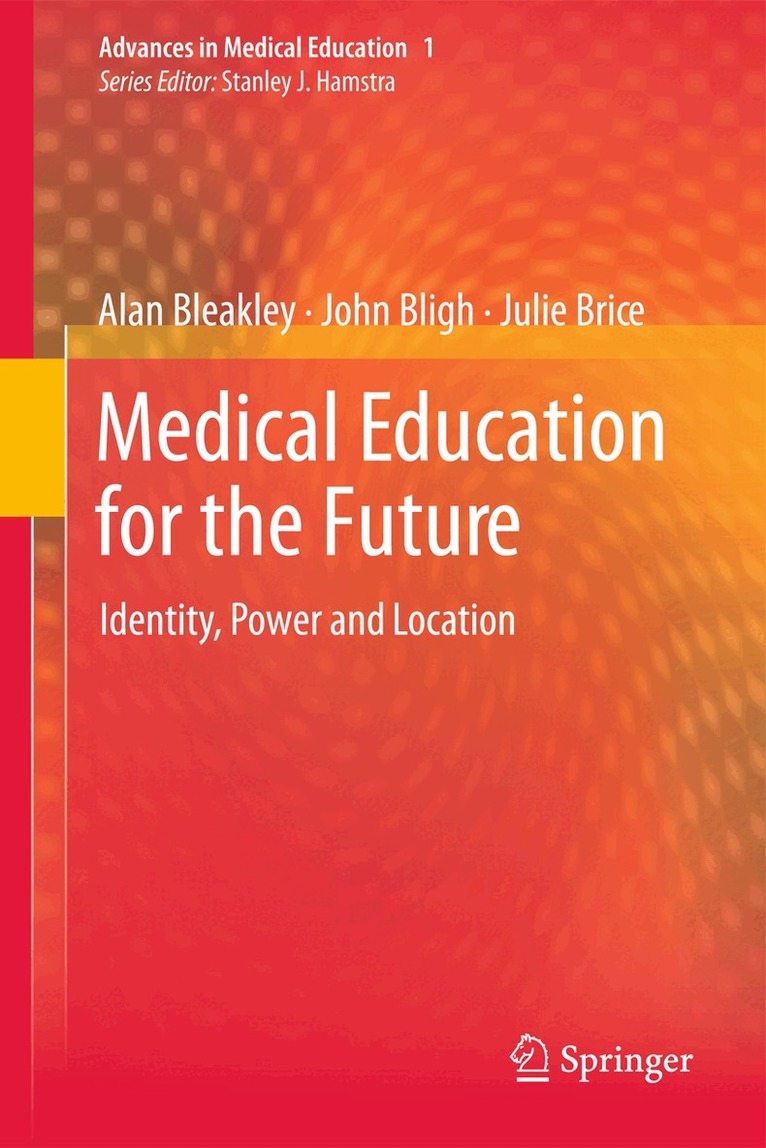
    Medical Education for the Future

    Identity, Power and Location

    AvAlan Bleakley,John Bligh

    Häftad, Engelska, 2013

    Del 1 i serien Advances in Medical Education

    2 563 kr

    Beställningsvara. Skickas inom 10-15 vardagar. Fri frakt över 249 kr.

    Fler format och utgåvor

    Inbunden

    2 563 kr

    Beskrivning

    The purpose of medical education is to benefit patients by improving the work of doctors. Patient centeredness is a centuries old concept in medicine, but there is still a long way to go before medical education can truly be said to be patient centered. Ensuring the centrality of the patient is a particular challenge during medical education, when students are still forming an identity as trainee doctors, and conservative attitudes towards medicine and education are common amongst medical teachers, making it hard to bring about improvements. How can teachers, policy makers, researchers and doctors bring about lasting change that will restore the patient to the heart of medical education? The authors, experienced medical educators, explore the role of the patient in medical education in terms of identity, power and location. Using innovative political, philosophical, cultural and literary critical frameworks that have previously never been applied so consistently to the field, the authors provide a fundamental reconceptualisation of medical teaching and learning, with an emphasis upon learning at the bedside and in the clinic. They offer a wealth of practical and conceptual insights into the three-way relationship between patients, students and teachers, setting out a radical and exciting approach to a medical education for the future.“The authors provide us with a masterful reconceptualization of medical education that challenges traditional notions about teaching and learning.  The book critiques current practices and offers new approaches to medical education based upon sociocultural research and theory.  This thought provoking narrative advances the case for reform and is a must read for anyone involved in medical education.”  -  David M. Irby, PhD, Vice Dean for Education,University of California, San Francisco School of Medicine; and co-author of Educating Physicians: A Call for Reform of Medical School and Residency"This book is a truly visionary contribution to the Flexner centenary. It is compulsory reading for the medical educationalist with a serious concern for the future - and for the welfare of patients and learners in the here and now." Professor Tim Dornan, University of Manchester Medical School and Maastricht University Graduate School of Health Professions Education.

    Produktinformation

    • Utgivningsdatum:2013-04-21
    • Mått:155 x 235 x 17 mm
    • Vikt:470 g
    • Format:Häftad
    • Språk:Engelska
    • Serie:Advances in Medical Education
    • Antal sidor:292
    • Upplaga:2011
    • Förlag:Springer
    • ISBN:9789400735187

    Utforska kategorier

    • Medicin: allmänt inom Medicin
    • Pedagogisk psykologi inom Psykologi och pedagogik
    • Läroplaner och kursplaner inom Psykologi och pedagogik

    Innehållsförteckning

    • Contents Acknowledgements Introduction PART ONE: MEDICAL EDUCATION – A DEMOCRATISING FORCE FOR MEDICINE.- Chapter 1: Medical education as patient Not prophecy, but spotting trends Medical education in an historical key Crossroads and crisis: how is the patient? The symptom may be the ‘education’ in medical education, while the cure may be a new approach to education.- Chapter 2: Beyond practical reasoning From critical thinking to practical reasoning: a necessary but not sufficient change in medical education A new wave of medical education thinking ‘Good enough’ is not good enough.- Chapter 3: Learning from learning theory To the things themselves Where’s the sense in medical education? - revisiting practical knowing.- Chapter 4: Socio-cultural learning theories Learning from history Three approaches to learning Miller lite Contrasting metaphors for learning Activity theory Cognitive apprenticeship and distributed cognition Dynamicist learning and complexity Systems thinking and learning Conclusions PART TWO: IDENTITY, POWER AND LOCATION IN MEDICAL EDUCATION.- Chapter 5: Producing doctors What is ‘identity’? From the identity of ‘medical student’ to the identity of ‘doctor’: can learning theory illuminate this transition? Actor-Network-Theory (ANT) Communities of Practice (COP) Cultural-historical Activity Theory (CHAT).- Chapter 6: New forms of identity in a runaway world of medicine Can the centre hold? The doctor as diagnostician, symptomatologist and connoisseur The doctor at work in the 21st century: emergence of new identities such as the ‘medical citizen.- Chapter 7: The medical educator and the clinical teacher Unpicking the threads A framework for discussing the identity of the medical educator Using social learning theory frameworks to identify the medical educator and clinical teacher.- Chapter 8: Identity construction of the medical educator through learning and writing Introduction Identity defined by philosophy ofteaching and learning: student-centredness and democracy in the classroom and clinic A literary perspective on identities of the medical educator.- Chapter 9: Power in medical education Bodies of power Sovereign, capillary, virtue, and virtual power.- Chapter 10: Place matters: location in medical education Introduction Where are we in medical education? Hospital architectures and cognitive architectures The white cube Work-based learning: vocation as location and deterritorialization.- Chapter 11: Learning by simulation and the simulation of learning An age of simulation Theory of simulation: classical to postmodern Strengths and weaknesses of learning by simulation The simulation project: will a dialogue emerge between simulation and work-based learning?- Chapter 12: Global medical education – a post-colonial dilemma Imperialism by the back door? Comparative education Is western medical education infectious? Flaws in the global medical education vision Global, local, or ‘glocal’? The trade in knowledge as a commodity From reinforcing the colonial legacy to challenging the colonial gaze Empire and forms of resistance PART THREE: MEDICAL EDUCATION RESEARCH – A DEMOCRATISING FORCE FOR MEDICAL EDUCATION.- Chapter 13: Let’s get real: medical students learning from, with and about patients Productive forms of the medical encounter Towards an authentic patient-centred medical education Learning from the past Medical students learning from patients, supported by clinical teachers: a new vintage Patient, medical student and doctor exchanges in medical education.- Chapter 14: Texts, authoring and reading in medical education The text is produced, not given (doing, talking and reading in the patient encounter) Kinds of text in reading patients: a summary model Text is not an answer, but a question Problem-based learning or patient-based learning? Evidence for the value of a triadic model.- Chapter 15: Lack, trajectories and ruptures in medical education researchMedical education research at a crossroads Origins of medical education research A five-point agenda for improving medical education research.- Chapter 16: A framework for medical education research: cultures, contexts and concepts. Identity, power and location revisited Cultures Contexts Concepts Landscape Bibliography Index.