• Fri frakt över 249 kr
  • •
  • Snabba leveranser
  • •
  • Billiga böcker
Kundservice

Du är på sajten för privatpersoner.

Företag, bibliotek eller offentlig verksamhet?

Du handlar på classic.bokus.com, där alla dina funktioner finns intakta.
Till classic.bokus.com
Bokus logotyp. Gå till startsidan.
  • Erbjudanden
  • Nyheter
  • Student
  • Topplistor
  • Barn & ungdom
  • Bokus Play
  • E-böcker
  • Pocketböcker
  • Spel & pussel

10% rabatt på allt med kod: NYSTART10 →

Sidfot

Mina sidor

    Hjälp

    • Kundservice
    • Vanliga frågor och svar
    • Frakt och leverans
    • Retur vid ångerrätt
    • Reklamera vara
    • Betalning
    • Köpvillkor
    • Allmänna villkor
    • Information om webbplatsens tillgänglighet

    Om Bokus

    • Om oss
    • Pressrum
    • För studenter
    • För företag
    • För bibliotek och offentlig verksamhet
    • För leverantörer
    • Hållbarhet

    Populärt

    • Aktuella erbjudanden
    • Presentkort
    • Studentlitteratur
    • Nya böcker
    • Topplistor
    • Signerade böcker
    • Engelska böcker

    Inspiration

    • Boktips
    • BookTok
    • Populära bokserier
    • Barnbokskaraktärer
    • Populära författare
    Logotyp för Bokus
    Följ oss på Facebook (extern länk)Följ oss på Instagram (extern länk)Följ oss på YouTube (extern länk)Följ oss på TikTok (extern länk)
    bokus @ CookiesAnpassa cookiesIntegritetspolicyKöpvillkor
    Till Citymail hemsida (extern länk)Till Budbee hemsida (extern länk)Till Postnord hemsida (extern länk)Till Schenker hemsida (extern länk)Till Early Bird hemsida (extern länk)Till Walleys hemsida (extern länk)
    1. Naturvetenskap och teknik
    2. Geovetenskap
    3. Geografi

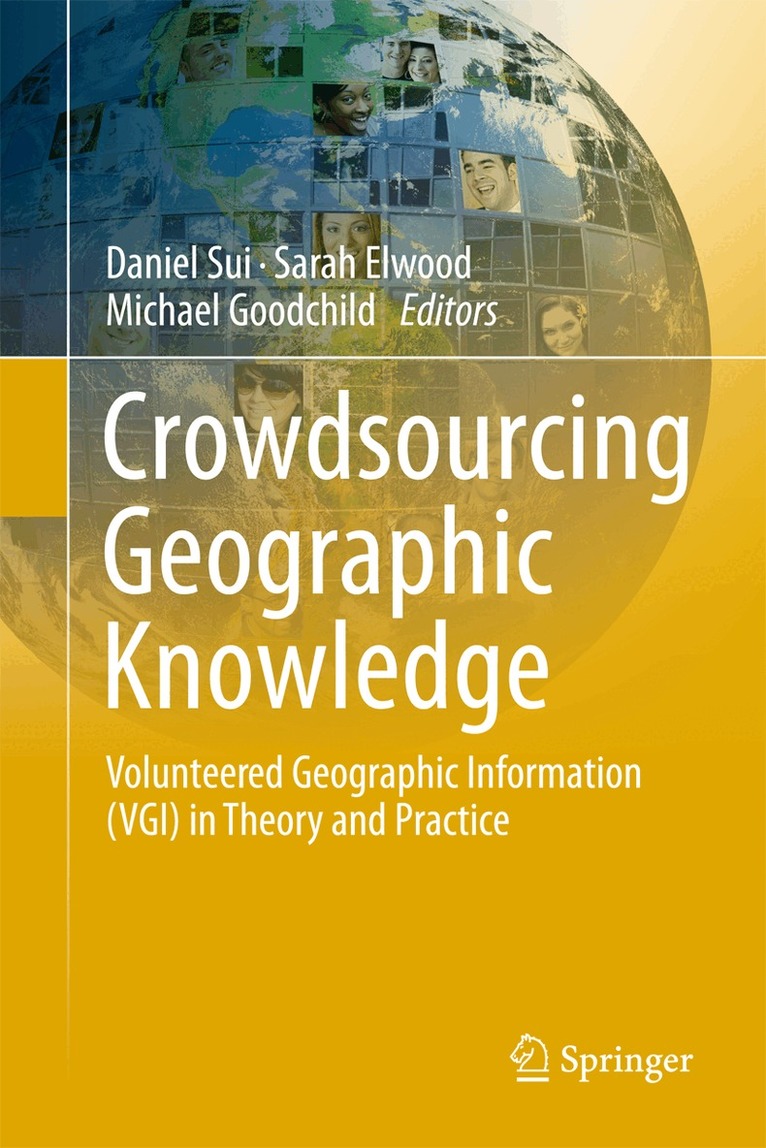
    Crowdsourcing Geographic Knowledge

    Volunteered Geographic Information (VGI) in Theory and Practice

    AvDaniel Sui,Sarah Elwood

    Inbunden, Engelska, 2012

    1 625 kr

    Beställningsvara. Skickas inom 10-15 vardagar. Fri frakt över 249 kr.

    Beskrivning

    The phenomenon of volunteered geographic information is part of a profound transformation in how geographic data, information, and knowledge are produced and circulated. By situating volunteered geographic information (VGI) in the context of big-data deluge and the data-intensive inquiry, the 20 chapters in this book explore both the theories and applications of crowdsourcing for geographic knowledge production with three sections focusing on 1).  VGI, Public Participation, and Citizen Science; 2). Geographic Knowledge Production and Place Inference; and 3). Emerging Applications and New Challenges.  This book argues that future progress in VGI research depends in large part on building strong linkages with diverse geographic scholarship. Contributors of this volume situate VGI research in geography’s core concerns with space and place, and offer several ways of addressing persistent challenges of quality assurance in VGI. This book positions VGI as part of a shift toward hybrid epistemologies, and potentially a fourth paradigm of data-intensive inquiry across the sciences. It also considers the implications of VGI and the exaflood for further time-space compression and new forms, degrees of digital inequality, the renewed importance of geography, and the role of crowdsourcing for geographic knowledge production.

    Produktinformation

    • Utgivningsdatum:2012-08-08
    • Mått:155 x 235 x 27 mm
    • Vikt:776 g
    • Format:Inbunden
    • Språk:Engelska
    • Antal sidor:396
    • Upplaga:2013
    • Förlag:Springer
    • ISBN:9789400745865

    Utforska kategorier

    • Geografi inom Naturvetenskap och teknik

    Recensioner i media

    From the reviews: "Although there are many books on crowdsourcing in general, there is no other current work of this type that addresses geographic crowdsourcing, also referred to as volunteered geographic information-a central element of neogeography. ... The chapters are well-written and edited and all present interesting and timely information. The book could be used as part of a seminar on geospatial science and provide fertile ground for discussion." (Michael Peterson, The AAG Review of Books, Vol. 1 (3), 2013)

    Innehållsförteckning

    • Chapter 1: VGI, the exaflood, and the growing digital divide: Daniel Sui, Michael Goodchild, & Sarah Elwood.- Section I.  Public Participation and Citizen Science.- Chapter 2: Understanding the value of VGI: Rob Feick & Stéphane Roche.- Chapter 3: To volunteer or to contribute locational information? Towards truth in labeling for crowd-sourced geographic information: Francis Harvey.- Chapter 4: Metadata squared: Enhancing its usability for volunteered geographic information and  the GeoWeb: Barbara Poore &  Eric Wolf.- Chapter 5: Situating the adoption of VGI by government: Peter Johnson & Renee Sieber.- Chapter 6: When Web 2.0 meets public participation GIS (PPGIS): VGI and spaces of participatory mapping in China: Wen Lin.- Chapter 7: Citizen science and volunteered geographic information: Overview and typology of participation: Muki Haklay.- Section II. Geographic Knowledge Production  and Place Inference.- Chapter 8: Volunteered geographic information and computational geography: New perspectives: Bin Jiang.- Chapter 9: The evolution of geo-crowdsourcing: Bringing volunteered geographic information to the third dimension: Marcus Goetz & Alexander Zipf: Chapter 10: From volunteered geographic information to volunteered geographic services:Jim Thatcher.- Chapter 11: The geographic nature of Wikipedia authorship.- Darren Hardy.- Chapter 12: Inferring thematic places from spatially referenced natural language observations: Benjamin Adams & Grant McKenzie.- Chapter 13: “I don't come from anywhere:" Exploring the role of VGI and the Geoweb in rediscovering a sense of place in a dispersed Aboriginal community: Jon Corbett.- Section III.   Emerging Applications  and New Challenges.- Chapter 14: Potential contributions and challenges of VGI for conventional topographic base-mapping programs: David Coleman.- Chapter 15: “We know who you are and we know where you live:”A research agenda for web demographics: T. Edwin Chow.- Chapter 16: Volunteered geographic information, actor-network theory, and severe storm reports: Mark Palmer & Scott Kraushaar.- Chapter 17: VGI as a compilation tool for navigation map databases: Michael Dobson.- Chapter 18: VGI and public health: Possibilities and pitfalls: Christopher Goranson, Sayone Thihalolipavan, &  Nicolás di Tada.- Chapter 19: VGI in education: From K-12 to graduate studies: Thomas Bartoschek & Carsten Keßler.- Chapter 20: The prospects VGI research and the emerging fourth paradigm: Sarah Elwood, Michael Goodchild, & Daniel Sui.