• Fri frakt över 249 kr
  • •
  • Snabba leveranser
  • •
  • Billiga böcker
Kundservice

Du är på sajten för privatpersoner.

Företag, bibliotek eller offentlig verksamhet?

Du handlar på classic.bokus.com, där alla dina funktioner finns intakta.
Till classic.bokus.com
Bokus logotyp. Gå till startsidan.
  • Erbjudanden
  • Nyheter
  • Student
  • Topplistor
  • Barn & ungdom
  • Bokus Play
  • E-böcker
  • Pocketböcker
  • Spel & pussel

10% rabatt på allt med kod: NYSTART10 →

Sidfot

Mina sidor

    Hjälp

    • Kundservice
    • Vanliga frågor och svar
    • Frakt och leverans
    • Retur vid ångerrätt
    • Reklamera vara
    • Betalning
    • Köpvillkor
    • Allmänna villkor
    • Information om webbplatsens tillgänglighet

    Om Bokus

    • Om oss
    • Pressrum
    • För studenter
    • För företag
    • För bibliotek och offentlig verksamhet
    • För leverantörer
    • Hållbarhet

    Populärt

    • Aktuella erbjudanden
    • Presentkort
    • Studentlitteratur
    • Nya böcker
    • Topplistor
    • Signerade böcker
    • Engelska böcker

    Inspiration

    • Boktips
    • BookTok
    • Populära bokserier
    • Barnbokskaraktärer
    • Populära författare
    Logotyp för Bokus
    Följ oss på Facebook (extern länk)Följ oss på Instagram (extern länk)Följ oss på YouTube (extern länk)Följ oss på TikTok (extern länk)
    bokus @ CookiesAnpassa cookiesIntegritetspolicyKöpvillkor
    Till Citymail hemsida (extern länk)Till Budbee hemsida (extern länk)Till Postnord hemsida (extern länk)Till Schenker hemsida (extern länk)Till Early Bird hemsida (extern länk)Till Walleys hemsida (extern länk)
    1. Naturvetenskap och teknik
    2. Matematik och naturvetenskap
    3. Kemi

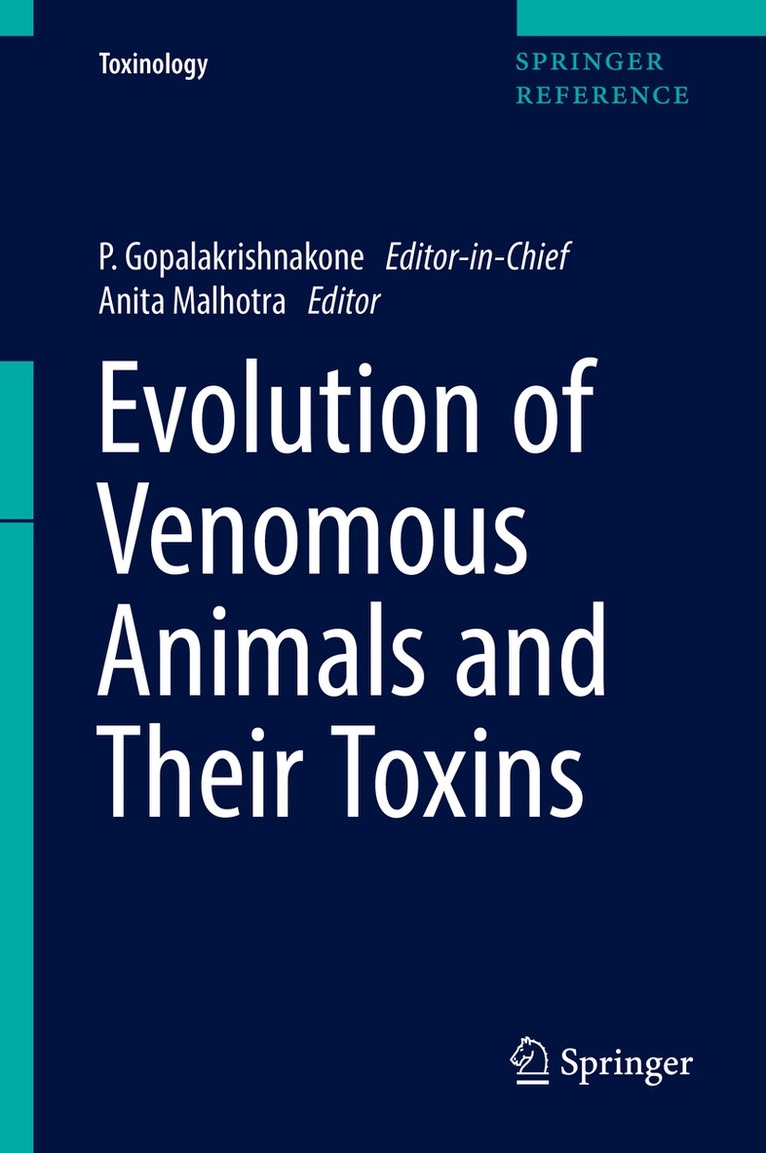
    Evolution of Venomous Animals and Their Toxins

    AvAnita Malhotra

    Inbunden, Engelska, 2017

    Del i serien Toxinology

    3 341 kr

    Beställningsvara. Skickas inom 10-15 vardagar. Fri frakt över 249 kr.

    Beskrivning

    This volume contains a section on the wider evolutionary context of venom in animals, the molecular evolutionary processes involved in generating diversity, and the concept of venom evolution as being driven by an arms race that also involves evolution of resistance to toxins by prey. It also studies the relationship between the evolution of toxins and the evolution of the animals that they evolved within.  The last section discusses the evolution of venom delivery systems. The definition of a venomous animal, as opposed to a poisonous one, encompasses the evolution not just of toxins but also a specialized mechanism for administering them by injection.

    Produktinformation

    • Utgivningsdatum:2017-04-07
    • Mått:155 x 235 x 29 mm
    • Vikt:948 g
    • Format:Inbunden
    • Språk:Engelska
    • Serie:Toxinology
    • Antal sidor:446
    • Upplaga:17001
    • Förlag:Springer
    • Medarbetare:P. Gopalakrishnakone
    • ISBN:9789400764576

    Utforska kategorier

    • Kemi inom Naturvetenskap och teknik
    • Biologi inom Naturvetenskap och teknik
    • Zoologi inom Naturvetenskap och teknik

    Mer om författaren

    P. Gopalakrishnakone, M.B.B.S., Ph.D., F.A.M.S., D.Sc., is presently professor of anatomy and chairman of the Venom and Toxin Research Programme at Yong Loo Lin School of Medicine, National University of Singapore. He is also a consultant to the Defence Science Organization in Singapore and adjunct senior research scientist at the Defence Medical Research Institute. Prof. Gopalakrishnakone is an honorary principal fellow at the Australian Venom Research Unit, University of Melbourne, Australia.His research studies include structure function studies, toxin detection, biosensors, antitoxins and neutralization factors, toxinogenomics and expression studies, antimicrobial peptides from venoms and toxins, and PLA2 inhibitors as potential drug candidates for inflammatory diseases. The techniques he employs include quantum dots to toxinology, computational biology, microarrays, and protein chips.Prof. Gopalakrishnakone has more than 160 international publications, 4 books, about 350 conference presentations, and 10 patent applications.He has been an active member of the International Society on Toxinology (IST) for 30 years and was president from 2008 to 2012. He is also the founder president of its Asia Pacific Section, a council member, as well as an editorial board member of Toxicon, the society’s official journal.His research awards include the Outstanding University Researcher Award from the National University of Singapore (1998); Ministerial Citation, NSTB Year 2000 Award in Singapore; and the Research Excellence Award from the Faculty of Medicine at NUS (2003). His awards in teaching include Faculty Teaching Excellence Award 2003/4 and NUS Teaching Excellence Award 2003/4. Prof. Gopalakrishnakone also received the Annual Teaching Excellence Award in 2010 at both university and faculty levels.Anita Malhotra received her BA in Zoology from Oxford University (Jesus College) in 1985 and her PhD from the University of Aberdeen in 1992. She then moved to Bangor University in 1994, where she took up a lectureship in 1995. She is now Director of the Graduate School of the College of Natural Sciences. She is a molecular ecologist and evolutionary geneticist, who developed the first robust and largely comprehensive molecular phylogenies for Asian pitvipers, based on both mitchodondrial and nuclear markers. This work revealed a number of cryptic species and resulted in the radical revision of the taxonomy of the group. She has used this phylogeny to test hypotheses about the evolution of specific venom components such as the phospholipase A2 enzymes, using a multidisciplinary genomic, proteomic and functional approach. She has active collaborations all over the world with other academic institutions and research-based SMEs (particularly in Europe, India, China and Japan). Other research involves investigation of the dynamics of natural selection, vicariance and evolutionary response to changing environmental conditions, and honeybee genetics in the UK.  Author of over 100 publications, her work regularly attracts media attention and been covered by BBC Wildlife, the Sunday Telegraph, and Radio 4 as well as in local news media in the UK and abroad. She was a recipient of the Zoological Society of London’s Thomas Henry Huxley award and Marsh prize in 1992 and a co-author on the article that received the 2004 Joseph B. Slowinski Award for Excellence in Venomous Snake Systematics. She is joint co-ordinator for East Asia on the IUCN Viper Specialist Group, and is also a guest professor at Shenyang University and Yibin University in China.

    Innehållsförteckning

    • A Critique of the Toxicoferan Hypothesis.- Evolution of Resistance to Toxins in Prey.- Evolution of Separate Predation- and Defence-Evoked Venoms in Carnivorous Cone Snails.- Evolutionary Context of Venom in Animals.- Functional and Genetic Diversity of Toxins in Sea Anemones.- Independent Origins of Scorpion Toxins Affecting Potassium and Sodium Channels.- Mutation, Duplication, and More in the Evolution of Venomous Animals and Their Toxins.- Parasitoid Wasps and Their Venoms.- The Strategic Use of Venom by Spiders.- Toxicity in Cephalopods.- Venom Use in Mammals: Evolutionary Aspects.- Venom as a Component of External Immune Defense in Hymenoptera.- Phylogeny of Annelida.- Systematics and Evolution of the Conoidea.- Systematics of Cephalopods.- Systematics of Siphonophores.- Evolution of the Snake Venom Delivery System.- Evolution, Morphology andDevelopment of the Centipede Venom System.- Evolutionary History of Venom Glands in the Siluriformes.