• Fri frakt över 249 kr
  • •
  • Snabba leveranser
  • •
  • Billiga böcker
Kundservice

Du är på sajten för privatpersoner.

Företag, bibliotek eller offentlig verksamhet?

Du handlar på classic.bokus.com, där alla dina funktioner finns intakta.
Till classic.bokus.com
Bokus logotyp. Gå till startsidan.
  • Erbjudanden
  • Student
  • Topplistor
  • Barn & ungdom
  • Bokus Play
  • E-böcker
  • Ljudböcker
  • Pocketböcker
  • Spel och pussel

Skapa nya rutiner – hälsoböcker upp till 50% →

Sidfot

Mina sidor

    Hjälp

    • Kundservice
    • Vanliga frågor och svar
    • Frakt och leverans
    • Retur vid ångerrätt
    • Reklamera vara
    • Betalning
    • Köpvillkor
    • Allmänna villkor
    • Information om webbplatsens tillgänglighet

    Om Bokus

    • Om oss
    • Pressrum
    • För studenter
    • För företag
    • För bibliotek och offentlig verksamhet
    • För leverantörer
    • Hållbarhet

    Populärt

    • Aktuella erbjudanden
    • Presentkort
    • Studentlitteratur
    • Nya böcker
    • Topplistor
    • Signerade böcker
    • Engelska böcker

    Inspiration

    • Boktips
    • BookTok
    • Barnbokskaraktärer
    • Populära författare
    Logotyp för Bokus
    Följ oss på Facebook (extern länk)Följ oss på Instagram (extern länk)Följ oss på YouTube (extern länk)Följ oss på TikTok (extern länk)
    bokus @ CookiesAnpassa cookiesIntegritetspolicyKöpvillkor
    Till Citymail hemsida (extern länk)Till Budbee hemsida (extern länk)Till Postnord hemsida (extern länk)Till Schenker hemsida (extern länk)Till Early Bird hemsida (extern länk)Till Walleys hemsida (extern länk)
    1. Djur och Natur
    2. Naturböcker
    3. Växtböcker

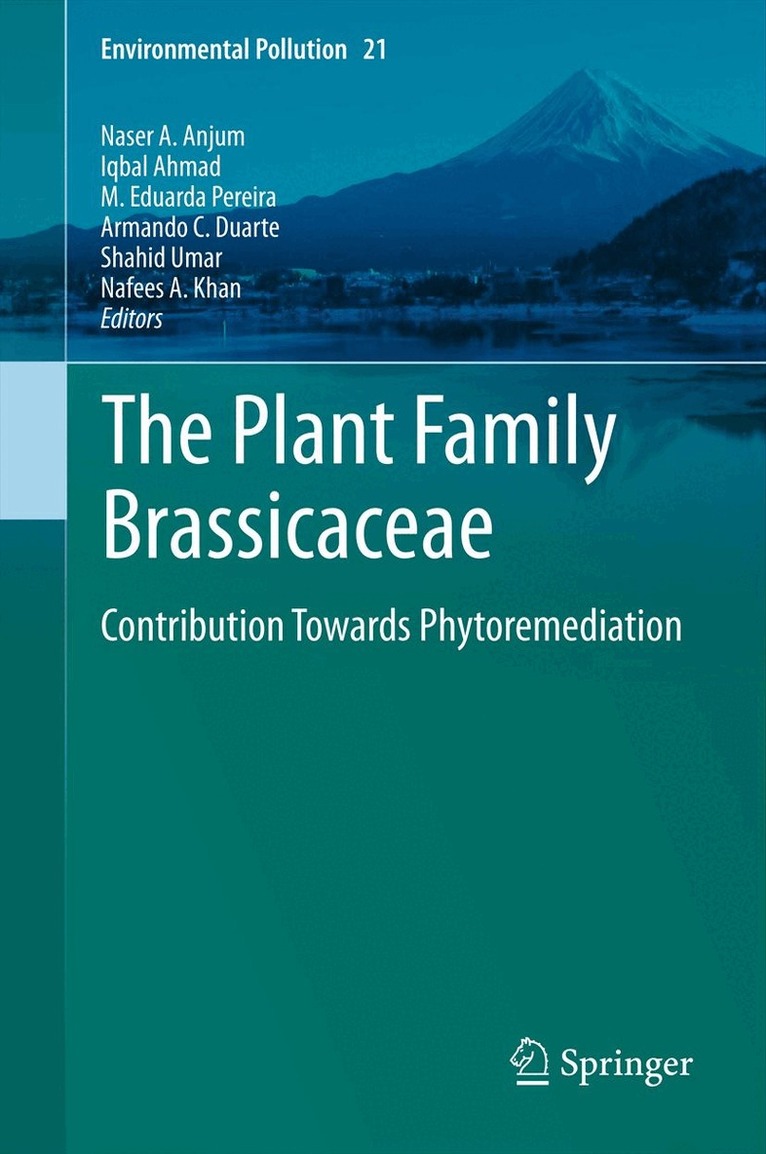
    Plant Family Brassicaceae

    Contribution Towards Phytoremediation

    AvNaser A. Anjum,Iqbal Ahmad

    Häftad, Engelska, 2014

    Del 21 i serien Environmental Pollution

    1 613 kr

    Beställningsvara. Skickas inom 10-15 vardagar. Fri frakt över 249 kr.

    Beskrivning

    With the advent of the industrial revolution , the biosphere has been continuously polluted with a myriad of contaminants that urgently need global attention. In this perspective, most of the genera of the plant family Brassicaceae (Crucifereae or the mustard family) are a significant part of the plants- and associated microbes-based strategies adopted for the cleanup of varied contaminants from environmental compartments. Important genus such as Alyssum, Arabidopsis, Brassica and Thlaspi from Brassicaceae which, besides acting as an attractive genetic model, well-represent the metal hyperaccumulation among approximately 0.2% of all angiosperms and thus, play a key role in the phytoremediation technology. This book i) provides an exhaustive evaluation of the current status of contaminants (metals/metalloids)-addition to varied environmental compartments and its consequences, ii) offers comprehensive and state-of-the-art information on the significance of the plants from the family Brassicaceae in solving environmental pollution issues, iii) examines the physiological, biochemical and molecular-genetic strategies adopted by the plants from Brassicaceae for the remediation of and tolerance to varied environmental contaminants, and iv) supplies a broad reference to the field of environmental science and related disciplines. As a pioneer work and significant addition to the Environmental Pollution book series, the current volume promises to be a useful asset for researchers, students, other academicians and policy makers involved in sustainable remediation of varied environmental compartments.

    Produktinformation

    • Utgivningsdatum:2014-05-09
    • Mått:155 x 235 x 20 mm
    • Vikt:546 g
    • Format:Häftad
    • Språk:Engelska
    • Serie:Environmental Pollution
    • Antal sidor:342
    • Upplaga:2012
    • Förlag:Springer
    • ISBN:9789400793835

    Utforska kategorier

    • Växtböcker inom Djur och Natur
    • Botanik inom Naturvetenskap och teknik
    • Miljövetenskap och miljöpolitik inom Naturvetenskap och teknik

    Mer om författaren

    Naser A. Anjum and Iqbal Ahmad are Scientists at Centre for Environmental and Marine Studies & Department of Chemistry, University of Aveiro, 3810-193 Aveiro, Portugal. M. Edurada Pereira and Armando C. Duarte are Professors in the Department of Chemistry, University of Aveiro, 3810-193 Aveiro, Portugal; and Researchers at Centre for Environmental and Marine Studies, University of Aveiro, 3810-193 Aveiro, Portugal. Shahid Umar is Associate Professor in the Department of Botany, Division of Plant Stress Physiology, Hamdard University, New Delhi, India. Nafees A. Khan is a Professor of Plant Physiology in the Department of Botany, Division of Plant Physiology and Biochemistry, Faculty of Life Sciences, Aligarh Muslim University, Aligarh, U.P., India.

    Recensioner i media

    From the reviews: "This volume bringing together a review of the underlying fundamental mechanisms underpinning phytoremediation combined with translational aspects is both timely and of considerable interest. ... They are largely well written and give a good summary of the current scientific literature. ... I would recommend this volume to undergraduate and postgraduate students, and academic and applied scientists working in the field of phytoremediation. It would be a welcome addition in university libraries, and I will be recommending it to students that I teach and supervise." (Richard Mithen, Experimental Agriculture, Vol. 49 (1), 2013)

    Innehållsförteckning

    • 1. The Plant Family Brassicaceae: An Introduction.-  2. Current Status of Toxic Metals-Addition to Environment and Its Consequences.-  3. Cadmium Accumulation by Plants of Brassicaceae Family and Its Connection with Their Primary and Secondary Metabolism.-  4. Metal Hyperaccumulation and Tolerance in Alyssum, Arabidopsis and Thlaspi: An Overview.-  5. Brassica Rhizosphere-Microbe Interactions and their Role in Phytoremediation.-  6. Phytoremediation of Heavy Metals by Brassica juncea in Aquatic and Terrestrial Environment.-  7. Toxic Metals Accumulation, Tolerance and Homeostasis in Brassicaoilseed Species: Overview of Physiological, Biochemical and Molecular Mechanisms.-  8. The Role of Plant Growth-Promoting Rhizosphere Bacteria in Toxic Metal Extraction by Brassica spp.-  9. Biochemical and Functional Responses of Arabidopsis thaliana Exposed to Cadmium, Copper and Zinc.-  10. Brassicas in Turkey and Their Potential Role for Degraded Habitats’ Remediation.-  11. Chelate Assisted Phytoextraction Using Oilseed Brassicas.-  12. Roles of Rhizospheric Processes and Plant Physiology in Applied Phytoremediation of Contaminated Soils using Brassica Oilseeds. ​