E-bok, Engelska, 2012
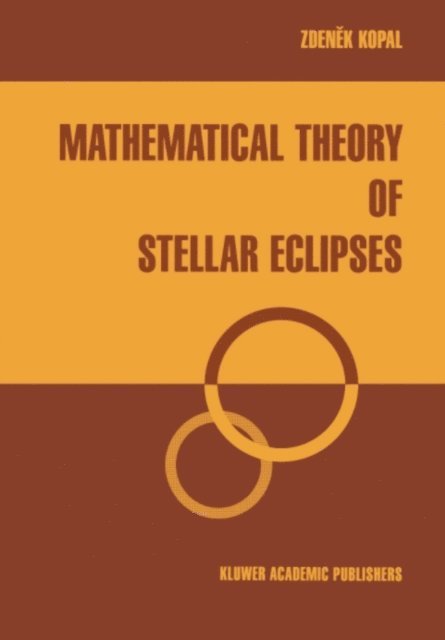
Mathematical Theory of Stellar Eclipses
Av Zdenek Kopal
710 kr
Skickas fredag 9/10
Beskrivning
ASTRONOMICAL ECLIPSE PHENOMENA In looking over the long history of human science from time immemorial to our own times, it is impossible to overestimate the role played in it by the phenomena of eclipses of the celestial bodies-both within our solar system as well as in the stellar universe at large. Not later than in the 4th century B. C. , the observed features of the shadow cast on the Moon by the Earth during eclipses led Aristotle (384-322 B. C. ) to formulate the first scientific proof worthy of that name of the spherical shape of the Earth; and only somewhat later, the eclipses of the Sun provided Aristarchos (in the early part of the 3rd century B. C. ) or Hipparchos (2nd half ofthe same century) with the geometric means to ascertain the distance which separates the Earth from the Sun. In the 17th century A. D. (in 1676, to be exact) the timings of the eclipses of the satellites of Jupiter by their central planet enabled Olaf Romer to discover that the velocity with which light propagates through space is finite.
Produktinformation
- Utgivningsdatum: 2012-12-06
- Format: E-bok
- Språk: Engelska
- Förlag: Springer Netherlands
- ISBN: 9789400905399
Utforska kategorier
Betyg & recensioner
0 recensioner
Inga recensioner tillgängliga.