• Fri frakt över 249 kr
  • •
  • Snabba leveranser
  • •
  • Billiga böcker
Kundservice

Du är på sajten för privatpersoner.

Företag, bibliotek eller offentlig verksamhet?

Du handlar på classic.bokus.com, där alla dina funktioner finns intakta.
Till classic.bokus.com
Bokus logotyp. Gå till startsidan.
  • Erbjudanden
  • Nyheter
  • Student
  • Topplistor
  • Barn & ungdom
  • Bokus Play
  • E-böcker
  • Pocketböcker
  • Spel & pussel

10% rabatt på allt med kod NYSTART10 →

Sidfot

Mina sidor

    Hjälp

    • Kundservice
    • Vanliga frågor och svar
    • Frakt och leverans
    • Retur vid ångerrätt
    • Reklamera vara
    • Betalning
    • Köpvillkor
    • Allmänna villkor
    • Information om webbplatsens tillgänglighet

    Om Bokus

    • Om oss
    • Pressrum
    • För studenter
    • För företag
    • För bibliotek och offentlig verksamhet
    • För leverantörer
    • Hållbarhet

    Populärt

    • Aktuella erbjudanden
    • Presentkort
    • Studentlitteratur
    • Nya böcker
    • Topplistor
    • Signerade böcker
    • Engelska böcker

    Inspiration

    • Boktips
    • BookTok
    • Populära bokserier
    • Barnbokskaraktärer
    • Populära författare
    Logotyp för Bokus
    Följ oss på Facebook (extern länk)Följ oss på Instagram (extern länk)Följ oss på YouTube (extern länk)Följ oss på TikTok (extern länk)
    bokus @ CookiesAnpassa cookiesIntegritetspolicyKöpvillkor
    Till Citymail hemsida (extern länk)Till Budbee hemsida (extern länk)Till Postnord hemsida (extern länk)Till Schenker hemsida (extern länk)Till Early Bird hemsida (extern länk)Till Walleys hemsida (extern länk)
    1. Naturvetenskap och teknik
    2. Geovetenskap
    3. Geografi

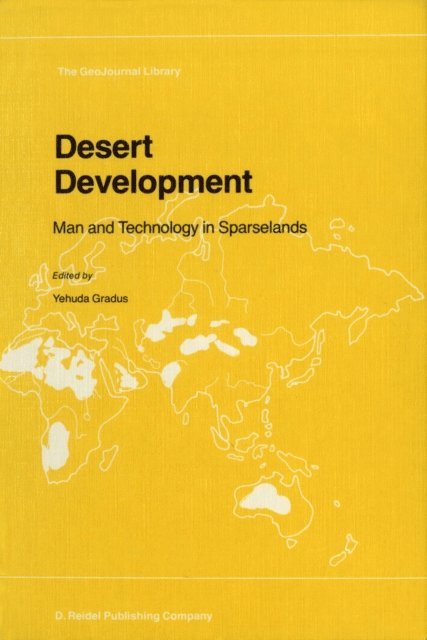
    Desert Development

    Man and Technology in Sparselands

    AvYehuda Gradus

    E-bok
    PDF, Engelska, 2012

    1 413 kr

    Läs direkt i Bokus Reader – eller ladda ned till din enhet (PDF kräver ofta zoom och scroll på små skärmar).

    Beskrivning

    The fact that approximately one-third of the world''s land mass is arid desert may be congenial for the camel and the cactus, but not for people. Nevertheless, well over half a billion people, or 15% of the world''s population live in arid desert areas. If the world''s population were distributed evenly over the land surface, we would expect to find about 30% of the population inhabiting arid desert areas. Does the fact that ''only'' 15% of the world''s population live in an arid desert environment reflect the harshness of the environment? Or is it a testimony to the adaptability and ingenuity of mankind? Do we view the glass as half-full? Or half-empty? The contributors to Desert Development: Man and Technology in Sparselands adopt the position that the cup is half-full and, in fact, could be filled much more. Indeed, many arid desert zones do thrive with life, and given appropriate technological develop­ ment, such areas could support even greater popUlations. While the dire Malthusian prediction that rapid world population growth exceeds the carrying capacity of existent resource systems has gained popularity (typified by the 1972 Club of Rome book, Limits to Growth), there is a growing body of serious work which rejects such pessimistic ''depletion'' models, in favor of models which are mildly optimistic.

    Produktinformation

    • Utgivningsdatum:2012-12-06
    • Språk:Engelska
    • Filformat:PDF
    • Kopieringsskydd:LCP
    • ISBN:9789400953963
    • Förlag:Springer Netherlands

    Utforska kategorier

    • Geografi inom Naturvetenskap och teknik