• Fri frakt över 249 kr
  • •
  • Snabba leveranser
  • •
  • Billiga böcker
Kundservice

Du är på sajten för privatpersoner.

Företag, bibliotek eller offentlig verksamhet?

Du handlar på classic.bokus.com, där alla dina funktioner finns intakta.
Till classic.bokus.com
Bokus logotyp. Gå till startsidan.
  • Erbjudanden
  • Nyheter
  • Student
  • Topplistor
  • Barn & ungdom
  • Bokus Play
  • E-böcker
  • Pocketböcker
  • Spel & pussel

10% rabatt på allt med kod NYSTART10 →

Sidfot

Mina sidor

    Hjälp

    • Kundservice
    • Vanliga frågor och svar
    • Frakt och leverans
    • Retur vid ångerrätt
    • Reklamera vara
    • Betalning
    • Köpvillkor
    • Allmänna villkor
    • Information om webbplatsens tillgänglighet

    Om Bokus

    • Om oss
    • Pressrum
    • För studenter
    • För företag
    • För bibliotek och offentlig verksamhet
    • För leverantörer
    • Hållbarhet

    Populärt

    • Aktuella erbjudanden
    • Presentkort
    • Studentlitteratur
    • Nya böcker
    • Topplistor
    • Signerade böcker
    • Engelska böcker

    Inspiration

    • Boktips
    • BookTok
    • Populära bokserier
    • Barnbokskaraktärer
    • Populära författare
    Logotyp för Bokus
    Följ oss på Facebook (extern länk)Följ oss på Instagram (extern länk)Följ oss på YouTube (extern länk)Följ oss på TikTok (extern länk)
    bokus @ CookiesAnpassa cookiesIntegritetspolicyKöpvillkor
    Till Citymail hemsida (extern länk)Till Budbee hemsida (extern länk)Till Postnord hemsida (extern länk)Till Schenker hemsida (extern länk)Till Early Bird hemsida (extern länk)Till Walleys hemsida (extern länk)
    1. Språk och ordböcker
    2. Språkvetenskap och lingvistik

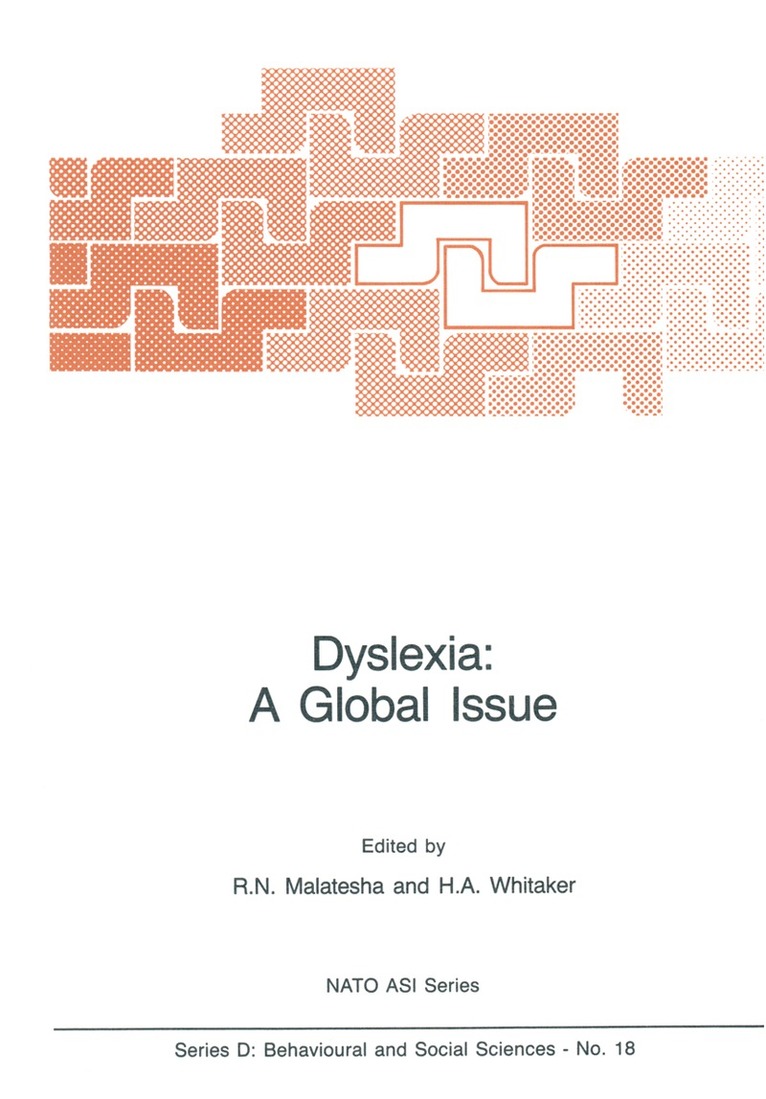
    Dyslexia: A Global Issue

    AvRattihalli N. Malatesha,Harry Whitaker

    Häftad, Engelska, 2011

    Del 18 i serien NATO Science Series D:

    562 kr

    Beställningsvara. Skickas inom 10-15 vardagar. Fri frakt över 249 kr.

    Beskrivning

    Reading is cne of the highest farns of aa;ru:i. red oogni ti ve func- tioos. It cares as no sw:prise, therefore, that the study of reeding has attracted nmerous investigators who, in spite of their diverse background, have been notivated by cne ultimate goal --to understand how we read and how we learn to reed. A s\bstantial prQIX)rticn of these investigators have attenpted to gain knowled~ about the neuro- p:;ychological processes that 1mderlie the reading process by studying individuals who fail to acquire reading skill (developtental dyslexia) and individuals wOO aa;IUire a reading deficit as a result of brain pathology (alexia~ aa;IUired dyslexia). OVer the years, these two sources, using different tedmiqll3S and nethods, have yielded a good deal of infonration. Unfortunately, the enpirical findings that have been c:btained under these two circunstances have, to a lar~ extent, failed to influence the other. Bringing these two approaches (developtental dyslexia and aCXIUired alexia) t~ther, therefore, remains a top priority.With a view towards bringing these two disciplines together, the Scientific Affairs Divisioo of the North Atlantic Treaty Organi- zation (NAro) cwarded us a grant to ccnduct an Advanced Stuly Institute (ASI) in Maratea, Italy, from Octc:ber 10-22, 1982. '!his volure is the result of that Institute. The book is divided into four parts: developtental reading and spelling disorders, acquired alexia, diagnosis and reI'lEdiation, and research :inplications.

    Produktinformation

    • Utgivningsdatum:2011-11-03
    • Mått:170 x 244 x 33 mm
    • Vikt:1 027 g
    • Format:Häftad
    • Språk:Engelska
    • Serie:NATO Science Series D:
    • Antal sidor:599
    • Upplaga:1984
    • Förlag:Springer
    • ISBN:9789400969315

    Utforska kategorier

    • Språkvetenskap och lingvistik inom Språk och ordböcker
    • Neurologi och klinisk neurofysiologi inom Medicin

    Innehållsförteckning

    • One.- 1. The three phases of developmental dyslexia.- 2. Toward a rational taxonomy of the developmental dyslexias.- 3. Classification issues in subtype research: An application of some methods and concepts.- 4. Specific spelling problems.- 5. Neuropsychological perspectives on reading and developmental reading disability.- 6. In search of the core of dyslexia: Analysis of the reading process of dyslectic children.- 7. Developmental surface dyslexia in Italian.- 8. Developmental analogues to acquired phonological dyslexia.- 9. Letter naming as a spelling strategy.- 10. Temporal order perception and lateralization in dyslexic children.- 11. Eye movements in developmental dyslexia.- 12. Visual half-field studies of developmental reading disability.- Two.- 13. Alexia in relation to aphasia and agnosia.- 14. Toward a rational taxonony of acquired dyslexias.- 15. Word-recognition and word-production: data from pathology.- 16. Comments on pathological reading behavior due to lesions of the left hemisphere.- 17. Consistency and types of semantic errors in a deep dyslexic patient.- 18. Phonological dyslexia: A review.- 19. Acquired dyslexias and normal reading.- Three.- 20. Neuropsychological assessment of children and adults with developmental dyslexia.- 21. A diagnostic screening test for subtypes of dyslexia: The Boder test of reading-spelling patterns.- 22. Dyslexia: A diagnostic profile for a “special educational need”.- 23. An experimental study of multi-sensory teaching with normal and retarded readers.- 24. Instructing learning disabled children to make continued and general use of a strategy for memorizing information Margaret Jo Shepherd and Lynn.- 25. Dyslexia Diagnosis and treatment from the perspective of a reading specialist.- Four.- 26. Dyslexia inbilinguals.- 27. Hemispheric specialization and dual coding of alphabet.- 28. The importance of grapheme-to-phoneme conversion rules in beginning readers.- 29. Hyperlexia: Developmental reading without meaning.- 30. Interhemispheric integration of conflicting information by a split-brain man.- 31. The use of adult acquired neuropsychological syndromes as models of childhood developmental disorders.- 32. On the use of word and context based information sources evaluated by oral reading error analysis.- 33. Differences in levels of processing related to age.- 34. Information value of print size on reading performance.