• Fri frakt över 249 kr
  • •
  • Snabba leveranser
  • •
  • Billiga böcker
Kundservice

Du är på sajten för privatpersoner.

Företag, bibliotek eller offentlig verksamhet?

Du handlar på classic.bokus.com, där alla dina funktioner finns intakta.
Till classic.bokus.com
Bokus logotyp. Gå till startsidan.
  • Erbjudanden
  • Nyheter
  • Student
  • Topplistor
  • Barn & ungdom
  • Bokus Play
  • E-böcker
  • Pocketböcker
  • Spel & pussel

10% rabatt på allt med kod: NYSTART10 →

Sidfot

Mina sidor

    Hjälp

    • Kundservice
    • Vanliga frågor och svar
    • Frakt och leverans
    • Retur vid ångerrätt
    • Reklamera vara
    • Betalning
    • Köpvillkor
    • Allmänna villkor
    • Information om webbplatsens tillgänglighet

    Om Bokus

    • Om oss
    • Pressrum
    • För studenter
    • För företag
    • För bibliotek och offentlig verksamhet
    • För leverantörer
    • Hållbarhet

    Populärt

    • Aktuella erbjudanden
    • Presentkort
    • Studentlitteratur
    • Nya böcker
    • Topplistor
    • Signerade böcker
    • Engelska böcker

    Inspiration

    • Boktips
    • BookTok
    • Populära bokserier
    • Barnbokskaraktärer
    • Populära författare
    Logotyp för Bokus
    Följ oss på Facebook (extern länk)Följ oss på Instagram (extern länk)Följ oss på YouTube (extern länk)Följ oss på TikTok (extern länk)
    bokus @ CookiesAnpassa cookiesIntegritetspolicyKöpvillkor
    Till Citymail hemsida (extern länk)Till Budbee hemsida (extern länk)Till Postnord hemsida (extern länk)Till Schenker hemsida (extern länk)Till Early Bird hemsida (extern länk)Till Walleys hemsida (extern länk)
    1. Filosofi och religion
    2. Filosofi
    3. Filosofiska discipliner

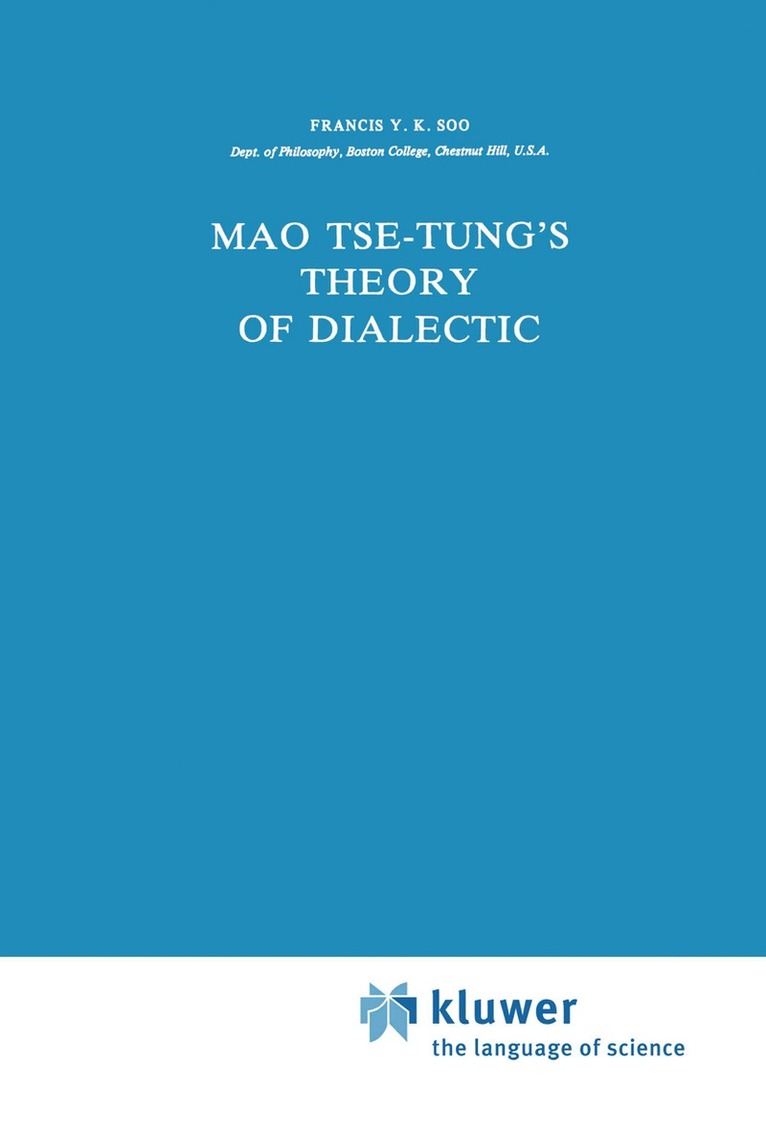
    Mao Tse-Tung’s Theory of Dialectic

    AvF.Y.K. Soo

    Häftad, Engelska, 2011

    Del 44 i serien Sovietica

    1 626 kr

    Beställningsvara. Skickas inom 10-15 vardagar. Fri frakt över 249 kr.

    Fler format och utgåvor

    Inbunden

    1 626 kr

    E-bok

    2 044 kr

    Beskrivning

    The year 1979 ushered in a new phase in China's long and continuous revolu­ tion. Currently, this new phase is being symbolically referred to, by the Chinese leaders themselves, as the 'New Long March' (a continuation of the legendary and historical Long March) in terms of modernization, which comprises the Four Modernizations: Agriculture, Industry, Science and Technology, and Military Defense. Such an all-encompassing attempt at modernization may appear, to some at least, to be something new, or may indicate a radical shift in her policy. But upon closer examination, this decision seems only to reflect an historical continuity in terms of the two major long-term goals of the Chinese Revolution: 'national independence' and 'modernization' (or 'industrialization'). The former would make China strong; the latter, wealthy. For, ever since the Opium War in 1840 and throughout the Revolutions of 1911 and 1949, China has always pursued these two revolutionary goals, though with different emphases at different times. This has been especially true during the past three decades as this twofold goal has dictated all of China's important policies, both domestic and foreign. In other words, while the concrete policies may have appeared to be lacking in unity at times, they have been formulated with the specific intent of achieving national independence and modernization. From this perspective, the New Long March marks the passage of post-Mao China beyond the transition of succession toward the continued pursuit of the same revolutionary goals.

    Produktinformation

    • Utgivningsdatum:2011-10-19
    • Mått:152 x 223 x 12 mm
    • Vikt:312 g
    • Format:Häftad
    • Språk:Engelska
    • Serie:Sovietica
    • Antal sidor:196
    • Förlag:Springer
    • ISBN:9789400983915

    Utforska kategorier

    • Filosofiska discipliner inom Filosofi och religion

    Innehållsförteckning

    • The Purpose of the Study.- Methodology of the Study.- A Note on Sources.- Organization of the Study.- 1 / Mao Tse-Tung: The Man and His Time.- 1.1. Historical Perspective.- 1.2. Mao Tse-tung: The Man.- 2 / Mao’s Methodology and Point of Departure.- 2.1. Textual Basis.- 2.2. Mao’s Methodology.- 2.3. Mao’s Point of Departure.- 3 / Mao’s Theory of Dialectic.- 3.1. The Concept of Contradiction.- 3.2. The Universality of Contradiction.- 3.3. The Particularity of Contradiction.- 3.4. The Dialectic of Contradiction.- 4 / On Mao’s Methodology.- 4.1. The Method of Chinese Philosophy.- 4.2. On Mao’s Synthetic Praxis.- 5 / A Philosophical Critique of Contradiction.- 5.1. ‘Dialectical Ideas’ in Chinese Thought.- 5.2. A Critique of Contradiction as a Philosophical Term.- 6 / A Philosophical Analysis of Mao’s Theory of Dialectic.- 6.1. Universality.- 6.2. Particularity.- 6.3. Dialectic.- 6.4. A Related Question.- Conclusion.- Notes.