• Fri frakt över 249 kr
  • •
  • Snabba leveranser
  • •
  • Billiga böcker
Kundservice

Du är på sajten för privatpersoner.

Företag, bibliotek eller offentlig verksamhet?

Du handlar på classic.bokus.com, där alla dina funktioner finns intakta.
Till classic.bokus.com
Bokus logotyp. Gå till startsidan.
  • Erbjudanden
  • Nyheter
  • Student
  • Topplistor
  • Barn & ungdom
  • Bokus Play
  • E-böcker
  • Pocketböcker
  • Spel & pussel

10% rabatt på allt med kod: NYSTART10 →

Sidfot

Mina sidor

    Hjälp

    • Kundservice
    • Vanliga frågor och svar
    • Frakt och leverans
    • Retur vid ångerrätt
    • Reklamera vara
    • Betalning
    • Köpvillkor
    • Allmänna villkor
    • Information om webbplatsens tillgänglighet

    Om Bokus

    • Om oss
    • Pressrum
    • För studenter
    • För företag
    • För bibliotek och offentlig verksamhet
    • För leverantörer
    • Hållbarhet

    Populärt

    • Aktuella erbjudanden
    • Presentkort
    • Studentlitteratur
    • Nya böcker
    • Topplistor
    • Signerade böcker
    • Engelska böcker

    Inspiration

    • Boktips
    • BookTok
    • Populära bokserier
    • Barnbokskaraktärer
    • Populära författare
    Logotyp för Bokus
    Följ oss på Facebook (extern länk)Följ oss på Instagram (extern länk)Följ oss på YouTube (extern länk)Följ oss på TikTok (extern länk)
    bokus @ CookiesAnpassa cookiesIntegritetspolicyKöpvillkor
    Till Citymail hemsida (extern länk)Till Budbee hemsida (extern länk)Till Postnord hemsida (extern länk)Till Schenker hemsida (extern länk)Till Early Bird hemsida (extern länk)Till Walleys hemsida (extern länk)
    1. Naturvetenskap och teknik
    2. Matematik och naturvetenskap
    3. Astronomi

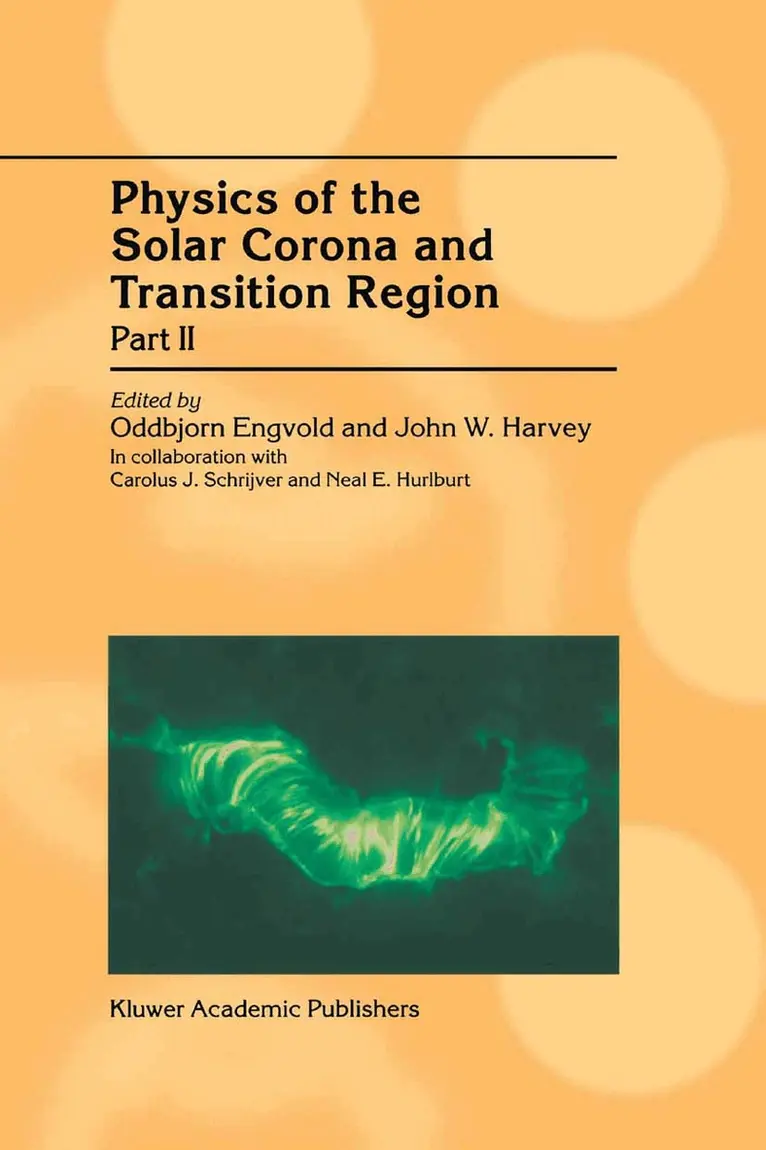
    Physics of the Solar Corona and Transition Region

    Part II Proceedings of the Monterey Workshop, held in Monterey, California, August 1999

    AvOddbjorn Engvold,John W. Harvey

    Häftad, Engelska, 2012

    2 165 kr

    Beställningsvara. Skickas inom 10-15 vardagar. Fri frakt över 249 kr.

    Beskrivning

    Solar Physics publishes up to two TopicalIssues per year that focus on areas of especially vigorousand activeresearch. The present TopicalIssue containspapers of recent results on the solar corona, as well as on the transition region and low solar wind. The majority of these papers, which were all refereed in accordance withthe standards of Solar Physics, werepresentedin August 1999at a workshop heldin Monterey, California. TheSun's magneticfieldis responsibleforthe spectacularly dynamicand intri- cate phenomenonthat we call the corona. The past decade has seen an enormous increase in our understanding of this part of the solar outer atmosphere, both as a result of observations and because of rapid advances in numerical studies.The Yohkoh satellitehasobservedthe Sun nowfor overeightyears, producingspectac- ular sequences of images that conveythe complexity of the corona. The imaging andspectroscopic instrumentsonSOHOhaveaddedinformationonthecoolerpart of the corona. Andsince April of 1998TRACEhas givenus very high resolution imagesof the 1-2 MKcorona, atcadencesthat allowdetailedobservations of field oscillations, loopevolution, mass ejecta, etc.The papers of thisTopicalIssue revolvearoundone keytheme:the entire outer atmosphereof the Sun is intrinsicallydynamic, evolvingso rapidly that even the concept of a single local temperaturefor a single fluid often breaks down. More- over, the corona is an intrinsicallynonlinearand non-localmedium.These aspects are discussedin thisTopicalIssue, includingboth papers that reviewrecentdevel- opments(both basedon observations and on theoretical/numerical modeling), and original research papers based on observations from many different observatories. Weareverygratefulto the manyrefereeswhoweregivenlittletimeto respond, andto the staffofKluwerfor theproductionofthetopicalissuesandtheirreprints. Thepapers acceptedforthisTopicalIssueadduptosuchavolumethattheyhaveto be distributedovertwo TopicalIssues of SolarPhysics (December 1999and April 2000),which are reprintedin two bound volumes, of whichthis is the second.

    Produktinformation

    • Utgivningsdatum:2012-10-04
    • Mått:155 x 235 x 22 mm
    • Vikt:604 g
    • Format:Häftad
    • Språk:Engelska
    • Antal sidor:392
    • Upplaga:2001
    • Förlag:Springer
    • ISBN:9789401038461

    Utforska kategorier

    • Astronomi inom Naturvetenskap och teknik
    • Tillämpad fysik inom Naturvetenskap och teknik

    Innehållsförteckning

    • Three-Dimensional Separator Reconnection — How Does It Occur?.- The Structure of Force-Free Magnetic Fields.- Models of Dynamic Coronal Loops.- Cross-Sectional Properties of Coronal Loops.- Width Variations along Coronal Loops Observed by TRACE.- How Accurately Can We Determine the Coronal Heating Mechanism in the Large-Scale Solar Corona?.- SERTS-97 Measurements of Relative Wavelength Shifts in Coronal Emission Lines across a Solar Active Region.- Modeling Coronal Loop Abundances: Effects of Parameter Variations on Observables.- Waves and Oscillations in the Corona.- Can Gravitational Effects Damp Alfvén Waves?.- Observations of the 24 September 1997 Coronal Flare Waves.- Structure of a Large Low-Latitude Coronal Hole.- Electro-Mechanical Coupling between the Photosphere and Transition Region.- The Magnetic Connectivity of Moss Regions.- Magnetic Activity Associated with Radio Noise Storms.- A Kinetic Model of Coronal Heating and Acceleration by Ion-Cyclotron Waves; Preliminary Results.- SECIS: The Solar Eclipse Coronal Eclipse Imaging System.- The SOHO-Stellar Connection.- New Boundary Integral Equation Representation for Finite Energy Force-Free Magnetic Fields in Open Space above the Sun.- Synoptic Maps of Solar Wind; Comparison of IPS Data and the NOAA/SEC Version of the Wang and Sheeley Model.- Topology of Magnetic Field and Coronal Hearing in Solar Active Regions. II. The Role of Quasi-Separatrix Layers.- Recent Theoretical Results on Coronal Heating.- MACS for Global Measurement of the Solar Wind Velocity and the Thermal Electton Temperature during the Total Solar Eclipse on 11 August 1999.- Multi-Wavelength Observations of the 1998 September 27 Flare Spray.