• Fri frakt över 249 kr
  • •
  • Snabba leveranser
  • •
  • Billiga böcker
Kundservice

Du är på sajten för privatpersoner.

Företag, bibliotek eller offentlig verksamhet?

Du handlar på classic.bokus.com, där alla dina funktioner finns intakta.
Till classic.bokus.com
Bokus logotyp. Gå till startsidan.
  • Erbjudanden
  • Nyheter
  • Student
  • Topplistor
  • Barn & ungdom
  • Bokus Play
  • E-böcker
  • Pocketböcker
  • Spel & pussel

10% rabatt på allt med kod NYSTART10 →

Sidfot

Mina sidor

    Hjälp

    • Kundservice
    • Vanliga frågor och svar
    • Frakt och leverans
    • Retur vid ångerrätt
    • Reklamera vara
    • Betalning
    • Köpvillkor
    • Allmänna villkor
    • Information om webbplatsens tillgänglighet

    Om Bokus

    • Om oss
    • Pressrum
    • För studenter
    • För företag
    • För bibliotek och offentlig verksamhet
    • För leverantörer
    • Hållbarhet

    Populärt

    • Aktuella erbjudanden
    • Presentkort
    • Studentlitteratur
    • Nya böcker
    • Topplistor
    • Signerade böcker
    • Engelska böcker

    Inspiration

    • Boktips
    • BookTok
    • Populära bokserier
    • Barnbokskaraktärer
    • Populära författare
    Logotyp för Bokus
    Följ oss på Facebook (extern länk)Följ oss på Instagram (extern länk)Följ oss på YouTube (extern länk)Följ oss på TikTok (extern länk)
    bokus @ CookiesAnpassa cookiesIntegritetspolicyKöpvillkor
    Till Citymail hemsida (extern länk)Till Budbee hemsida (extern länk)Till Postnord hemsida (extern länk)Till Schenker hemsida (extern länk)Till Early Bird hemsida (extern länk)Till Walleys hemsida (extern länk)
    1. Naturvetenskap och teknik
    2. Teknik och industri
    3. Biokemisk teknik

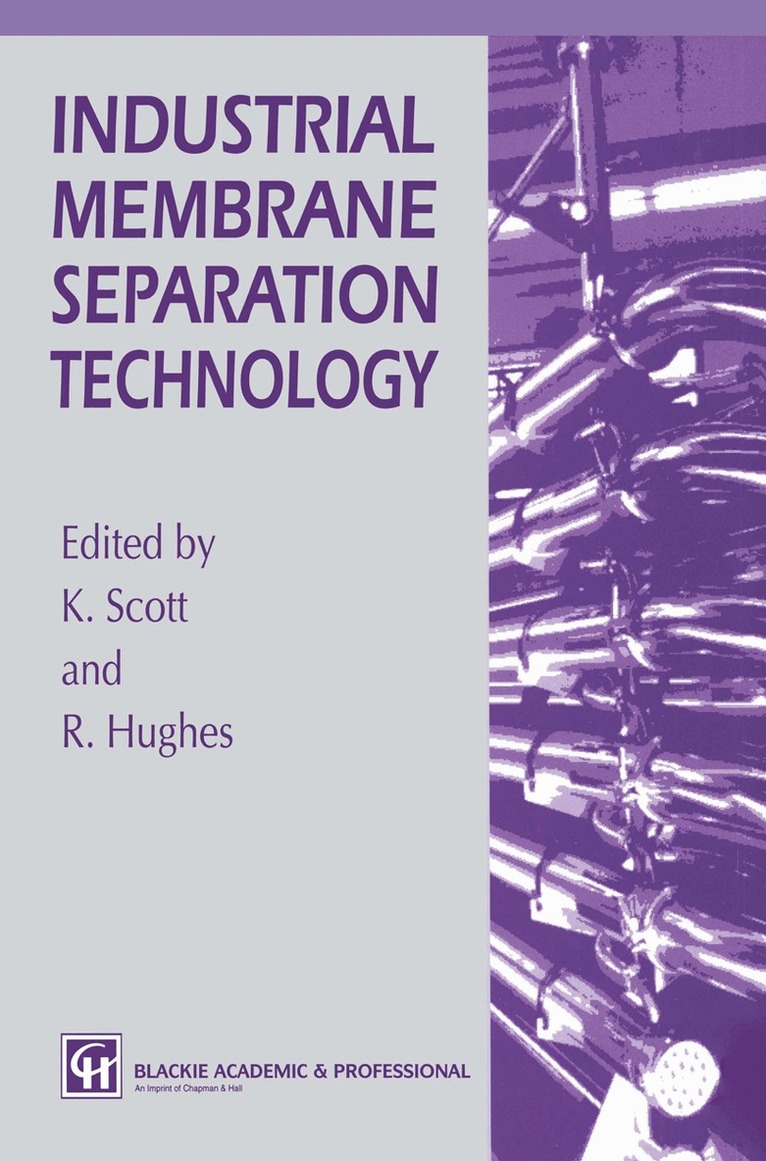
    Industrial Membrane Separation Technology

    AvK. Scott,R. Hughes

    Häftad, Engelska, 2012

    4 856 kr

    Beställningsvara. Skickas inom 10-15 vardagar. Fri frakt över 249 kr.

    Fler format och utgåvor

    Inbunden

    4 856 kr

    Beskrivning

    Membrane science and technology is an expanding field and has become a prominent part of many activities within the process industries. It is relatively easy to identify the success stories of membranes such as desali­ nation and microfiltration and to refer to others as developing areas. This, however, does not do justice to the wide field of separations in which membranes are used. No other 'single' process offers the same potential and versatility as that of membranes. The word separation classically conjures up a model of removing one component or species from a second component, for example a mass transfer process such as distillation. In the field of synthetic membranes, the terminology 'separation' is used in a wider context. A range of separations of the chemical/mass transfer type have developed around the use of membranes including distillation, extraction, absorption, adsorption and stripping, as well as separations of the physical type such as filtration. Synthetic membranes are an integral part of devices for analysis, energy generation and reactors (cells) in the electrochemical industry.

    Produktinformation

    • Utgivningsdatum:2012-09-18
    • Mått:155 x 235 x 18 mm
    • Vikt:493 g
    • Format:Häftad
    • Språk:Engelska
    • Antal sidor:305
    • Upplaga:1996
    • Förlag:Springer
    • ISBN:9789401042741

    Utforska kategorier

    • Biokemisk teknik inom Naturvetenskap och teknik

    Innehållsförteckning

    • 1 Introduction to industrial membrane processes.- 1.1 Introduction.- 1.2 Membrane classification.- 1.3 Conclusions.- 2 Overview of the application of synthetic membrane processes.- 2.1 Classification of membrane separation processes.- 2.2 Membrane processes.- 2.3 Other applications of membranes.- 2.4 Conclusions.- 3 Membrane equipment and plant design.- 3.1 Introduction.- 3.2 Membrane materials.- 3.3 Membrane format and modules.- 3.4 Plant design.- References.- 4 Mass transport and the design of membrane systems.- 4.1 Introduction.- 4.2 Elements of transport phenomena.- 4.3 Fouling and its amelioration.- 4.4 Process design of membrane systems.- References.- 5 Applications in gas and vapour phase separations.- List of symbols.- 5.1 Gas separation.- 5.2 Gas transport through porous membranes.- 5.3 Non-porous membranes.- 5.4 Single-stage permeators and separation factor.- 5.5 Applications of membranes for separation of gases.- 5.6 Operating schemes.- 5.7 Permeator design.- 5.8 Pervaporation.- References.- 6 Applications of cross-flow membrane processes.- 6.1 Introduction.- 6.2 Potable water treatment.- 6.3 Process water treatment.- 6.4 Process applications.- 6.5 Waste water treatment.- 7 Ion-exchange and charge driven processes.- Notation.- 7.1 Electrochemical separators for cells.- 7.2 Membrane and diaphragm materials.- 7.3 Semi-permeable membranes: ion-exchange embranes.- 7.4 Preparation of ion-exchange membranes.- 7.5 Transport in membranes and diaphragms.- 7.6 Membranes in electrolytic cells and fuel cells.- 7.7 Electrodialysis.- 7.8 Electrodialysis cells.- 7.9 Cell stack performance.- 7.10 Polarisation.- 7.11 Membranes and cell design.- 7.12 Applications of electrodialysis.- 7.13 Diffusion dialysis.- 7.14 Salt solution regeneration, recycling and effluent treatment.-7.15 Bipolar membranes.- 7.16 Other membrane processes.- 7.17 Direct membrane cleaning.- 7.18 Electrochemically enhanced cross-flow filtration.- 7.19 Electrochemical membrane gas separations.- 7.20 Electrochemical ion-exchange.- References.- 8 Liquid membranes.- 8.1 Double emulsion membranes.- 8.2 Supported liquid membranes.- 8.3 Membrane contactors.- References.- 9 Membrane reactors.- 9.1 Introduction.- 9.2 Catalytic membrane reactors.- 9.3 Operational aspects of catalytic membrane reactors.- References.