• Fri frakt över 249 kr
  • •
  • Snabba leveranser
  • •
  • Billiga böcker
Kundservice

Du är på sajten för privatpersoner.

Företag, bibliotek eller offentlig verksamhet?

Du handlar på classic.bokus.com, där alla dina funktioner finns intakta.
Till classic.bokus.com
Bokus logotyp. Gå till startsidan.
  • Erbjudanden
  • Student
  • Topplistor
  • Barn & ungdom
  • Bokus Play
  • E-böcker
  • Ljudböcker
  • Pocketböcker
  • Spel & pussel

10% rabatt på allt med kod NYSTART10 →

Sidfot

Mina sidor

    Hjälp

    • Kundservice
    • Vanliga frågor och svar
    • Frakt och leverans
    • Retur vid ångerrätt
    • Reklamera vara
    • Betalning
    • Köpvillkor
    • Allmänna villkor
    • Information om webbplatsens tillgänglighet

    Om Bokus

    • Om oss
    • Pressrum
    • För studenter
    • För företag
    • För bibliotek och offentlig verksamhet
    • För leverantörer
    • Hållbarhet

    Populärt

    • Aktuella erbjudanden
    • Presentkort
    • Studentlitteratur
    • Nya böcker
    • Topplistor
    • Signerade böcker
    • Engelska böcker

    Inspiration

    • Boktips
    • BookTok
    • Populära bokserier
    • Barnbokskaraktärer
    • Populära författare
    Logotyp för Bokus
    Följ oss på Facebook (extern länk)Följ oss på Instagram (extern länk)Följ oss på YouTube (extern länk)Följ oss på TikTok (extern länk)
    bokus @ CookiesAnpassa cookiesIntegritetspolicyKöpvillkor
    Till Citymail hemsida (extern länk)Till Budbee hemsida (extern länk)Till Postnord hemsida (extern länk)Till Schenker hemsida (extern länk)Till Early Bird hemsida (extern länk)Till Walleys hemsida (extern länk)
    1. Djur och Natur
    2. Naturböcker
    3. Växtböcker

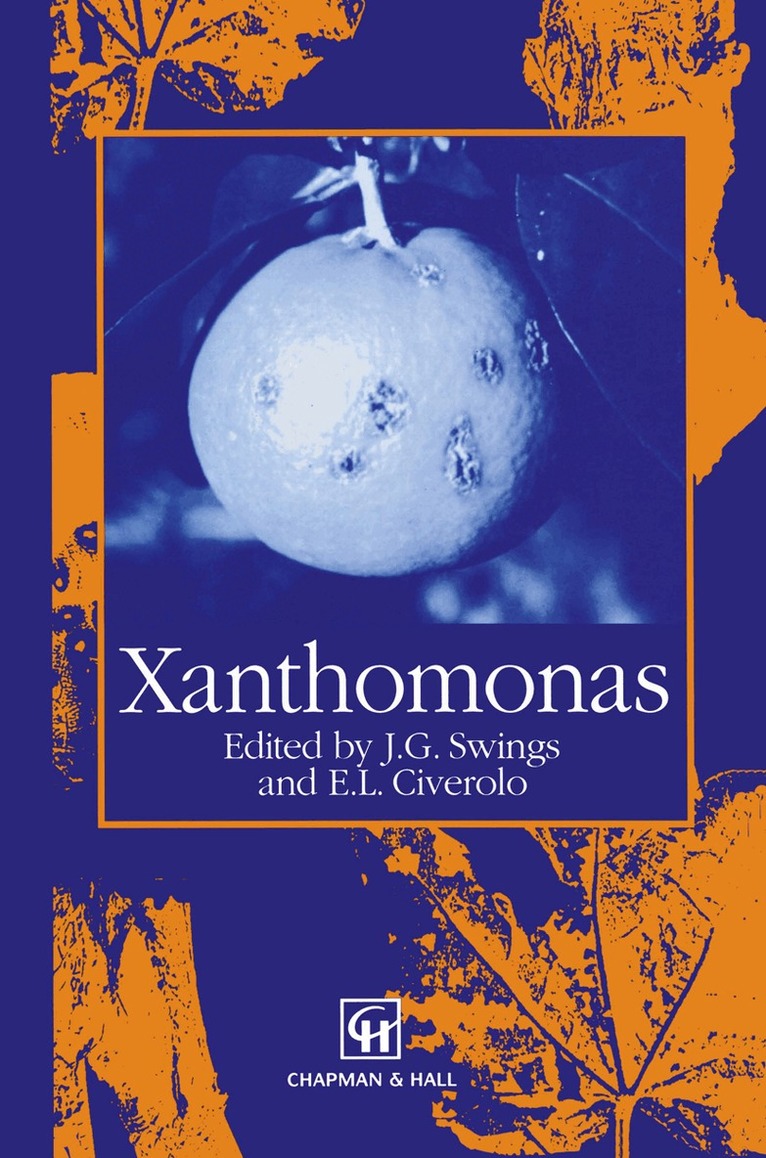
    Xanthomonas

    AvJean Swings,Lucia Civetta

    Häftad, Engelska, 2012

    2 161 kr

    Beställningsvara. Skickas inom 10-15 vardagar. Fri frakt över 249 kr.

    Fler format och utgåvor

    Inbunden

    2 161 kr

    Beskrivning

    5 Table 1.1 Continued Species Hosts Families ~-------- ----- X. campestris pv. cassavae Manihot spp. Euphorbiaceae (Wiehe and Dowson 1953) Maraite and Weyns 1979 Cassia tora, C. occidentalis, Cicer Fabaceae X. campestris pv. cassiae arietinum, Pisum sativum (Kulkarni, Patel and Dhande 1951) Dye 1978 Musaceae X. campestris pv. celebensis Musa spp. (Gaumann 1923) Dye 1978 Apiaceae X. campestris pv. centellae Centella asiatica Basnyat and Kulkarni 1979 X. campestris pv. cerealis Agropyron spp., Avena spp., Poaceae Bromus spp., Hordeum spp., (Hagborg 1942) Dye 1978 Secale cereale, Triticum spp. Aegle marmelos, Atalantia spp., Rutaceae X. campestris pv. citri Balsamocitrus paniculata, (Hasse 1915) Dye 1978 Casimiroa edulis, Chaetospermum glutinosa, Citropsis schweinfurthii, Citrus spp. and hybrids, Clausena lansium, Eremocitrus glauca, Evodia spp., Ferollia sPP" Feroniella spp., Fortunella spp., Hesperethusa crellulata, Limonia spp., Melicope triphylla, Microcitrus spp., Murraya exotica, Paramigyna longipedunculata, Poncirus trifoliata and hybrids, Severina buxifolia, Toddalia asiatica, Zanthoxylum spp.

    Produktinformation

    • Utgivningsdatum:2012-09-20
    • Mått:155 x 235 x 23 mm
    • Vikt:628 g
    • Format:Häftad
    • Språk:Engelska
    • Antal sidor:399
    • Förlag:Springer
    • ISBN:9789401046664

    Utforska kategorier

    • Växtböcker inom Djur och Natur
    • Botanik inom Naturvetenskap och teknik
    • Skogsbruk inom Naturvetenskap och teknik

    Recensioner i media

    '... the final (eighth) chapter by Sutherland provides an invaluable source of information about the synthesis, structure, industrial usage and food applications of the xanthan polymer... very clear and informative... useful general summary tables of vectors and properties of avirulence genes are given... useful discussion... this is a very successful compilation of authoritative and up-to-date reviews, and the editors have achieved a good blend of complementing chapters. The book will be of considerable value for teaching and research... the text will not lose its usefulness quickly.' Trends in Microbiology '... an excellent overview of plant diseases caused by Xanthomonas, and gives an insight into the ecology and biology of this bacterium, as well as into genetic loci playing a role in the interaction with the plant...I believe that this very well-written book will be of great value to advanced students and to experts in both classical and molecular plant pathology, as well as to readers interested in plant-bacterium interactions.' Plant Science

    Innehållsförteckning

    • 1 The hosts of Xanthomonas.- 1.1 Introduction.- 1.2 Xanthomonas campestris pathovars on cassava: cause of bacterial blight and bacterial necrosis.- 1.3 Xanthomonas campestris pv. malvacearum: cause of bacterial blight of cotton.- 1.4 Xanthomonas oryzae pathovars on rice: cause of bacterial blight and bacterial leaf streak.- 1.5 Xanthomonas campestris pv. phaseoli: cause of common bacterial blight of bean.- 1.6 Xanthomonas campestris pv. glycines: cause of bacterial pustule of soybean.- 1.7 Xanthomonas campestris pv. citri: cause of citrus canker.- 1.8 Xanthomonas campestris pv. campestris: cause of black rot of crucifers.- 1.9 Xanthomonas campestris pv. graminis: cause of bacterial wilt of forage grasses.- 1.10 Xanthomonas campestris pv. vesicatoria: cause of bacterial spot of tomato and pepper.- 1.11 Xanthomonas campestris pv. pruni: cause of Prunus bacterial spot.- 1.12 Xanthomonas populi: cause of bacterial canker of poplar.- 1.13 Xanthomonas fragariae: cause of angular leaf spot of strawberry.- 1.14 Xanthomonas albilineans: cause of leaf scald of sugarcane.- 1.15 Xanthomonas campestris pathovars on cereals: cause of leaf streak or black chaff diseases.- 1.16 Xanthomonas campestris pv. pelargonii: cause of bacterial leaf spot and stem rot on Pelargonium spp..- 1.17 Xanthomonas campestris pv. hyacinthi: cause of yellow disease in Hyacinthus.- 1.18 Xanthomonas campestris pv. mangiferaeindicae: cause of bacterial black spot of mangoes.- References.- 2 The bacterium Xanthomonas.- 2.1 Introduction.- 2.2 The cell.- 2.3 Growth characteristics.- 2.4 Physiology and metabolism.- References.- 3 Taxonomy of the genus Xanthomonas.- 3.1 Introduction.- 3.2 Current status of the taxonomy of Xanthomonas.- 3.3 Phenetic basis of the taxonomy of Xanthomonas.- 3.4 Genetic basis of the classification.- 3.5 Perspectives for an improved taxonomy of Xanthomonas.- References.- 4 Infection of the plant by Xanthomonas.- 4.1 Epiphytic growth.- 4.2 Penetration.- 4.3 Initial events in pathogenesis.- 4.4 Multiplication and spread in the plant.- 4.5 Pathological manifestation.- 4.6 Bacterial determinants for virulence and/or pathogenicity.- 4.7 Plant-resistant reactions to xanthomonads.- 4.8 Effects of the environment.- References.- 5 Ecology of plant pathogenic xanthomonads.- 5.1 Introduction.- 5.2 Climatic conditions favourable for Xanthomonas.- 5.3 Life cycle.- 5.4 Epidemic development.- 5.5 Quantitative epidemiology.- References.- 6 Genetics of Xanthomonas.- 6.1 Introduction.- 6.2 Methodology.- 6.3 Properties of the Xanthomonas genome.- 6.4 Genes which are important for pathogenicity.- 6.5 The contribution of genetics to the understanding of bacteria-plant interactions.- References.- 7 Management of Xanthomonas diseases.- 7.1 Introduction.- 7.2 Seed health.- 7.3 Cultural practices.- 7.4 Chemical control.- 7.5 Host resistance.- 7.6 Conclusion.- References.- 8 Xanthan.- 8.1 Introduction.- 8.2 Structure of xanthan.- 8.3 Synthesis.- 8.4 Biosynthetic process.- 8.5 Physical properties of xanthan.- 8.6 Industrial usage of xanthan.- 8.7 Food uses of xanthan.- References.