• Fri frakt över 249 kr
  • •
  • Snabba leveranser
  • •
  • Billiga böcker
Kundservice

Du är på sajten för privatpersoner.

Företag, bibliotek eller offentlig verksamhet?

Du handlar på classic.bokus.com, där alla dina funktioner finns intakta.
Till classic.bokus.com
Bokus logotyp. Gå till startsidan.
  • Erbjudanden
  • Nyheter
  • Student
  • Topplistor
  • Barn & ungdom
  • Bokus Play
  • E-böcker
  • Pocketböcker
  • Spel & pussel

10% rabatt på allt med kod NYSTART10 →

Sidfot

Mina sidor

    Hjälp

    • Kundservice
    • Vanliga frågor och svar
    • Frakt och leverans
    • Retur vid ångerrätt
    • Reklamera vara
    • Betalning
    • Köpvillkor
    • Allmänna villkor
    • Information om webbplatsens tillgänglighet

    Om Bokus

    • Om oss
    • Pressrum
    • För studenter
    • För företag
    • För bibliotek och offentlig verksamhet
    • För leverantörer
    • Hållbarhet

    Populärt

    • Aktuella erbjudanden
    • Presentkort
    • Studentlitteratur
    • Nya böcker
    • Topplistor
    • Signerade böcker
    • Engelska böcker

    Inspiration

    • Boktips
    • BookTok
    • Populära bokserier
    • Barnbokskaraktärer
    • Populära författare
    Logotyp för Bokus
    Följ oss på Facebook (extern länk)Följ oss på Instagram (extern länk)Följ oss på YouTube (extern länk)Följ oss på TikTok (extern länk)
    bokus @ CookiesAnpassa cookiesIntegritetspolicyKöpvillkor
    Till Citymail hemsida (extern länk)Till Budbee hemsida (extern länk)Till Postnord hemsida (extern länk)Till Schenker hemsida (extern länk)Till Early Bird hemsida (extern länk)Till Walleys hemsida (extern länk)
    1. Ekonomi och Ledarskap
    2. Nationalekonomi

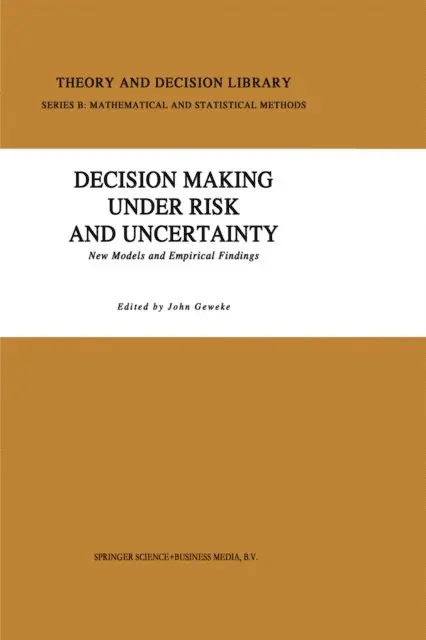
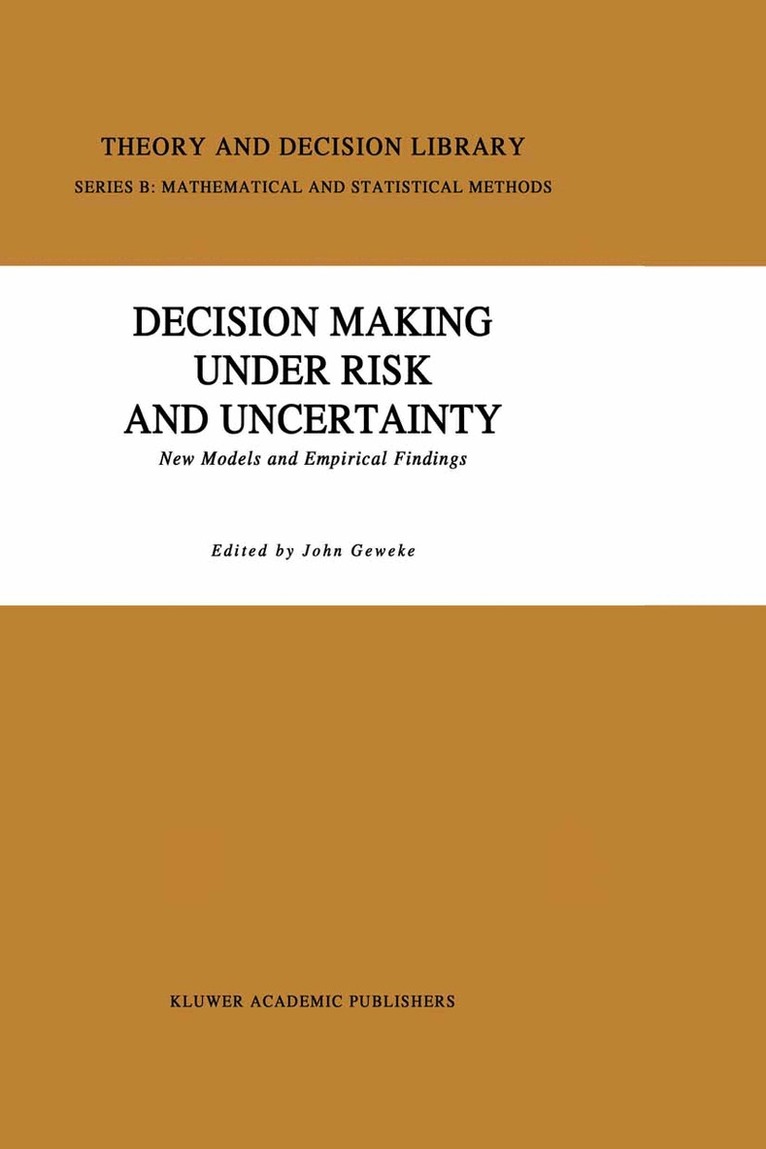
    Decision Making Under Risk and Uncertainty

    New Models and Empirical Findings

    AvJ. Geweke

    Häftad, Engelska, 2012

    Del 22 i serien Theory and Decision Library B

    2 227 kr

    Beställningsvara. Skickas inom 10-15 vardagar. Fri frakt över 249 kr.

    Beskrivning

    As desired, the infonnation demand correspondence is single valued at equilibrium prices. Hence no planner is needed to assign infonnation allocations to individuals. Proposition 4. For any given infonnation price system p E . P (F *), almost every a E A demands a unique combined infonnation structure (although traders may be indifferent among partial infonnation sales from different information allocations, etc. ). In particular, the aggregate excess demand correspondence for net combined infonnation trades is a continuous function. Proof Uniqueness fails only if an agent can obtain the same expected utility from two or more net combined infonnation allocations. If this happens, appropriate slight perturbations of personal probability vectors destroy the equality unless the utility functions and wealth allocations were independent across states. Yet, when utilities and wealths don't depend on states in S, no infonnation to distinguish the states is desired, so that the demand for such infonnation structures must equal zero. To show the second claim, recall that if the correspondence is single valued for almost every agent, then its integral is also single valued. Finally, note that an upper hemicontinuous (by Proposition 2) correspondence which is single valued everywhere is, in fact, a continuous function. [] REFERENCES Allen, Beth (1986a). "The Demand for (Differentiated) Infonnation"; Review of Economic Studies. 53. (311-323). Allen, Beth (1986b). "General Equilibrium with Infonnation Sales"; Theory and Decision. 21. (1-33). Allen, Beth (1990). "Infonnation as an Economic Commodity"; American Economic Review. 80. (268-273).

    Produktinformation

    • Utgivningsdatum:2012-10-04
    • Mått:160 x 240 x 16 mm
    • Vikt:446 g
    • Format:Häftad
    • Språk:Engelska
    • Serie:Theory and Decision Library B
    • Antal sidor:262
    • Förlag:Springer
    • ISBN:9789401052610

    Utforska kategorier

    • Nationalekonomi inom Ekonomi och Ledarskap
    • Ledarskap och motivation inom Ekonomi och Ledarskap
    • Företagsekonomi inom Ekonomi och Ledarskap

    Innehållsförteckning

    • I. Expected Utility Theory: Extensions.- Nontransitive Preferences and Normative Decision Theory.- Healthy Scepticism as an Expected-Utility Evolution of the Ellsberg Paradox.- Intertemporal Risk-Aversion and Calibration Uncertainty May Explain Violations of the Independence Axiom.- Decision Versus Policy: An Expected Utility Resolution of the Ellsberg Paradox.- Comparative Statics for Endogenous Risk.- Deterministic Transformations: Some Comparative Statistics Results.- Defining the Mean-Preserving Spread: 3-PT Versus 4-PT.- II. Expected Utility Theory: Alternatives.- A Descriptive Model and a Decision Technique.- Risk Aversion Measures with Expected and Non-Expected Utility.- Linear Lexicographic State-Depended Utility.- On the Foundations of Decision Making Under Partial Information.- The Bayesian Model of Conditional Preference and Trade Under Uncertainty.- Consumption Style as Choice Under Risk Static Choice, Dynamic Irrationality and Crimes of Passion.- III. Evidence from Experiments.- The Effect of Explicit Probability Estimates on Violations of Subjective Expected Utility Theory in the Allais Paradox.- Testing Alternative Representations of Behavior Under Uncertainty.- Generic Utility: Measurements of Risk Functions and their Robustness.- Studies on Judgmental Probability Forecasting.- Risk Attitude, Strength of Preference and Relative Risk Attitude: An Assessment with Multiple Indicators.- IV. Information, Learning and Equilibrium.- A Simple Model of Partial Information Exchange Among Individuals with Different Subjective Probabilities.- Tests for a Reservation Wage Effect.- Market Uncertainty and Belief Formation with a Finite Number of Events.- Arbitrage, Rationality, and Equilibrium.- Adaptive Behavior in Games.- An Experimental Investigation of Focal Pointsin Coordination and Bargaining: Some Preliminary Results.- Some Versions of Newcomb’s Problem are Prisoners’ Dilemmas.- Foundations for the Theory of Rational Choice with Vague Priors.- Public Knowledge About Indoor Radon: The Effects of Risk Communication.- Risk Perceptions and Risk Taking in the Presence of Multiple Risks.