• Fri frakt över 249 kr
  • •
  • Snabba leveranser
  • •
  • Billiga böcker
Kundservice

Du är på sajten för privatpersoner.

Företag, bibliotek eller offentlig verksamhet?

Du handlar på classic.bokus.com, där alla dina funktioner finns intakta.
Till classic.bokus.com
Bokus logotyp. Gå till startsidan.
  • Erbjudanden
  • Student
  • Topplistor
  • Barn & ungdom
  • Bokus Play
  • E-böcker
  • Ljudböcker
  • Pocketböcker
  • Spel och pussel

5% studentrabatt – använd koden KURSBOK27 →

Sidfot

Mina sidor

    Hjälp

    • Kundservice
    • Vanliga frågor och svar
    • Frakt och leverans
    • Retur vid ångerrätt
    • Reklamera vara
    • Betalning
    • Köpvillkor
    • Allmänna villkor
    • Information om webbplatsens tillgänglighet

    Om Bokus

    • Om oss
    • Pressrum
    • För studenter
    • För företag
    • För bibliotek och offentlig verksamhet
    • För leverantörer
    • Hållbarhet

    Populärt

    • Aktuella erbjudanden
    • Presentkort
    • Studentlitteratur
    • Nya böcker
    • Topplistor
    • Signerade böcker
    • Engelska böcker

    Inspiration

    • Boktips
    • BookTok
    • Barnbokskaraktärer
    • Populära författare
    Logotyp för Bokus
    Följ oss på Facebook (extern länk)Följ oss på Instagram (extern länk)Följ oss på YouTube (extern länk)Följ oss på TikTok (extern länk)
    bokus @ CookiesAnpassa cookiesIntegritetspolicyKöpvillkor
    Till Citymail hemsida (extern länk)Till Budbee hemsida (extern länk)Till Postnord hemsida (extern länk)Till Schenker hemsida (extern länk)Till Early Bird hemsida (extern länk)Till Walleys hemsida (extern länk)
    1. Medicin
    2. Kirurgi
    3. Transplantationskirurgi

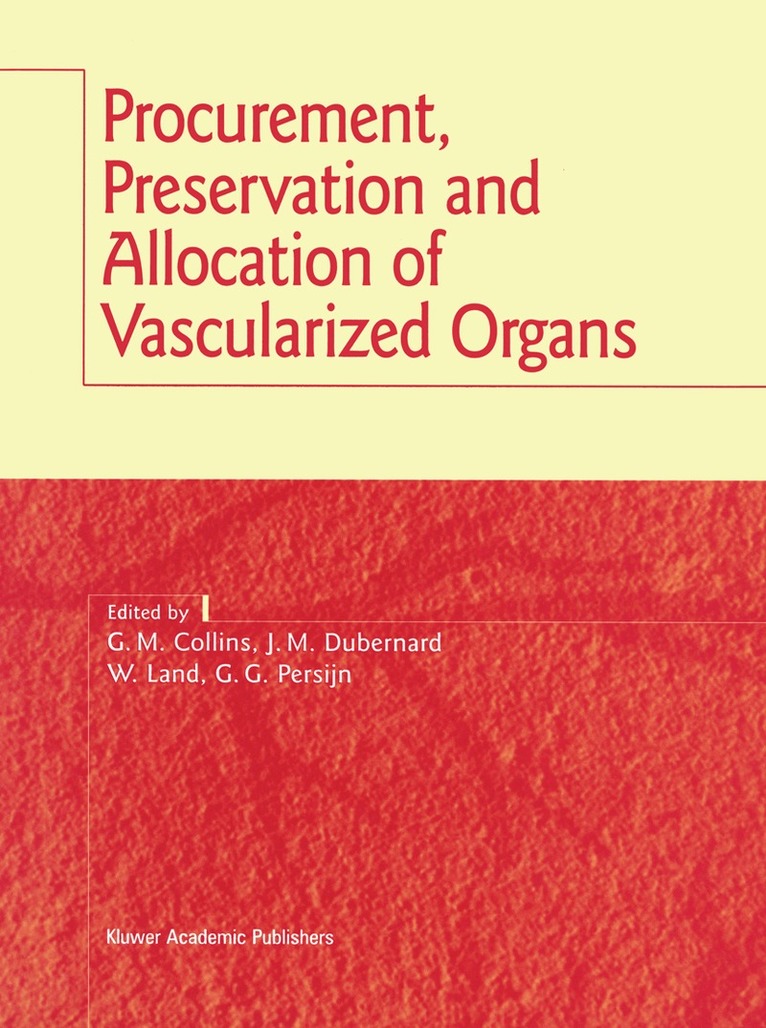
    Procurement, Preservation and Allocation of Vascularized Organs

    AvG.M. Collins,J.-M. Dubernard

    Häftad, Engelska, 2012

    559 kr

    Beställningsvara. Skickas inom 10-15 vardagar. Fri frakt över 249 kr.

    Beskrivning

    At the brink of the third millennium organ transplanta­ mati on how, in the case of shortage, a fair allocation of tion will become routine and the results will be so ex­ the scarce organs can be achieved. This is a very cellent that every patient in need of a transplant timely subject that continues to be discussed between deserves to be transplanted. How to provide every doctors and between laymen. patient with his or her organ and how to guarantee This book serves the needs of several groups of that the organ is in a superb condition? That is the specialists working with transplant patients. Firstly, the challenge for all of us privileged to work in this doctors who are directly involved in the care of the magnificent field of medicine. multi-organ donor, and who have to collaborate to do In this book, an international team of experts has the best for their recipients. Heart surgeons might like laid down their intellectual knowledge on the process to learn from liver surgeons and vice versa. Secondly, that precedes successful transplantation: Procurement, the paramedical specialist who is involved in the treat­ Preservation and Allocation. In four sections important ment of transplant patients and their families will find aspects of this preamble of the actual transplantation in this book many answers to questions. Students can are dealt with. also use it as a source for general information.

    Produktinformation

    • Utgivningsdatum:2012-11-06
    • Mått:195 x 260 x 22 mm
    • Vikt:841 g
    • Format:Häftad
    • Språk:Engelska
    • Antal sidor:381
    • Förlag:Springer
    • ISBN:9789401062800

    Utforska kategorier

    • Transplantationskirurgi inom Medicin
    • Njurmedicin och nefrologi inom Medicin
    • Klinisk medicin och internmedicin inom Medicin

    Innehållsförteckning

    • Section I: Donor Conditioning and Surgery.- 1 Living kidney donation: preoperative evaluation and preparation for surgery.- 2 Kidney recovery from living related donors.- 3 Anaesthesia and resuscitation of the genetically related living donor in liver transplantation.- 4 Living-related liver transplantation (LRLT).- 5 Diagnosis of brain death.- 6 Selection of multivisceral cadaveric organ donors.- 7 Management of the cadaver donor in the intensive care unit.- 8 Donor conditioning in organ procurement.- 9 Perioperative management of cadaveric donor.- 10 Multiple organ procurement.- 11 The contribution of the non-heart-beating donor to the solution of the shortage of kidneys.- Section II: Organ Preservation.- 12 Biochemistry and cell physiology of organ preservation.- 13 Preservation by simple hypothermia.- 14 Pulsatile preservation in renal transplantation.- 15 Endothelial cell damage and Kupffer cell activation in reperfusion injury to livers stored for transplantation.- 16 Pharmacological agents in organ preservation.- 17 Kidney preservation.- 18 Liver preservation: historical review of preservation techniques.- 19 Heart and lung preservation.- 20 Small bowel preservation.- 21 Pancreas preservation.- Section III: Allocation and Logistics.- 22 Principles of kidney allocation.- 23 Principles of liver allocation in Eurotransplant.- 24 Principles of heart allocation.- 25 Kidney allocation in highly sensitized patients.- 26 Principles of lung allocation.- 27 Organization and logistics in organ exchange.- 28 Costs of transplantation.- 29 The role of the transplant coordinator.- 30 Organ availability in Europe: problems and results.- 31 Donor hospital development in non-university hospitals.- 32 Kidney preservation and graft outcome: Eurotransplant experience.- 33 Primary dysfunction after orthotopic liver transplantation.- 34 Results of intestinal transplantation.- 35 Cardiac transplant survival in relation to preservation.- Section IV: Ethics and Legislation in Organ Donation.- 36 Voluntarism and coercion in living organ donation.- 37 Reimbursement, ‘rewarded gifting’, financial incentives and commercialism in living organ donation.- 38 International legislation in living organ donation.- 39 Psychological aspects in living organ donation.- 40 Brain death.- 41 A survey of religious attitudes towards organ donation and transplantation.- 42 Philosophical arguments for accepting the brain death criterion.- 43 Legal and judicial aspects of postmortem organ donation.- 44 The dilemma of organ allocation: the combination of a therapeutic modality for an ill individual with the distribution of a scarce valuable public (health) good.- 45 Living unrelated kidney transplantation.