• Fri frakt över 249 kr
  • •
  • Snabba leveranser
  • •
  • Billiga böcker
Kundservice

Du är på sajten för privatpersoner.

Företag, bibliotek eller offentlig verksamhet?

Du handlar på classic.bokus.com, där alla dina funktioner finns intakta.
Till classic.bokus.com
Bokus logotyp. Gå till startsidan.
  • Erbjudanden
  • Nyheter
  • Student
  • Topplistor
  • Barn & ungdom
  • Bokus Play
  • E-böcker
  • Pocketböcker
  • Spel & pussel

10% rabatt på allt med kod: NYSTART10 →

Sidfot

Mina sidor

    Hjälp

    • Kundservice
    • Vanliga frågor och svar
    • Frakt och leverans
    • Retur vid ångerrätt
    • Reklamera vara
    • Betalning
    • Köpvillkor
    • Allmänna villkor
    • Information om webbplatsens tillgänglighet

    Om Bokus

    • Om oss
    • Pressrum
    • För studenter
    • För företag
    • För bibliotek och offentlig verksamhet
    • För leverantörer
    • Hållbarhet

    Populärt

    • Aktuella erbjudanden
    • Presentkort
    • Studentlitteratur
    • Nya böcker
    • Topplistor
    • Signerade böcker
    • Engelska böcker

    Inspiration

    • Boktips
    • BookTok
    • Populära bokserier
    • Barnbokskaraktärer
    • Populära författare
    Logotyp för Bokus
    Följ oss på Facebook (extern länk)Följ oss på Instagram (extern länk)Följ oss på YouTube (extern länk)Följ oss på TikTok (extern länk)
    bokus @ CookiesAnpassa cookiesIntegritetspolicyKöpvillkor
    Till Citymail hemsida (extern länk)Till Budbee hemsida (extern länk)Till Postnord hemsida (extern länk)Till Schenker hemsida (extern länk)Till Early Bird hemsida (extern länk)Till Walleys hemsida (extern länk)
    1. Naturvetenskap och teknik
    2. Geovetenskap
    3. Geovetenskap
    4. Geologi

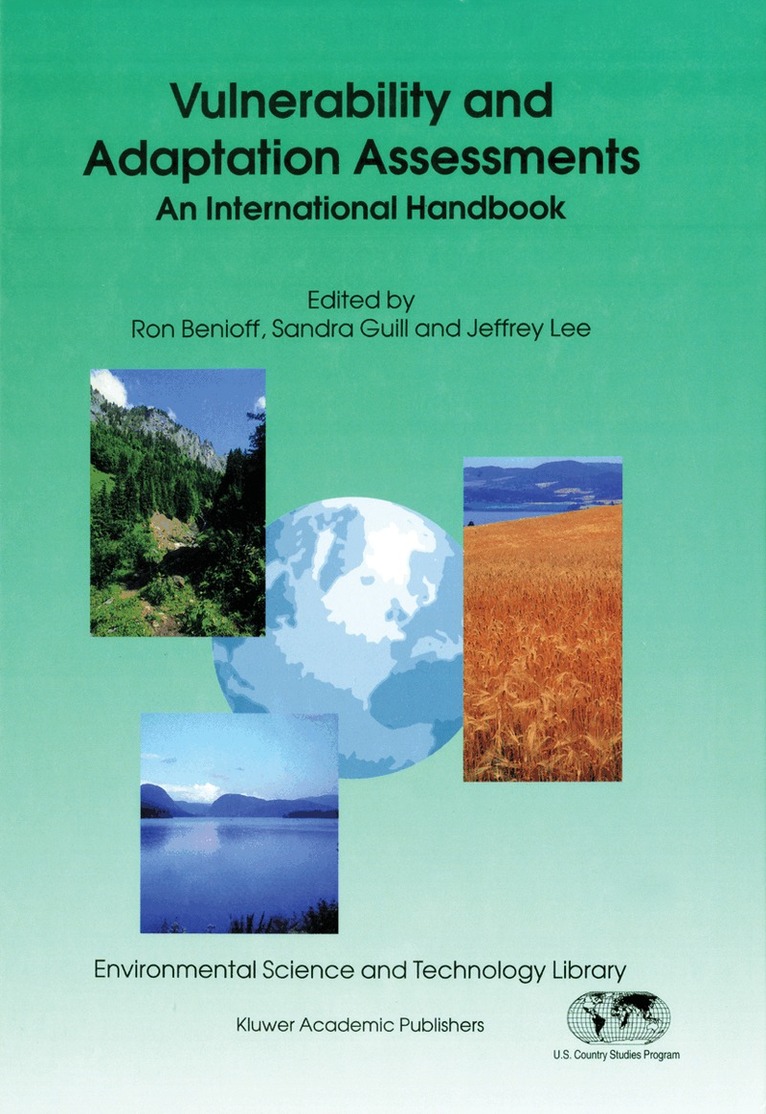
    Vulnerability and Adaptation Assessments

    An International Handbook

    AvRon Benioff,Sandra Guill

    Häftad, Engelska, 2011

    Del i serien Environmental Science and Technology Library

    546 kr

    Beställningsvara. Skickas inom 10-15 vardagar. Fri frakt över 249 kr.

    Beskrivning

    The possible impacts of global climate change on different countries has led to the development and ratification of the Framework Convention on Climate Change (FCCC) and has a strong bearing on the future sustainable development of developing countries and countries with economies in transition. The preparation of analytical methodologies and tools for carrying out assessments of vulnerability and adaptation to climate change is therefore of prime importance to these countries. Such assessments are needed to both fulfill the reporting requirements of the countries under the FCCC as well as to prepare their own climate change adaptation and mitigation plans. The vulnerability and adaptation assessment guidelines prepared by the U.S. Country Studies Program bring together all the latest knowledge and experience from around the world on both vulnerability analysis as well as adaptation methodologies. It is currently being applied successfully by scientists in over fifty countries from all the regions of the globe. This guidance is being published to share it with the wider scientific community interested in global climate change issues. This guidance document has two primary purposes: • To assist countries in making decisions about the scope and methods for their vulnerability and adaptation assessments, • To provide countries with guidance and step-by-step instructions on each of the basic elements of vulnerability and adaptation assessments.

    Produktinformation

    • Utgivningsdatum:2011-10-08
    • Mått:210 x 297 x 32 mm
    • Vikt:1 484 g
    • Format:Häftad
    • Språk:Engelska
    • Serie:Environmental Science and Technology Library
    • Antal sidor:564
    • Förlag:Springer
    • ISBN:9789401066211

    Utforska kategorier

    • Geologi inom Naturvetenskap och teknik
    • Meteorologi och klimatologi inom Naturvetenskap och teknik
    • Kemi inom Naturvetenskap och teknik

    Recensioner i media

    'The book should not be missed by analysts, planners and research workers engaged in studies of vulnerability and adaptation to climate change. However, because of its excellent, condensed, and well-illustrated introduction to each of the different potential impacts of climatic change, it is also of substantial value for trainers and training programmes dealing with these issues.' International Journal of Environment and Pollution, 9:4 (1998)

    Innehållsförteckning

    • 1 U.S. Country Studies Program.- 1.1 Technical Assistance.- 2 Overview of the Vulnerability and Adaptation Assessment Process.- 2.1 Elements of Vulnerability and Adaptation Assessments.- 2.2 Vulnerability and Adaptation Assessment Process.- 3 Defining the Scope of an Assessment.- 3.1 Identify Assessment Goals.- 3.2 Define Sectors to Be Studied.- 3.3 Select the Study Region.- 3.4 Select the Time Frame.- 3.5 Determine Data Needs.- 3.6 Develop the Context for Assessment.- 3.7 Develop a Schedule.- 3.8 References for Section 3.- 4 Defining and Applying Scenarios and Using GCM Data for Vulnerability Assessments.- 4.1 Time Frame.- 4.2 Baseline Scenarios.- 4.3 Climate Change Scenarios.- 4.4 GCM Model and Observed Climate Data.- 5 Conducting Biophysical Impact and Technical Adaptation Assessments.- 5.1 Crop Impact and Adaptation Assessments.- 5.2 Grassland/Livestock Impact and Adaptation Assessments.- 5.3 Forest Impact and Adaptation Assessments.- 5.4 Water Resource Impact and Adaptation Assessments.- 5.5 Coastal Impact and Adaptation Assessment.- 5.6 Soil Erosion Impact and Adaptation Assessments.- 5.7 Human Health Vulnerability Assessment.- 5.8 Fisheries Vulnerability and Adaptation Assessment.- 5.9 Wildlife and Biodiversity Impact and Adaptation Assessment.- 6 Integration of Impact Assessment Results.- 6.1 Integration Approaches.- 6.2 Dealing with Uncertainty.- 7 Assessment of Adaptation Policy Options.- 7.1 Introduction.- 7.2 Goals of the Adaptation Policy Assessments.- 7.3 Necessary Elements of Adaptation Policy Assessments.- 7.4 Primary Approach.- 7.5 References for Section 7.- 8 Documentation and Presentation of Results.- APPENDICES.- APPENDIX A: Baseline Scenarios.- APPENDIX B: Climate Change Scenarios for Vulnerability Assessments.- APPENDIX C: General Circulation Models and Data.- APPENDIX D: Crop Impacts.- APPENDIX E: Grassland/Livestock Impacts.- APPENDIX F: Forest Impacts.- APPENDIX G: Water Resource Impacts.- APPENDIX H: Coastal Resource Impacts and Methods of Adaptation Assessment.- APPENDIX I: Assessment of Adaptation Options.- APPENDIX J: Description of Assessment Methods for Assessing Impacts on Fisheries.