• Fri frakt över 249 kr
  • •
  • Snabba leveranser
  • •
  • Billiga böcker
Kundservice

Du är på sajten för privatpersoner.

Företag, bibliotek eller offentlig verksamhet?

Du handlar på classic.bokus.com, där alla dina funktioner finns intakta.
Till classic.bokus.com
Bokus logotyp. Gå till startsidan.
  • Erbjudanden
  • Nyheter
  • Student
  • Topplistor
  • Barn & ungdom
  • Bokus Play
  • E-böcker
  • Pocketböcker
  • Spel & pussel

10% rabatt på allt med kod: NYSTART10 →

Sidfot

Mina sidor

    Hjälp

    • Kundservice
    • Vanliga frågor och svar
    • Frakt och leverans
    • Retur vid ångerrätt
    • Reklamera vara
    • Betalning
    • Köpvillkor
    • Allmänna villkor
    • Information om webbplatsens tillgänglighet

    Om Bokus

    • Om oss
    • Pressrum
    • För studenter
    • För företag
    • För bibliotek och offentlig verksamhet
    • För leverantörer
    • Hållbarhet

    Populärt

    • Aktuella erbjudanden
    • Presentkort
    • Studentlitteratur
    • Nya böcker
    • Topplistor
    • Signerade böcker
    • Engelska böcker

    Inspiration

    • Boktips
    • BookTok
    • Populära bokserier
    • Barnbokskaraktärer
    • Populära författare
    Logotyp för Bokus
    Följ oss på Facebook (extern länk)Följ oss på Instagram (extern länk)Följ oss på YouTube (extern länk)Följ oss på TikTok (extern länk)
    bokus @ CookiesAnpassa cookiesIntegritetspolicyKöpvillkor
    Till Citymail hemsida (extern länk)Till Budbee hemsida (extern länk)Till Postnord hemsida (extern länk)Till Schenker hemsida (extern länk)Till Early Bird hemsida (extern länk)Till Walleys hemsida (extern länk)
    1. Samhälle och politik
    2. Samhälle och kultur
    3. Kultur och medier
    4. Referensverk och tvärvetenskap

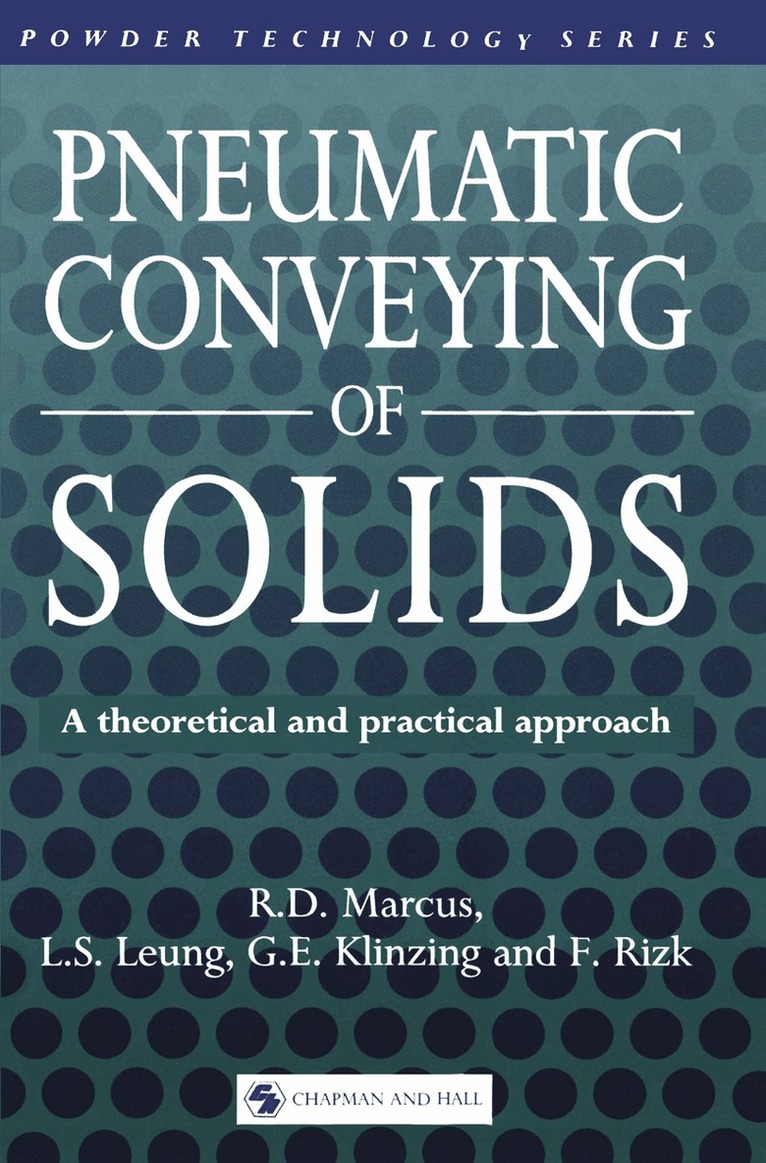
    Pneumatic Conveying of Solids

    AvR. D. Marcus

    Häftad, Engelska, 2011

    Del i serien Powder Technology Series

    539 kr

    Beställningsvara. Skickas inom 10-15 vardagar. Fri frakt över 249 kr.

    Fler format och utgåvor

    E-bok

    700 kr

    Beskrivning

    When the four of us decided to collaborate to write this book on pneumatic conveying, there were two aspects which were of some concern. Firstly, how could four people, who live on four different continents, write a book on a fairly complex subject with such wide lines of communications? Secondly, there was the problem that two of the authors are chemical engineers. It has been noted that the majority of chemical engineers who work in the field of pneumatic conveying research have spent most of their time considering flow in vertical pipes. As such, there was some concern that the book might be biased towards vertical pneumatic conveying and that the horizontal aspects (which are clearly the most difficult!) would be somewhat neglected. We hope that you, as the reader, are going to be satisfied with the fact that you have a truly international dissertation on pneumatic conveying and, also, that there is an even spread between the theoretical and practical aspects of pneumatic conveying technology.

    Produktinformation

    • Utgivningsdatum:2011-11-21
    • Mått:155 x 235 x 37 mm
    • Vikt:920 g
    • Format:Häftad
    • Språk:Engelska
    • Serie:Powder Technology Series
    • Antal sidor:575
    • Förlag:Springer
    • ISBN:9789401066693

    Utforska kategorier

    • Referensverk och tvärvetenskap inom Samhälle och politik

    Innehållsförteckning

    • 1 An overview of pneumatic conveying systems and performance.- 1.1 Introduction.- 1.2 Why pneumatic conveying?.- 1.3 What can be conveyed?.- 1.4 What constitutes a pneumatic conveying system?.- 1.5 Modes of pneumatic conveying.- 1.6 Basic pneumatic conveying systems.- 1.7 Further classification techniques.- 1.8 Description and operation of a pneumatic conveying system.- 1.9 Putting it all together.- 1.10 An overview.- 1.11 Some useful conversion factors and tables.- References.- 2 Single phase flow in pneumatic conveying systems.- 2.1 Introduction.- 2.2 Definitions.- 2.3 Perfect gas laws.- 2.4 Drying of compressed air.- 2.5 The compression process.- 2.6 Gas flow through pipes.- 2.7 Illustrative examples.- References.- 3 Fluid and particle dynamics.- 3.1 Introduction.- 3.2 Law of continuity.- 3.3 Drag on a particle.- 3.4 Equations for calculation of relevant properties.- 3.5 Fluidization characteristics of powders.- References.- 4 Fundamentals.- 4.1 Introduction.- 4.2 Forces acting on a single particle in an air stream.- 4.3 Particle size.- 4.4 Shape.- 4.5 Dynamic equations.- 4.6 Terminal velocity.- 4.7 Single particle acceleration.- 4.8 Centrifugal flow.- 4.9 Slip velocity in a gravitational field.- 4.10 Multiple particle systems.- 4.11 Voidage and slip velocity.- 4.12 Frictional representations.- 4.13 Acceleration and development regions.- 4.14 Particle distribution in pneumatic conveying.- 4.15 Compressibility effect not negligible.- 4.16 Speed of sound in gas—solid transport.- 4.17 Gas—solid flow with varying cross-sectional area.- 4.18 Branching arrangements.- 4.19 Bend analysis.- 4.20 Downward sloping particle flow.- 4.21 Dense phase transport.- 4.22 Estimation of pressure drop in slugging dense phase conveying.- 4.23 Estimation of pressure drop in non-sluggingdense phase conveying.- 4.24 Plug flows.- 4.25 Worked examples.- References.- 5 Flow regimes in vertical and horizontal conveying.- 5.1 Introduction.- 5.2 Choking versus non-choking system in vertical flow.- 5.3 Choking system in vertical flow.- 5.4 Non-choking system in vertical flow.- 5.5 Particle segregation in vertical pneumatic transport.- 5.6 Saltation in horizontal conveying.- References.- 6 Principles of pneumatic conveying.- 6.1 Introduction—putting it all together.- 6.2 The state diagram revisited.- 6.3 Methods for scaling-up.- 6.4 Use of theoretical models and definitions.- 6.5 Additional pressure drop factoz (?z).- 6.6 Pressure drop.- 6.7 Some important functional relationships.- 6.8 Sequence to be followed to obtain the system pressure loss (?p).- References.- 7 Feeding of pneumatic conveying systems.- 7.1 Introduction and overall design philosophy.- 7.2 Classification of feeding systems.- 7.3 Feeder selection criteria.- 7.4 Low pressure feeding devices.- 7.5 Medium pressure feeding systems.- 7.6 High pressure feeding devices.- 7.7 Conclusions.- References.- 8 Flow in standpipes and gravity conveyors.- 8.1 Introduction—standpipes and gravity conveyors.- 8.2 Classification of standpipe systems.- 8.3 Classification of flow modes in a standpipe.- 8.4 Equations pertaining to each flow mode.- 8.5 Flow through a valve.- 8.6 Stability of standpipe flow.- 8.7 Analysis of industrial standpipes—case studies.- 8.8 Gravity conveyors.- References.- 9 An overview of high pressure systems including long distance and dense phase pneumatic conveying systems.- 9.1 Introduction.- 9.2 High pressure systems.- 9.3 Dense phase flow classification.- 9.4 A description of plug flow and the relationships between plug flow and material characteristics.- 9.5 System selectionand product characteristics.- 9.6 Dense phase system design.- 9.7 Long distance pneumatic conveying and pressure loss minimization.- 9.8 Conclusions.- References.- 10 Gas—solids separation.- 10.1 Introduction.- 10.2 Selection criteria.- 10.3 Cyclone separators—theory of the separation of particles in the centrifugal field.- 10.4 Fabric filters.- 10.5 Cleaning by sound.- 10.6 Conclusions.- References.- 11 Some comments on: the flow behaviour of solids from silos; wear in pneumatic conveying systems; ancillary equipment.- 11.1 Introduction.- 11.2 The flow of solids from bins.- 11.3 Flow aid devices for silos and hoppers.- 11.4 Wear in pneumatic conveying systems.- 11.5 Ancillary equipment.- 11.6 Conclusions.- References.- 12 Control of pneumatic transport.- 12.1 Basic material flow and control theory.- 12.2 Transport lags.- 12.3 Analysis of gas—solid flow by transfer functions.- 12.4 Stability of pneumatic transfer systems.- 12.5 Stability analysis with Taylor series linearization.- 12.6 Linear stability analysis—Jackson approach.- 12.7 Stability via the Liapunov analysis.- References.- 13 Instrumentation.- 13.1 Standard instrumentation.- 13.2 Transducers.- 13.3 Cross-correlation procedures.- 13.4 A Coriolis force meter.- 13.5 Dielectric meter.- 13.6 Load cells.- 13.7 Particle tagging.- 13.8 Electrostatic based meters.- 13.9 Acoustic measurements.- 13.10 Screw conveyors.- 13.11 Light measuring devices.- 13.12 Other techniques for particle velocities.- 13.13 Instrumentation for industrial applications.- References.- 14 System design and worked examples.- 14.1 Introduction.- 14.2 Moisture content in air.- 14.3 The design of industrial vacuum systems.- 14.4 Dilute phase pneumatic conveying system design (method 1).- 14.5 Dilute phase pneumatic conveying systemdesign (method 2).- 14.6 Dilute phase pneumatic conveying system design (method 3).- 14.7 Dense phase pneumatic conveying system design.- 14.8 Test yourself—dilute phase calculations.- 14.9 Gas—solid flow examples.- 14.10 Conclusions.- References.