• Fri frakt över 249 kr
  • •
  • Snabba leveranser
  • •
  • Billiga böcker
Kundservice

Du är på sajten för privatpersoner.

Företag, bibliotek eller offentlig verksamhet?

Du handlar på classic.bokus.com, där alla dina funktioner finns intakta.
Till classic.bokus.com
Bokus logotyp. Gå till startsidan.
  • Erbjudanden
  • Nyheter
  • Student
  • Topplistor
  • Barn & ungdom
  • Bokus Play
  • E-böcker
  • Pocketböcker
  • Spel & pussel

10% rabatt på allt med kod: NYSTART10 →

Sidfot

Mina sidor

    Hjälp

    • Kundservice
    • Vanliga frågor och svar
    • Frakt och leverans
    • Retur vid ångerrätt
    • Reklamera vara
    • Betalning
    • Köpvillkor
    • Allmänna villkor
    • Information om webbplatsens tillgänglighet

    Om Bokus

    • Om oss
    • Pressrum
    • För studenter
    • För företag
    • För bibliotek och offentlig verksamhet
    • För leverantörer
    • Hållbarhet

    Populärt

    • Aktuella erbjudanden
    • Presentkort
    • Studentlitteratur
    • Nya böcker
    • Topplistor
    • Signerade böcker
    • Engelska böcker

    Inspiration

    • Boktips
    • BookTok
    • Populära bokserier
    • Barnbokskaraktärer
    • Populära författare
    Logotyp för Bokus
    Följ oss på Facebook (extern länk)Följ oss på Instagram (extern länk)Följ oss på YouTube (extern länk)Följ oss på TikTok (extern länk)
    bokus @ CookiesAnpassa cookiesIntegritetspolicyKöpvillkor
    Till Citymail hemsida (extern länk)Till Budbee hemsida (extern länk)Till Postnord hemsida (extern länk)Till Schenker hemsida (extern länk)Till Early Bird hemsida (extern länk)Till Walleys hemsida (extern länk)
    1. Filosofi och religion
    2. Filosofi

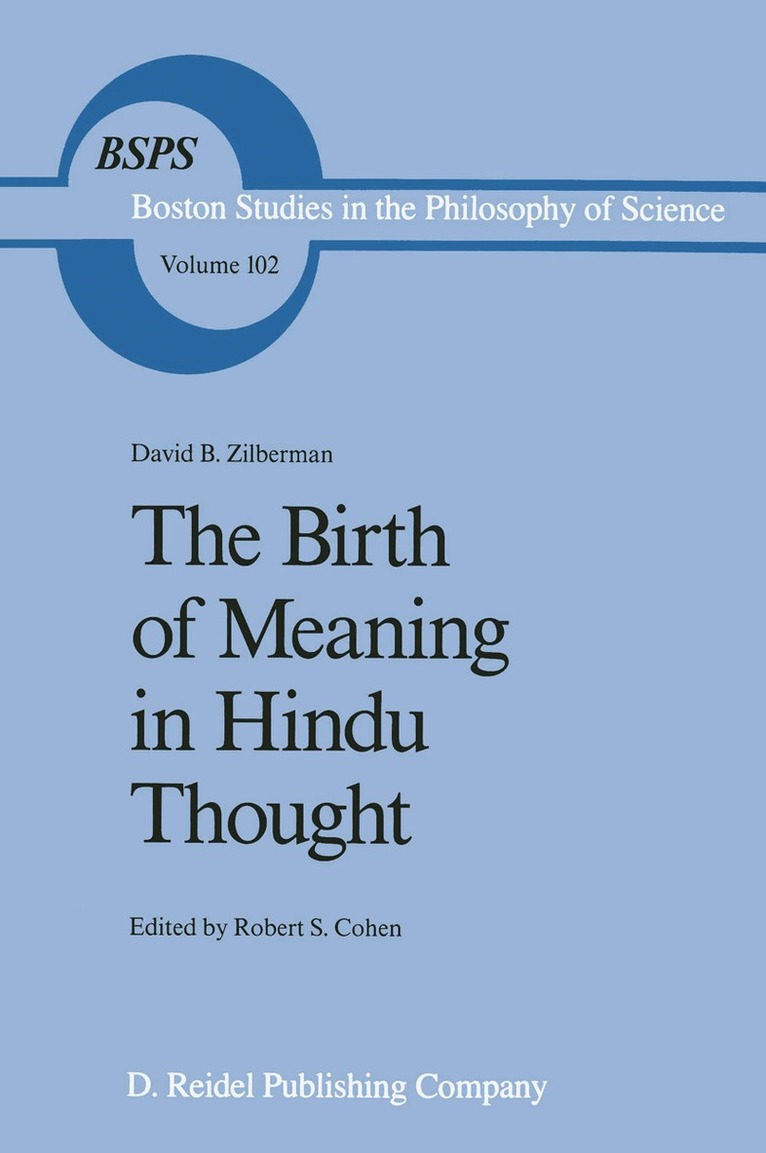
    Birth of Meaning in Hindu Thought

    AvDavid B. Zilberman,Robert S. Cohen

    Häftad, Engelska, 2011

    Del 102 i serien Boston Studies in the Philosophy and History of Science

    547 kr

    Beställningsvara. Skickas inom 10-15 vardagar. Fri frakt över 249 kr.

    Fler format och utgåvor

    E-bok

    710 kr

    Beskrivning

    In his letter to B. K. Matilal, dated February 20, 1977, the author of this book wrote about his work on Advaita-Vedanta: " ... It was not to present Advaita in the light of current problems of the logic of scientific discovery and modern philosophy of language ... but just the contrary. I do not believe that any 'logic without metaphysics' or 'philosophy of language without thinking' is possible." This passage alone may serve as the clue to Zilberman's understanding and mode of explaining that specific and highly original approach to (not 'of'!) philosophy that he himself nicknamed modal. Four points would seem to me to be most essential here. First, a philosophy cannot have 'anything un-thinking' as its object of investigation. Language, to Zilberman, is not a phenomenon of con­ sciousness but a spontaneously working natural mechanism (like, for instance, 'mind' to some Buddhist philosophers). It may, of course, be­ come used for and by consciousness; consciousness may see itself, so to speak, in language, but only secondarily, only as in one of its modifica­ tions, derivations or modalities. That is why to Zilberman linguistic- as to Kant psychology - cannot and must not figure as the primary ground for any philosophical investigation.

    Produktinformation

    • Utgivningsdatum:2011-10-08
    • Mått:152 x 229 x 22 mm
    • Vikt:572 g
    • Format:Häftad
    • Språk:Engelska
    • Serie:Boston Studies in the Philosophy and History of Science
    • Antal sidor:410
    • Förlag:Springer
    • ISBN:9789401071413

    Utforska kategorier

    • Filosofi inom Filosofi och religion

    Innehållsförteckning

    • I / Hindu Systems of Thought as Epistemic Disciplines.- I. The Science of Philosophies.- II. The Mechanism of Organization.- III. The Structural Design.- IV. Para-Methodology.- V. Modality and Modalization.- VI. The Self-Developing Culture and Text.- VII. Six Epistemic Disciplines Unfolding Into One Another.- VIII. Modal Semiotics and the Categories of Philosophical Thinking.- IX. Six Entries into the World of Philosophical Reflections.- X. Summa Philosophiae.- II / The Birth of ‘Meaning’: A Systematic Genealogy of Indian Semantics.- I. Segregation of Meaning and Language.- II. The Rgveda in the Making: A Meaningful Activity Without ‘Meaning’.- III. The Nirukta: A Knot of Semantic and Etymological Problems.- IV. P?nini: Separating and Interconnecting Language and Logic.- V. The Individual and the Universal in Language and Knowledge.- III / Dialectics in Kant and in the Ny?ya-S?tra: Toward the History of the Formation of Formal Logical Thinking.- IV / The Canonical Self in the World of Knowledge: A Note on Ny?ya Gnoseology.- V / Revelation in Advaita Ved?nta as an Experiment in the Semantic Destruction of Language.- I. Theoretical Basis of the Possibility of Coming to Know Brahman (Pary?ya).- II. Intuitive Basis of the Possibility of Coming to Know Brahman (Prayojana).- III. Pary?ya of the First Stage of Reflection from the Structure of the Text to the Nature of Brahman: The Theory of False Attribution and its Sublation (Transcendence).- IV. Prayojana of the First Stage of Reflection: The Intuition of False Attribution and its Sublation (Transcendence).- V. Pary?ya of the Second Stage of Reflection: The Theory of Brahman Shown in a Metaphoric Occurrence (Laksan?vritti).- VI. Prayojana of the Second Stage of Reflection: Intuition of Brahman Shown by theMethod of Metamorphic Definition.- VII. Language Inappropriateness Exposed and Brahman Demonstrated by the Netiv?da Method: The Theory of Intuition (Pary?ya).- VIII. Prayojana of the Vedic Realization by the Netiv?da Method: The Intuition of a Theory.- VI / Is The Bodhisattva a Skeptic? On the Trichotomy of ‘Indicative’, ‘Recollective’, and ‘Collective’ Signs.- VII / Hindu Values and Buddhism: An Exemplary Discourse.- I. Methodological.- II. Theoretical.- II.1. The Mim?msa Normology.- VIII / Understanding Cultural Traditions Through Types of Thinking.- I. Level of Absolute Reality.- II. Level of Phenomenation.- III. Level of Absolute Irreality.- IX / The Family of Hindu ‘Visions’ as Cultural Entities.- Notes and References.- Bibliography: Selected Works of David Zilberman.