• Fri frakt över 249 kr
  • •
  • Snabba leveranser
  • •
  • Billiga böcker
Kundservice

Du är på sajten för privatpersoner.

Företag, bibliotek eller offentlig verksamhet?

Du handlar på classic.bokus.com, där alla dina funktioner finns intakta.
Till classic.bokus.com
Bokus logotyp. Gå till startsidan.
  • Erbjudanden
  • Nyheter
  • Student
  • Topplistor
  • Barn & ungdom
  • Bokus Play
  • E-böcker
  • Pocketböcker
  • Spel & pussel

Må bättre, för mindre! Upp till 50% rabatt på hälsoböcker

Sidfot

Mina sidor

    Hjälp

    • Kundservice
    • Vanliga frågor och svar
    • Frakt och leverans
    • Retur vid ångerrätt
    • Reklamera vara
    • Betalning
    • Köpvillkor
    • Allmänna villkor
    • Information om webbplatsens tillgänglighet

    Om Bokus

    • Om oss
    • Pressrum
    • För studenter
    • För företag
    • För bibliotek och offentlig verksamhet
    • För leverantörer
    • Hållbarhet

    Populärt

    • Aktuella erbjudanden
    • Presentkort
    • Studentlitteratur
    • Nya böcker
    • Topplistor
    • Signerade böcker
    • Engelska böcker

    Inspiration

    • Boktips
    • BookTok
    • Populära bokserier
    • Barnbokskaraktärer
    • Populära författare
    Logotyp för Bokus
    Följ oss på Facebook (extern länk)Följ oss på Instagram (extern länk)Följ oss på YouTube (extern länk)Följ oss på TikTok (extern länk)
    bokus @ CookiesAnpassa cookiesIntegritetspolicyKöpvillkor
    Till Citymail hemsida (extern länk)Till Budbee hemsida (extern länk)Till Postnord hemsida (extern länk)Till Schenker hemsida (extern länk)Till Early Bird hemsida (extern länk)Till Walleys hemsida (extern länk)
    1. Ekonomi och Ledarskap
    2. Nationalekonomi

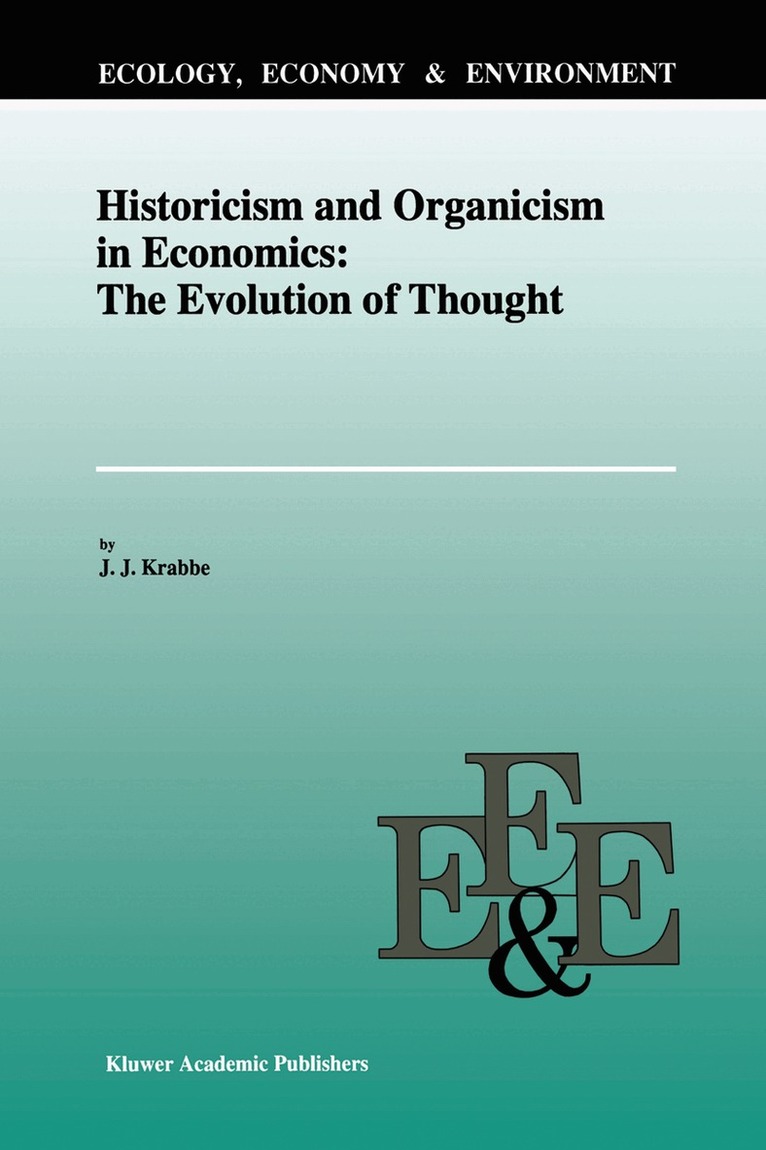
    Historicism and Organicism in Economics: The Evolution of Thought

    AvJ.J. Krabbe

    Häftad, Engelska, 2011

    Del 6 i serien Ecology, Economy & Environment

    1 119 kr

    Beställningsvara. Skickas inom 10-15 vardagar. Fri frakt över 249 kr.

    Fler format och utgåvor

    Inbunden

    1 119 kr

    E-bok

    1 459 kr

    Beskrivning

    This study looks at the roots of German legacy historistic and organistic economic thought, gives a survey of its development and indicates the present-day significance of these ideas. This approach is also of significance for today's institutional economics, and for the field of environmental and resource economics. In this book these fields of study are referred to in various ways. Essentially, some new ideas appear to be rather old and, what amounts to the same, some old ideas appear to be topical. This is particularly true of the "historical approach" to the economy, with its idea of development. It is also true of the organistic approach, which is largely tied up with it. The point of departure is my study on· the G. erman Historical School, published in Dutch in 1983. The scope of the following work, however, is broader, as it also refers to the evolution of historically oriented and organistically oriented economic thought in general. Thus, a number of authors who did not think along the lines of the Historical School are included. For instance, the organically oriented ideas of Menger and Georgescu-Roegen are also examined, as well as the ideas of those who were among the "Institutionalists" and other present-day writers in this field. This study is supported by various publications by other writers. A great part of the literature under consideration is in German.

    Produktinformation

    • Utgivningsdatum:2011-10-01
    • Mått:160 x 240 x 12 mm
    • Vikt:335 g
    • Format:Häftad
    • Språk:Engelska
    • Serie:Ecology, Economy & Environment
    • Antal sidor:190
    • Förlag:Springer
    • ISBN:9789401072564

    Utforska kategorier

    • Nationalekonomi inom Ekonomi och Ledarskap
    • Ekonomisk politik inom Ekonomi och Ledarskap
    • Miljöekonomi inom Ekonomi och Ledarskap

    Innehållsförteckning

    • 1: Concept and its matrix.- 2: Predecessors of German historicism.- 3: Phenomenon “Historical School”.- 4: The “older” Historical School.- Roscher, founder of economic historicism and organicism.- Knies’ historistic method.- Hildebrand’s “political” economics.- 5: Independents in the School’s second generation.- Bücher’s historically oriented approach.- Philippovich’s idealistically oriented approach.- 6: Menger’s New Organicism.- 7: Schmoller, founder of the “younger” Historical School.- His concept of economics.- His methodical “dualism”.- His economic systems theory.- His picture of development.- 8: Schmoller’s followers in the “younger” School.- Reformers.- Fundamentalists.- 9: Historical School’s “youngest” representatives.- Sombart and Spiethoff.- Max Weber.- 10: Institutionalism.- 11: Georgescu-Roegen’s “bioeconomics”.- 12: Economic aspects of cultural diversification.- 13: Economic systems theory.- General characteristics.- Organicism in economic systems theory.- 14: Efficient sustainability: an institutional approach.- 15: Perspectives of organistic thought.- 16: Epilogue.- Appendix: Long-term factor substitution.- References.