• Fri frakt över 249 kr
  • •
  • Snabba leveranser
  • •
  • Billiga böcker
Kundservice

Du är på sajten för privatpersoner.

Företag, bibliotek eller offentlig verksamhet?

Du handlar på classic.bokus.com, där alla dina funktioner finns intakta.
Till classic.bokus.com
Bokus logotyp. Gå till startsidan.
  • Erbjudanden
  • Nyheter
  • Student
  • Topplistor
  • Barn & ungdom
  • Bokus Play
  • E-böcker
  • Pocketböcker
  • Spel & pussel

10% rabatt på allt med kod NYSTART10 →

Sidfot

Mina sidor

    Hjälp

    • Kundservice
    • Vanliga frågor och svar
    • Frakt och leverans
    • Retur vid ångerrätt
    • Reklamera vara
    • Betalning
    • Köpvillkor
    • Allmänna villkor
    • Information om webbplatsens tillgänglighet

    Om Bokus

    • Om oss
    • Pressrum
    • För studenter
    • För företag
    • För bibliotek och offentlig verksamhet
    • För leverantörer
    • Hållbarhet

    Populärt

    • Aktuella erbjudanden
    • Presentkort
    • Studentlitteratur
    • Nya böcker
    • Topplistor
    • Signerade böcker
    • Engelska böcker

    Inspiration

    • Boktips
    • BookTok
    • Populära bokserier
    • Barnbokskaraktärer
    • Populära författare
    Logotyp för Bokus
    Följ oss på Facebook (extern länk)Följ oss på Instagram (extern länk)Följ oss på YouTube (extern länk)Följ oss på TikTok (extern länk)
    bokus @ CookiesAnpassa cookiesIntegritetspolicyKöpvillkor
    Till Citymail hemsida (extern länk)Till Budbee hemsida (extern länk)Till Postnord hemsida (extern länk)Till Schenker hemsida (extern länk)Till Early Bird hemsida (extern länk)Till Walleys hemsida (extern länk)
    1. Filosofi och religion
    2. Filosofi

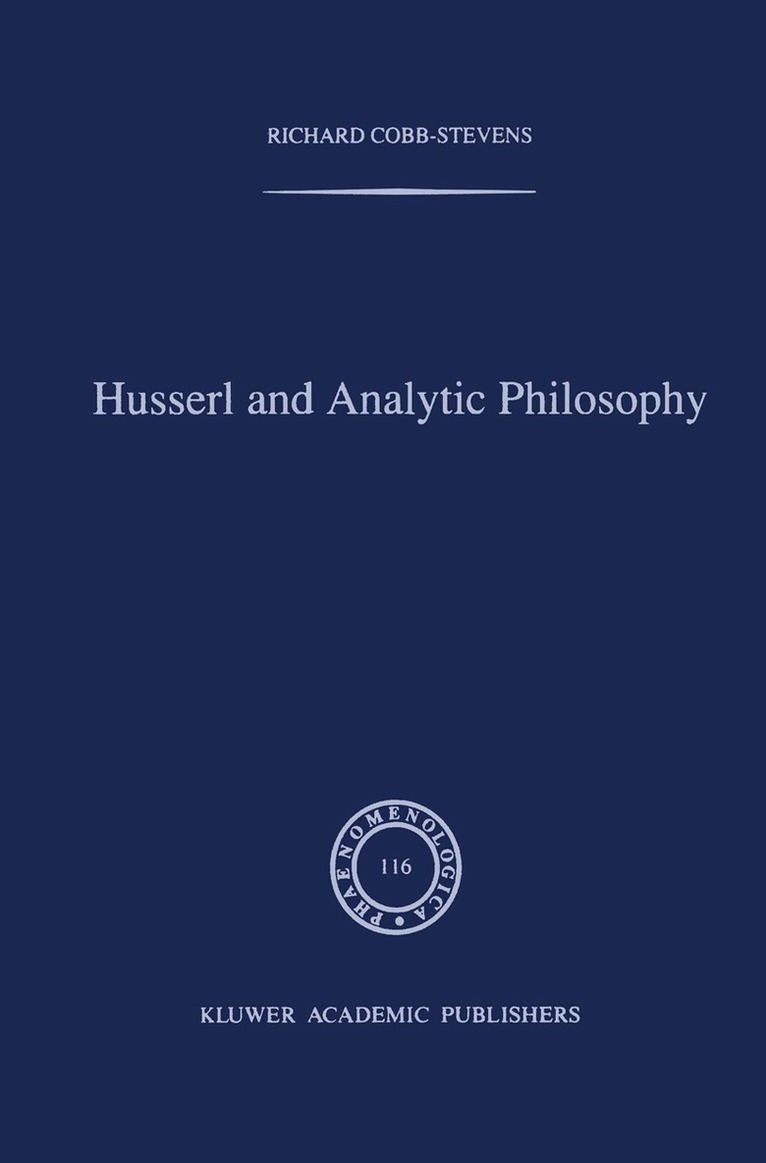
    Husserl and Analytic Philosophy

    AvR. Cobb-Stevens

    Häftad, Engelska, 2011

    Del 116 i serien Phaenomenologica

    1 625 kr

    Beställningsvara. Skickas inom 10-15 vardagar. Fri frakt över 249 kr.

    Fler format och utgåvor

    Inbunden

    1 625 kr

    E-bok

    2 044 kr

    Beskrivning

    The principal differences between the contemporary philosophic traditions which have come to be known loosely as analytic philosophy and phenomenology are all related to the central issue of the interplay between predication and perception. Frege's critique of psychologism has led to the conviction within the analytic tradition that philosophy may best defend rationality from relativism by detaching logic and semantics from all dependence on subjective intuitions. On this interpretation, logical analysis must account for the relationship of sense to reference without having recourse to a description of how we identify particulars through their perceived features. Husserl' s emphasis on the priority and objective import of perception, and on the continuity between predicative articulations and perceptual discriminations, has yielded the conviction within the phenomenological tradition that logical analysis should always be comple­ mented by description of pre-predicative intuitions. These methodological differences are related to broader differences in the philosophic projects of analysis and phenomenology. The two traditions have adopted markedly divergent positions in reaction to the critique of ancient and medieval philosophy initiated by Bacon, Descartes, and Hobbes at the beginning of the modern era. The analytic approach generally endorses the modern preference for calculative rationality and remains suspicious of pre-modern categories, such as formal causality and eidetic intuition. Its goal is to give an account of human intelligence that is compatible with the modern interpretation of nature as an ensemble of quantifiable entities and relations.


    Produktinformation

    • Utgivningsdatum:2011-12-09
    • Mått:155 x 235 x 13 mm
    • Vikt:365 g
    • Format:Häftad
    • Språk:Engelska
    • Serie:Phaenomenologica
    • Antal sidor:222
    • Förlag:Springer
    • ISBN:9789401073424

    Utforska kategorier

    • Filosofi inom Filosofi och religion
    • Filosofiska discipliner inom Filosofi och religion

    Innehållsförteckning

    • I. Psychologism and Logical Analysis.- 1. The Debate about Psychologism.- 2. Frege’s Critique of Psychologism.- 3. Propositions and Facts.- 4. Kantian and Platonic Fragments.- 5. Senses as Modes of Givenness.- II Semantics Without Epistemology.- 1. From Semantics to Pragmatism.- 2. Wittgenstein’s Metaphors.- 3. Private Sensations and Public Concepts.- 4. Tacit and Prepositional Knowing.- III. Quantifiers and Bound Variables.- 1. Functions and Concepts.- 2. Frege’s Critique of Traditional Logic.- 3. The Quantifier-Variable Notation.- 4. Leibniz’ Law.- 5. Concepts and their value-ranges: Two Paradoxes.- 6. Substitution vs. Intuition.- IV. On What There is.- 1. The Many Senses of the Science of Being.- 2. The Theory of Substance: From Aristotle to Leibniz.- 3. Frege’s Critique of the Theory of Substance.- 4. Concepts: Modes of Presentation or Extensions.- 5. Referential Opacity.- 6. The Impoverishment of Ontology.- V. Assertion and Predication.- 1. The Development of the Modern Theory of Judgment.- 2. Intentional Directedness and Propositional Attitudes.- 3. Brentano and Frege.- 4. Strawson’s Critique of Russell.- 5. Sortal Predicates and Contextual Identification.- VI. Psychologism and Cognitive Intuition.- 1. From Soul to Mind.- 2. Husserl’s Breakthrough: Early Writings.- 3. Husserl and the Language of Modern Philosophy.- 4. Signs and Signification.- 5. Judgments and Propositions.- 6. The Context of Reference.- 7. Truth as Identity-synthesis.- 8. Categorial Intuition.- 9. A Productive Paradox.- VII. Husserl’s Transcendental Turn.- 1. Kant’s Transcendentalism.- 2. The Idea of Phenomenology.- 3. Regions and Dimensions.- 4. Propositions and Facts: A Transcendental Approach.- VIII. Reason and History.- 1. Esprit de géométrie.- 2. Naturalism and theLogical Calculus.- 3. Naturalism and Historicism.- 4. Essences and Historical Perspectives.