• Fri frakt över 249 kr
  • •
  • Snabba leveranser
  • •
  • Billiga böcker
Kundservice

Du är på sajten för privatpersoner.

Företag, bibliotek eller offentlig verksamhet?

Du handlar på classic.bokus.com, där alla dina funktioner finns intakta.
Till classic.bokus.com
Bokus logotyp. Gå till startsidan.
  • Erbjudanden
  • Nyheter
  • Student
  • Topplistor
  • Barn & ungdom
  • Bokus Play
  • E-böcker
  • Pocketböcker
  • Spel & pussel

10% rabatt på allt med kod NYSTART10 →

Sidfot

Mina sidor

    Hjälp

    • Kundservice
    • Vanliga frågor och svar
    • Frakt och leverans
    • Retur vid ångerrätt
    • Reklamera vara
    • Betalning
    • Köpvillkor
    • Allmänna villkor
    • Information om webbplatsens tillgänglighet

    Om Bokus

    • Om oss
    • Pressrum
    • För studenter
    • För företag
    • För bibliotek och offentlig verksamhet
    • För leverantörer
    • Hållbarhet

    Populärt

    • Aktuella erbjudanden
    • Presentkort
    • Studentlitteratur
    • Nya böcker
    • Topplistor
    • Signerade böcker
    • Engelska böcker

    Inspiration

    • Boktips
    • BookTok
    • Populära bokserier
    • Barnbokskaraktärer
    • Populära författare
    Logotyp för Bokus
    Följ oss på Facebook (extern länk)Följ oss på Instagram (extern länk)Följ oss på YouTube (extern länk)Följ oss på TikTok (extern länk)
    bokus @ CookiesAnpassa cookiesIntegritetspolicyKöpvillkor
    Till Citymail hemsida (extern länk)Till Budbee hemsida (extern länk)Till Postnord hemsida (extern länk)Till Schenker hemsida (extern länk)Till Early Bird hemsida (extern länk)Till Walleys hemsida (extern länk)
    1. Filosofi och religion
    2. Filosofi
    3. Filosofiska discipliner

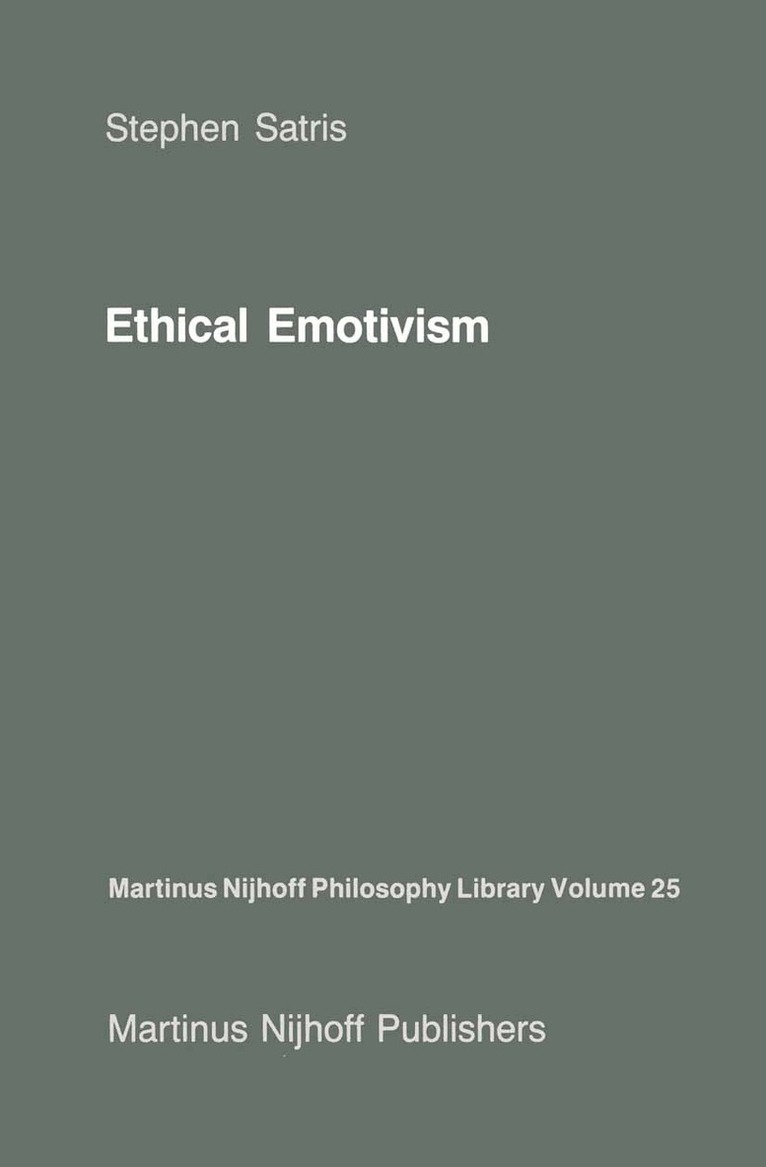
    Ethical Emotivism

    AvS.A. Satris

    Häftad, Engelska, 2011

    Del 25 i serien Martinus Nijhoff Philosophy Library

    1 085 kr

    Beställningsvara. Skickas inom 10-15 vardagar. Fri frakt över 249 kr.

    Fler format och utgåvor

    Inbunden

    1 085 kr

    E-bok

    1 413 kr

    Beskrivning

    The primary contributions of this work are in three overlapping categories: (i) the history of ideas (and in particular the history of the idea of value) and moral philosophy in both continental and Anglo-American traditions, (ii) the identification and interpretation of ethical emotivism as one of the major twentieth-century ethical theories, and (iii) the evolution of a philosophically viable form of ethical emotivism as an alternative to utilitarianism and Kantianism. In addition, along the way, many particular points are touched upon, e. g. , the relation of Hume to Stevenson and emotivism, the facti value distinction, and human emotional and social nature. The work begins by challenging the received account of the development of twentieth-century moral philosophy, i. e. , the account that occurs in all the recognized historical books (such as G. c. Kerner, The Revolution in Ethical Theory, Oxford, 1966; G. 1. Warnock, Contemporary Moral Philosophy, London, 1967; W. D. Hudson, Modern Moral Philosophy, London, 1967; Mary Warnock, Ethics Since 1900, 3rd ed. , Oxford, 1978; and W. D. Hudson, A Century of Moral Philosophy, New York, 1980). This received account is not only the property of scholars of the history of recent moral philosophy but is also generally assumed by philosophers themselves, and is repeated quite uncritically in the literature at large.

    Produktinformation

    • Utgivningsdatum:2011-09-20
    • Mått:155 x 235 x 13 mm
    • Vikt:341 g
    • Format:Häftad
    • Språk:Engelska
    • Serie:Martinus Nijhoff Philosophy Library
    • Antal sidor:204
    • Förlag:Springer
    • ISBN:9789401080675

    Utforska kategorier

    • Filosofiska discipliner inom Filosofi och religion

    Innehållsförteckning

    • I The Theory of Value and the Rise of Ethical Emotivism.- i. The standard account.- ii. German and Austrian roots.- iii. Ayer and the Vienna Circle.- II Attitudes, Beliefs and Disagreements.- i. Introductory.- ii. Attitudes and beliefs: interest and cognition.- iii. Disagreement in belief and disagreement in attitude.- III Emotive Meaning: Marty to Ayer.- i. Introductory.- ii. Marty.- iii. Ogden and Richards.- iv. Ayer.- IV Emotive Meaning: Stevenson.- i. Morris and pragmatic meaning.- ii. Dispositions and the causal theory of meaning.- iii. A confusion of two theses.- iv. The pragmatic meaning question: emotive meaning and descriptive meaning.- v. Emotive meaning and human social nature.- V Perry, Hume and the Rejection of Naturalism.- i. Introductory; Hume and Stevenson.- ii. Perry’s interest theory.- iii. Stevenson’s rejection of Perry.- iv. Stevenson on Hume.- v. Further on Hume and emotivism.- vi. Sympathy, the is/ought gap and motivation.- VI Reasons and Persuasion.- i. Introductory.- ii. Ethical argument.- iii. The two patterns of analysis and the issue of relevance.- iv. Further on the two patterns; naturalistic fallacy; self-persuasion.- VII Hare’s Critique of Emotivism.- i. Introductory.- ii. Hare: two groups of verbs and six differences.- VIII Does Prescriptivism Supersede Emotivism?.- i. Introductory.- ii. General criticism.- iii. Emotivism vs. prescriptivism.- iv. Moral thinking: two levels.