• Fri frakt över 249 kr
  • •
  • Snabba leveranser
  • •
  • Billiga böcker
Kundservice

Du är på sajten för privatpersoner.

Företag, bibliotek eller offentlig verksamhet?

Du handlar på classic.bokus.com, där alla dina funktioner finns intakta.
Till classic.bokus.com
Bokus logotyp. Gå till startsidan.
  • Erbjudanden
  • Nyheter
  • Student
  • Topplistor
  • Barn & ungdom
  • Bokus Play
  • E-böcker
  • Pocketböcker
  • Spel & pussel

10% rabatt på allt med kod NYSTART10 →

Sidfot

Mina sidor

    Hjälp

    • Kundservice
    • Vanliga frågor och svar
    • Frakt och leverans
    • Retur vid ångerrätt
    • Reklamera vara
    • Betalning
    • Köpvillkor
    • Allmänna villkor
    • Information om webbplatsens tillgänglighet

    Om Bokus

    • Om oss
    • Pressrum
    • För studenter
    • För företag
    • För bibliotek och offentlig verksamhet
    • För leverantörer
    • Hållbarhet

    Populärt

    • Aktuella erbjudanden
    • Presentkort
    • Studentlitteratur
    • Nya böcker
    • Topplistor
    • Signerade böcker
    • Engelska böcker

    Inspiration

    • Boktips
    • BookTok
    • Populära bokserier
    • Barnbokskaraktärer
    • Populära författare
    Logotyp för Bokus
    Följ oss på Facebook (extern länk)Följ oss på Instagram (extern länk)Följ oss på YouTube (extern länk)Följ oss på TikTok (extern länk)
    bokus @ CookiesAnpassa cookiesIntegritetspolicyKöpvillkor
    Till Citymail hemsida (extern länk)Till Budbee hemsida (extern länk)Till Postnord hemsida (extern länk)Till Schenker hemsida (extern länk)Till Early Bird hemsida (extern länk)Till Walleys hemsida (extern länk)
    1. Naturvetenskap och teknik
    2. Matematik och naturvetenskap
    3. Fysik
    4. Matematisk fysik

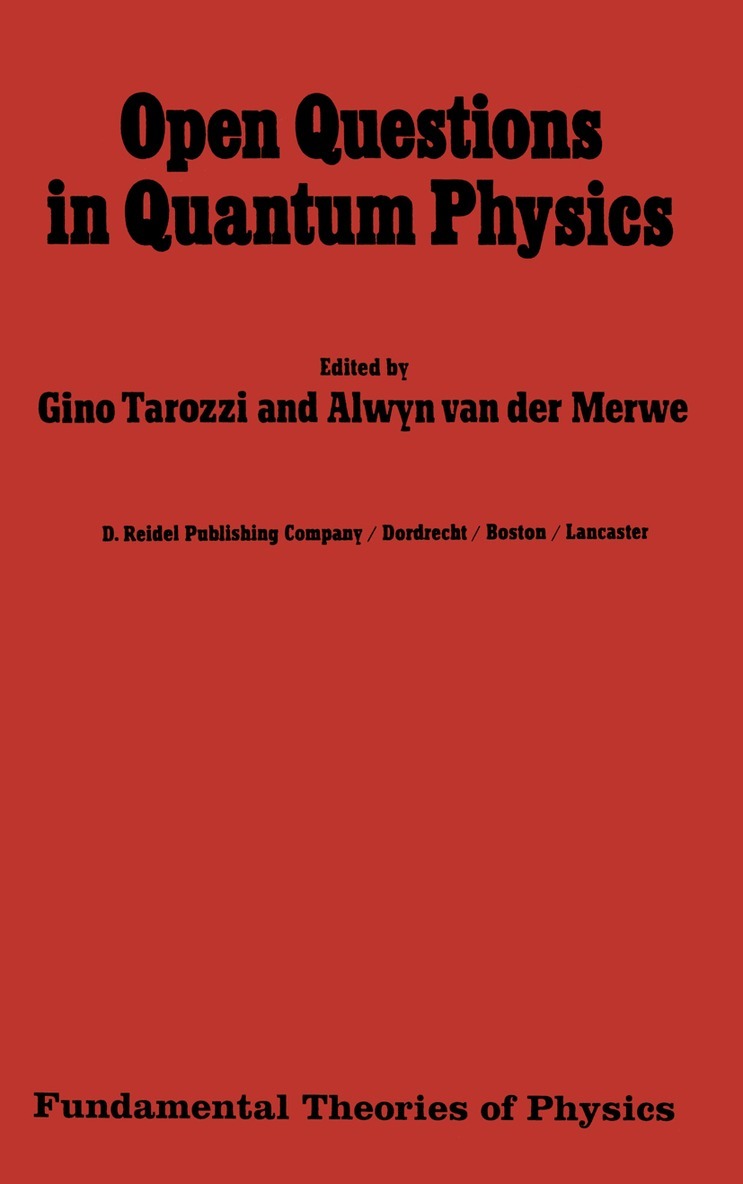
    Open Questions in Quantum Physics

    Invited Papers on the Foundations of Microphysics

    AvG. Tarozzi,Alwyn van der Merwe

    Häftad, Engelska, 2011

    Del 10 i serien Fundamental Theories of Physics

    2 162 kr

    Beställningsvara. Skickas inom 10-15 vardagar. Fri frakt över 249 kr.

    Beskrivning

    Due to its extraordinary predictive power and the great generality of its mathematical structure, quantum theory is able, at least in principle, to describe all the microscopic and macroscopic properties of the physical world, from the subatomic to the cosmological level. Nevertheless, ever since the Copen­ hagen and Gottingen schools in 1927 gave it the definitive formu­ lation, now commonly known as the orthodox interpretation, the theory has suffered from very serious logical and epistemologi­ cal problems. These shortcomings were immediately pointed out by some of the principal founders themselves of quantum theory, to wit, Planck, Einstein, Ehrenfest, Schrodinger, and de Broglie, and by the philosopher Karl Popper, who assumed a position of radical criticism with regard to the standard formulation of the theory. The aim of the participants in the workshop on Open Questions in Quantum Physics, which was held in Bari (Italy), in the Department of Physics of the University, during May 1983 and whose Proceedings are collected in the present volume, accord­ ingly was to discuss the formal, the physical and the epistemo­ logical difficulties of quantum theory in the light of recent crucial developments and to propose some possible resolutions of three basic conceptual dilemmas, which are posed respectively ~: (a) the physical developments of the Einstein-Podolsky-Rosen argument and Bell's theorem, i. e.

    Produktinformation

    • Utgivningsdatum:2011-11-22
    • Mått:160 x 240 x 24 mm
    • Vikt:698 g
    • Format:Häftad
    • Språk:Engelska
    • Serie:Fundamental Theories of Physics
    • Antal sidor:428
    • Förlag:Springer
    • ISBN:9789401088169

    Utforska kategorier

    • Matematisk fysik inom Naturvetenskap och teknik

    Recensioner i media

    'Even a physicist or philosopher of physics who does not subscribe to the realistic interpretation of quantum mechanics will find the book stimulating, informative and, perhaps to his surprise, also enjoyable.' Foundations of Physics

    Innehållsförteckning

    • 1. Quantum Mechanics, Reality and Separability: Physical Developments of the Einstein-Podolsky-Rosen Argument.- Realism in Quantum Mechanics and a New Version of the EPR Experiment.- Discussion: M. Cini, F. De Martini, K. Kraus, T.W. Marshall, K.R. Popper, H. Rauch, M.C. Robinson, F. Selleri, J. Six, G. Tarozzi, J.-P. Vigier..- The Physical Origin of the Einstein-Podolsky-Rosen Paradox.- Does the Bell Inequality Hold for All Local Theories?.- Is it Possible to Save Causality and Locality in Quantum Mechanics?.- Einstein-Podolsky-Rosen Experiments and Macroscopic Locality.- On the Compatibility of Local Realism with Atomic Cascade Experiments.- Is the Einstein-Podolsky-Rosen Paradox Demanded by Quantum Mechanics?.- Infinite Wave Resolution of the EPR Paradox.- On Non Local Influences.- Einstein Locality for Individual Systems and for Statistical Ensembles.- Can Nondetected Photons Simulate Nonlocal Effects in Two-Photon Polarization Correlation Experiments?.- 2. The Stochastic Interpretation of Quantum Processes.- Quantum Theory of Measurement without Wave Packet Collapse.- A Causal Fluidodynamical Model for the Relativistic Quantum Mechanics.- On the Nonlinear Schrödinger Equation.- Recent Developments in de Broglie Nonlinear Wave Mechanics.- The Role of the Quantum Potential in Determining Particle Trajectories and the Resolution of the Measurement Problem.- When is Statistical Theory Causal?.- Radiation Damping and Nonlinearity in the Pilot Wave Interpretation of Quantum Mechanics.- Stochastic Electrodynamics and the Bell Inequalities.- Nonlocal Quantum-Potential Interpretation of Relativistic Actions at a Distance in Many-Body Problems.- 3. The Realistic Interpretation of the Wave Function: Experimental Tests on the Wave-Particle Dualism.- Third Kind Measurementsand Wave-Particle Dualism.- Quantum Effects in the Interference of Light.- Tests of Quantum Mechanics by Neutron Interferometry.- A Unified Experiment for Testing both the Interpretation and the Reduction Postulate of the Quantum Mechanical Wave Function.- Epilogue.- Evolutionary Epistemology.