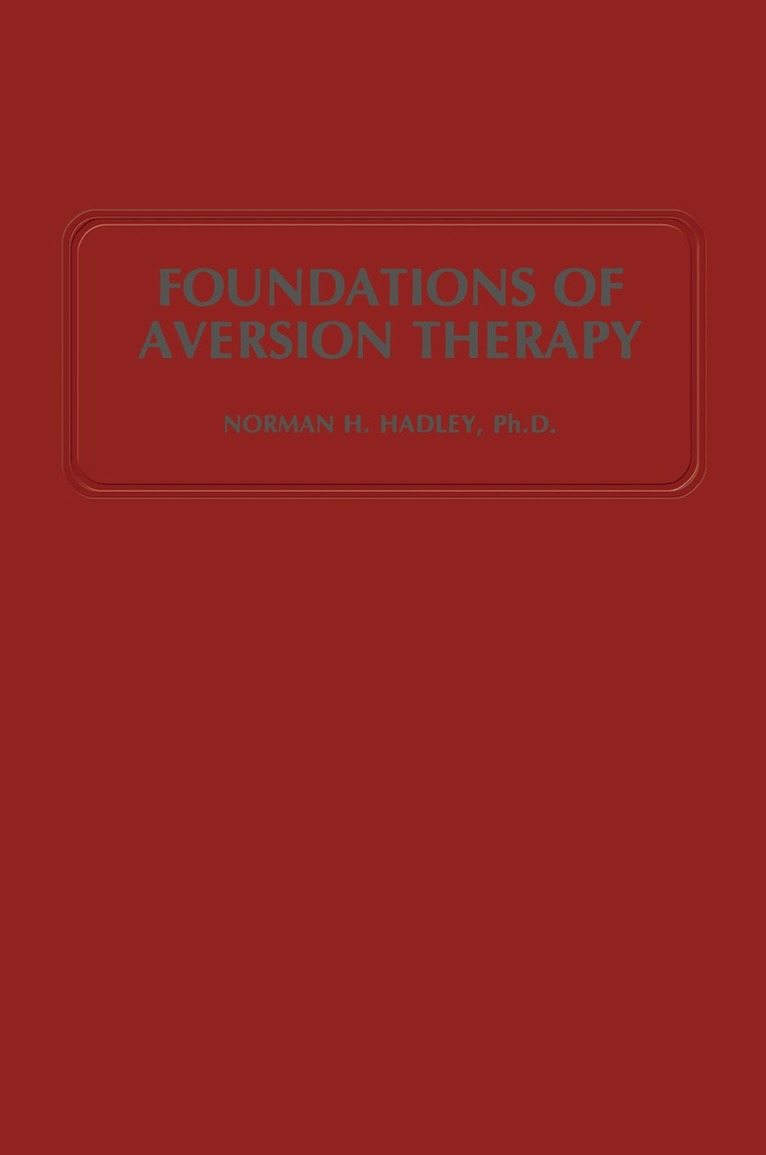
Häftad, Engelska, 2012
Foundations of Aversion Therapy
Av N.H. Hadley
567 kr
Beställningsvara. Skickas inom 10-15 vardagar. Fri frakt över 249 kr.
Beskrivning
The scene is Britain in the late 40's and early 50's. More specifically, the location is the newly formed Psychology Depart ment of the University of London Institute of Psychiatry, Mauds ley Hospital. Hans J. Eysenck, then University Reader in Psych ology, had an ambitious and bold plan. unheard of for those days, which he was determined to bring to fruition come what may. First, personality was to be mapped out in terms of a small number of operationally defined, measurable dimensions. Next, these di mensions would be related experimentally to their as yet to be identified underlying physiological determinants. This research was to lead to a comprehensive model of psychological, social and biological activity which would account for virtually every facet of human functioning. To facilitate this grand scheme, Eysenck gathered around him a carefully selected team of eager young faculty and doctoral can didates among whom I had the good fortune to be included, first as a graduate student and then as a full-fledged academic. The guiding model was that of the searching student rather than the unquestioning disciple, and it was this spirit of directed but open minded enquiry which guided us in the decades which lay ahead. That Eysenck's aspirations are not fully realized despite many years of intense endeavor does not detract from the intellectual excitement of those times and the impetus given to clinical psychology in the United Kingdom by these remarkable beginnings.
Produktinformation
- Utgivningsdatum: 2012-02-13
- Mått: 152 x 229 x 12 mm
- Vikt: 262 g
- Format: Häftad
- Språk: Engelska
- Antal sidor: 145
- Förlag: Springer
- ISBN: 9789401167093
Utforska kategorier
Betyg & recensioner
0 recensioner
Inga recensioner tillgängliga.