• Fri frakt över 249 kr
  • •
  • Snabba leveranser
  • •
  • Billiga böcker
Kundservice

Du är på sajten för privatpersoner.

Företag, bibliotek eller offentlig verksamhet?

Du handlar på classic.bokus.com, där alla dina funktioner finns intakta.
Till classic.bokus.com
Bokus logotyp. Gå till startsidan.
  • Erbjudanden
  • Nyheter
  • Student
  • Topplistor
  • Barn & ungdom
  • Bokus Play
  • E-böcker
  • Pocketböcker
  • Spel & pussel

10% rabatt på allt med kod NYSTART10 →

Sidfot

Mina sidor

    Hjälp

    • Kundservice
    • Vanliga frågor och svar
    • Frakt och leverans
    • Retur vid ångerrätt
    • Reklamera vara
    • Betalning
    • Köpvillkor
    • Allmänna villkor
    • Information om webbplatsens tillgänglighet

    Om Bokus

    • Om oss
    • Pressrum
    • För studenter
    • För företag
    • För bibliotek och offentlig verksamhet
    • För leverantörer
    • Hållbarhet

    Populärt

    • Aktuella erbjudanden
    • Presentkort
    • Studentlitteratur
    • Nya böcker
    • Topplistor
    • Signerade böcker
    • Engelska böcker

    Inspiration

    • Boktips
    • BookTok
    • Populära bokserier
    • Barnbokskaraktärer
    • Populära författare
    Logotyp för Bokus
    Följ oss på Facebook (extern länk)Följ oss på Instagram (extern länk)Följ oss på YouTube (extern länk)Följ oss på TikTok (extern länk)
    bokus @ CookiesAnpassa cookiesIntegritetspolicyKöpvillkor
    Till Citymail hemsida (extern länk)Till Budbee hemsida (extern länk)Till Postnord hemsida (extern länk)Till Schenker hemsida (extern länk)Till Early Bird hemsida (extern länk)Till Walleys hemsida (extern länk)
    1. Ekonomi och Ledarskap
    2. Ledarskapsböcker
    3. Ledarskap och motivation

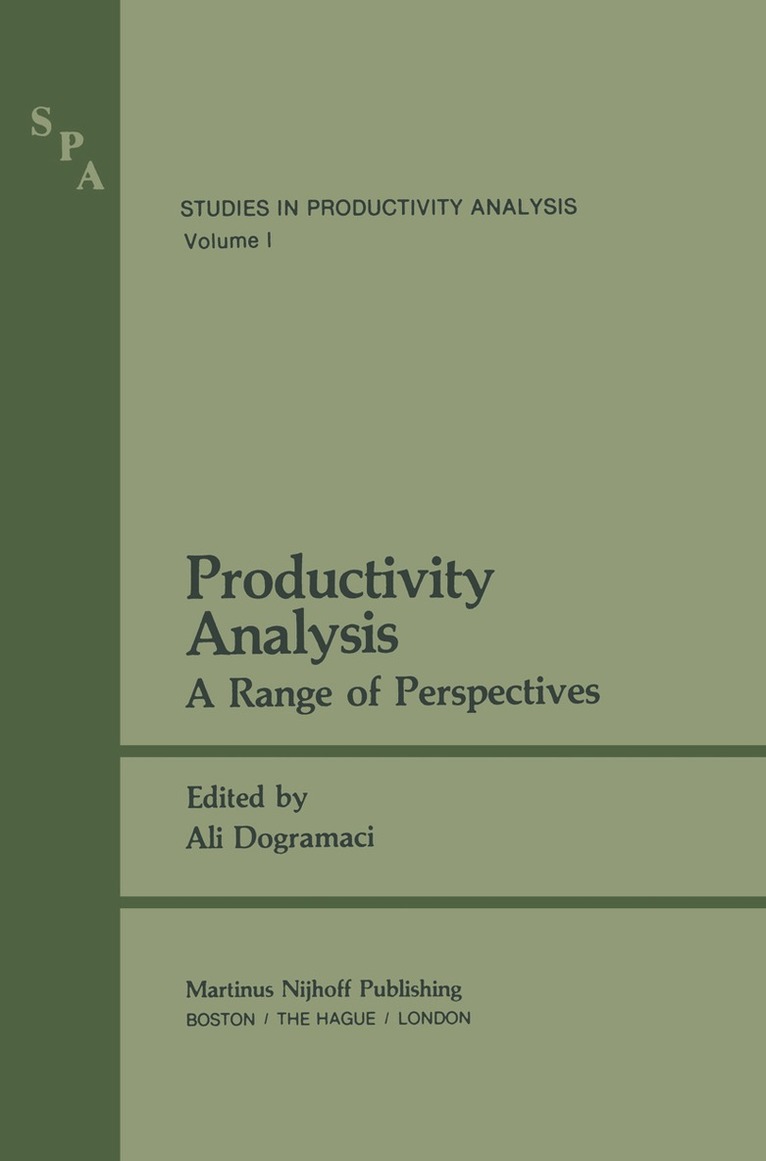
    Productivity Analysis

    A Range of Perspectives

    AvAli Dogramaci

    Häftad, Engelska, 2012

    Del 1 i serien Studies in Productivity Analysis

    562 kr

    Beställningsvara. Skickas inom 10-15 vardagar. Fri frakt över 249 kr.

    Beskrivning

    There is a wide variety of perspectives for productivity analysis. The back­ grounds of different researchers and practitioners who work on this topic include such fields as economics, business administration, and industrial engineering, among others. Within each such field, there are different schools of thought on the theory and application of productivity analysis. Often it is not difficult to observe a lack of communication among the advocates of these separate schools. The purpose of this book is to present in a single volume samples of alternative approaches to productivity analy­ sis. This may be considered as a first step toward a better communication among practitioners and researchers in the fields of management, industrial engineering, and economics. The focus of the book is on the United States, where the productivity growth problem has been acute for some time. The book begins with a brief overview chapter that covers some of the issues involved in productivity analysis and a sample of methodological ap­ proaches presently in use. After this introduction, we move to Chapter 2 where Solomon Fabricant presents the issues related to measurement and analysis at the macroeconomic level. In Chapter 3, C. Lowell Harriss discusses concepts that he considers es­ sential for productivity growth: capital formation, technological progress, and freedom.

    Produktinformation

    • Utgivningsdatum:2012-02-29
    • Mått:155 x 235 x 11 mm
    • Vikt:300 g
    • Format:Häftad
    • Språk:Engelska
    • Serie:Studies in Productivity Analysis
    • Antal sidor:192
    • Upplaga:1981
    • Förlag:Springer
    • ISBN:9789401174046

    Utforska kategorier

    • Ledarskap och motivation inom Ekonomi och Ledarskap
    • Projektledning inom Ekonomi och Ledarskap
    • Företagsekonomi inom Ekonomi och Ledarskap

    Innehållsförteckning

    • 1 Perspectives on Productivity.- 1.1 Introduction.- 1.2 Importance of Productivity Growth.- 1.3 The Measurement of Productivity.- 1.4 More on the Range of Productivity Analysis.- 1.5 Concluding Remarks.- Notes.- References.- 2 Issues in Productivity Measurement and Analysis.- 2.1 Introduction.- 2.2 The Slowdown of U.S. Productivity Growth.- 2.3 Measurement Problems.- 2.4 Timing of the Slowdown.- 2.5 Accounting for the Slowdown.- 2.6 Final Remarks.- Notes.- References.- 3 Basic Forces in Productivity Growth.- 3.1 Introduction.- 3.2 Challenges to “Policy”.- 3.3 Capital Formation.- 3.4 Technological Progress.- 3.5 Freedom.- 3.6 Concluding Comment.- Notes.- References.- 4 Capital Formation and U.S. Productivity Growth, 1948–1976.- 4.1 Introduction.- 4.2 Sectoral Value Added.- 4.3 Aggregate Production.- 4.4 Growth in Output and Inputs.- 4.5 Contribution to Economic Growth.- 4.6 Decomposition of Capital Input.- 4.7 Decomposition of Technical Change.- 4.8 Conclusion.- Notes.- References.- 5 Productivity Change as a Function of Variation in Microeconomy.- 5.1 Introduction.- 5.2 Cost Minimizing.- 5.3 Cost Maximizing.- 5.4 Cost Pass-Along.- 5.5 Conclusion.- Notes.- References.- 6 Improving Industrial Productivity and Technological Capabilities: Needs, Problems, and Suggested Policies.- 6.1 Introduction.- 6.2 Basic Objectives.- 6.3 Needed Revisions of Basic Concepts.- 6.4 Some Shortcomings of Common Productivity Measures.- 6.5 Strengthening Productivity Analysis.- 6.6 Primary Sources of Productivity Adjustments.- 6.7 Effects of Changes in Technology and Productivity Relationships.- 6.8 Productivity and Technology Improvement Efforts: Deterrents and Potential Remedial Measures.- Notes.- References.- 7 Productivity and Production Management.- 7.1 Introduction.- 7.2 Perceptionof a Productivity Problem.- 7.3 Causes of Productivity Problems.- 7.4 Failure to Use the Systems Approach.- 7.5 Higher Volume Work Configurations.- 7.6 Assembling High Demand Volume.- 7.7 Greater Reliance on Methodological Innovation.- 7.8 The Achievement of Renewable Growth.- References.- 8 Productivity and Organization Management.- 8.1 Introduction.- 8.2 Technical Progress.- 8.3 The Rational/Adaptable Organization.- 8.4 Changing Purpose.- 8.5 The Competitive/Progressive Organization.- 8.6 Changing Values.- 8.7 The Innovating/Improving Organization.- 8.8 Creative Environment.- 8.9 Innovative Process.- 8.10 Planned Change.- 8.11 Review.- References.- Name Index.