• Fri frakt över 249 kr
  • •
  • Snabba leveranser
  • •
  • Billiga böcker
Kundservice

Du är på sajten för privatpersoner.

Företag, bibliotek eller offentlig verksamhet?

Du handlar på classic.bokus.com, där alla dina funktioner finns intakta.
Till classic.bokus.com
Bokus logotyp. Gå till startsidan.
  • Erbjudanden
  • Nyheter
  • Student
  • Topplistor
  • Barn & ungdom
  • Bokus Play
  • E-böcker
  • Pocketböcker
  • Spel & pussel

Må bättre, för mindre! Upp till 50% rabatt på hälsoböcker

Sidfot

Mina sidor

    Hjälp

    • Kundservice
    • Vanliga frågor och svar
    • Frakt och leverans
    • Retur vid ångerrätt
    • Reklamera vara
    • Betalning
    • Köpvillkor
    • Allmänna villkor
    • Information om webbplatsens tillgänglighet

    Om Bokus

    • Om oss
    • Pressrum
    • För studenter
    • För företag
    • För bibliotek och offentlig verksamhet
    • För leverantörer
    • Hållbarhet

    Populärt

    • Aktuella erbjudanden
    • Presentkort
    • Studentlitteratur
    • Nya böcker
    • Topplistor
    • Signerade böcker
    • Engelska böcker

    Inspiration

    • Boktips
    • BookTok
    • Populära bokserier
    • Barnbokskaraktärer
    • Populära författare
    Logotyp för Bokus
    Följ oss på Facebook (extern länk)Följ oss på Instagram (extern länk)Följ oss på YouTube (extern länk)Följ oss på TikTok (extern länk)
    bokus @ CookiesAnpassa cookiesIntegritetspolicyKöpvillkor
    Till Citymail hemsida (extern länk)Till Budbee hemsida (extern länk)Till Postnord hemsida (extern länk)Till Schenker hemsida (extern länk)Till Early Bird hemsida (extern länk)Till Walleys hemsida (extern länk)
    1. Historia och arkeologi
    2. Historia
    3. Historia: teori och metod

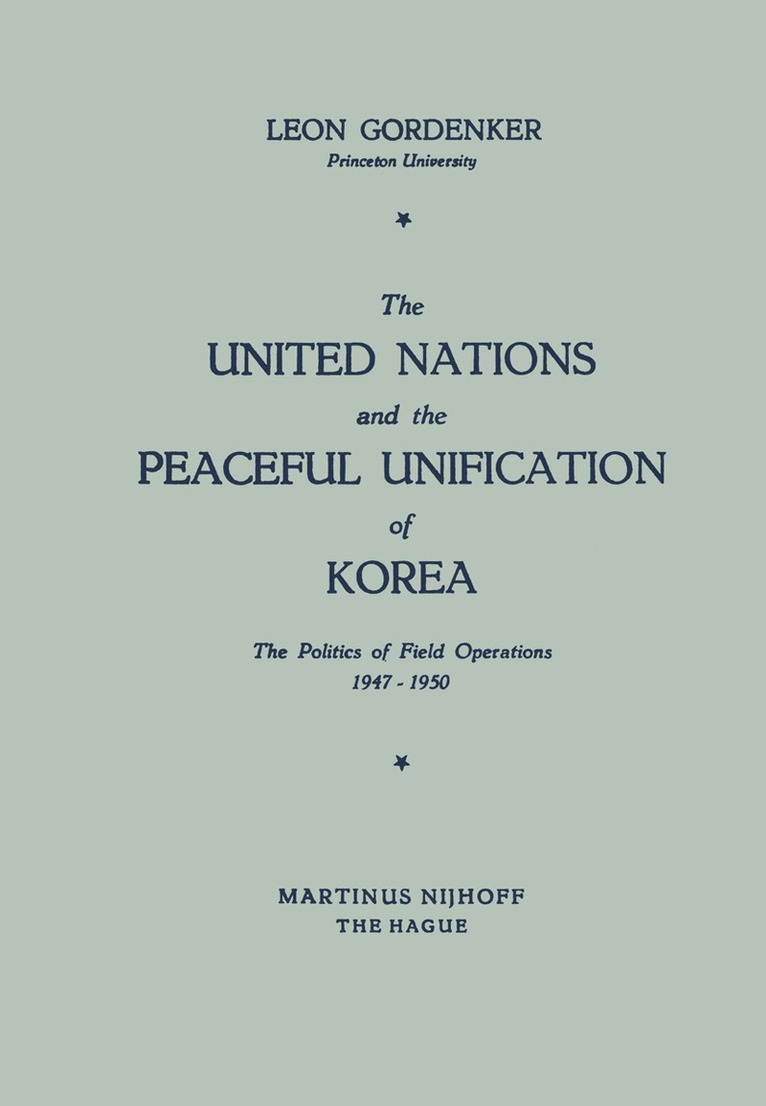
    United Nations and the Peaceful Unification of Korea

    The Politics of Field Operations, 1947–1950

    AvLeon Gordenker

    Häftad, Engelska, 1959

    563 kr

    Beställningsvara. Skickas inom 10-15 vardagar. Fri frakt över 249 kr.

    Fler format och utgåvor

    E-bok

    732 kr

    Beskrivning

    Where there has been fighting or the threat of fighting since the end of the Second World War, the United Nations has ahnost al­ ways been involved. Frequently that involvement has taken the concrete form of a field commission or a team of observers, made up of nationals of several countries and reporting to the General Assembly or the Security Council. Even while I write this, military observers wearing special United Nations insignia are patrolling the border areas of Syria and Lebanon. Meanwhile, observation groups with a longer history are on duty in Kashmir and along the Israeli borders. A field commission of the United Nations still remains in Korea, and others had been at work in Greece, Eritrea, Somalia and on the Hungarian border. All of them lived, worked and reported in an atmosphere of controversy. Perhaps none could have claimed that their work ended in full success. Their existence, however, suggests that the United Nations has developed a special political instrument for use in troubled areas where solutions are elusive but where danger of a spreading con­ flict is never distant. This study deals with the work of field com­ missions of the United Nations in Korea before the violence of 1950. Their work, whatever its merit, came crashing down with the North Korean attack.

    Produktinformation

    • Utgivningsdatum:1959-01-01
    • Mått:170 x 244 x 18 mm
    • Vikt:568 g
    • Format:Häftad
    • Språk:Engelska
    • Antal sidor:306
    • Upplaga:1959
    • Förlag:Springer
    • ISBN:9789401504263

    Utforska kategorier

    • Historia: teori och metod inom Historia och arkeologi
    • Statsvetenskap och politisk teori inom Samhälle och politik
    • Historia inom Historia och arkeologi

    Innehållsförteckning

    • I. The Korean Problem and the United Nations.- Wartime Policy and Liberation.- Trusteeship and Troops.- The Failure of the Soviet-American Joint Commission.- The General Assembly Faces the Korean Question.- The General Assembly and the Birth of UNTCOK.- Continued United Nations Concern with Korea.- II. Formal Organization of the Commissions.- Functions and Powers.- Composition.- Procedure.- Subsidiary Bodies.- Relation to Other Organs.- Secretariat.- III. Korean Election, 1948: The Decision to Observe.- Two Commissions, Two Elections.- The Problem of a Country-Wide Election.- The Temporary Commission Seeks Advice.- The “Little Assembly” Advises.- Informal Decision and Formal Protest.- UNTCOK Accepts Advice.- IV. Korean Election, 1948: Consultation, Observation and Report.- UNTCOK, the Occupation and a Free Election.- Reorganization and Pre-Election Observation.- UNTCOK Makes a Final Decision to Observe.- UNTCOK Watches the Voting.- Toward a Final Report.- A Valid Expression of Free Will.- V. UNTCOK and The Republic.- A Change in Temper.- Local Pressure, UNTCOK and the National Assembly.- The Commission Meets a National Assembly.- The National Assembly Consults UNTCOK.- The Commission Greets a Republic.- The Commission Judges the Government.- VI. The Development of Representative Government.- New Commissions and New Situations.- UNTCOK Disappears.- The General Assembly and the Republic Define Attitudes.- UNCOK I Discusses Consultations.- The President and the Chairman.- UNCOK I Attends Elections.- The Republic Writes Letters.- A Question of Motives.- A New Commission and Consultations.- The Republic Initiates Consultations.- UNCOK II Faces an Election.- UNCOK II Observes Voting.- UNCOK II Assays the Election.- Consultation Before the Storm.- VII. Troop Withdrawal andBorder Incidents.- Soldier, Go Home!.- A Weak Link Forged.- Eyes on the Troops.- Washington Decides on Withdrawal.- UNCOK I Worries about Withdrawal.- UNCOK Watches Withdrawal.- Observation and Observers.- The General Assembly Wants Observers.- Observation and the Invasion.- VIII. The Failure of Unification.- The Meaning of Unity.- Unity and the 1948 Election.- The Problem of Communication.- Diplomatic Channels.- Informal Approaches.- Approach by Broadcast.- Underground Approaches.- Unification and Violence.- IX. Conclusions.- The Political Influence of the Commissions.- The Commissions as Observers.- The Commissions and Decisions.- The Commission Form.- The Secretariat.- A Single Representative.- Successes and Failures.- Selected Bibliography.- Notes.