E-bok, Engelska, 2026
Cross-Border VAT/GST Disputes
Av Richard Stern, Ine Lejeune, Anastasiya Piakarskaya, Jeffrey Owens
2497 kr
Skickas måndag 12/10
Beskrivning
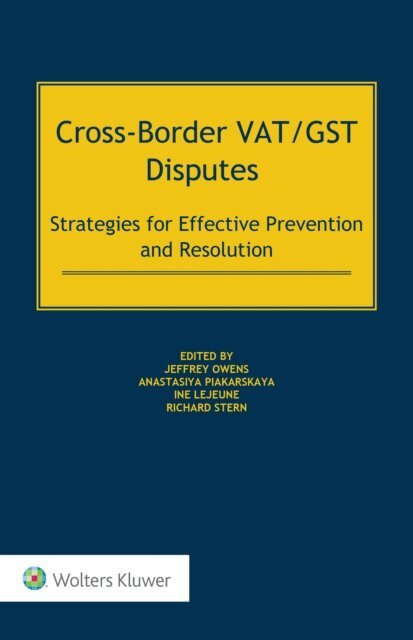
Cross-Border VAT/GST Disputes: Strategies for Effective Prevention and ResolutionEdited By Jeffrey Owens, Anastasiya Piakarskaya, Ine Lejeune & Richard Stern As international trade expands and the digital economy transforms global business, value added tax (VAT) or goods and services tax (GST) systems are increasingly interacting across borders. While VAT/GST has become one of the most important sources of government revenue worldwide, differences in national rules, administrative practices, and interpretations are creating a growing number of cross-border disputes. These disputes generate significant uncertainty for businesses and tax administrations alike, potentially leading to double taxation, delayed VAT refunds, increased compliance costs, and barriers to cross-border trade and investment. Despite the global importance of VAT/GST now implemented in more than 170 countries there is still no comprehensive international framework governing the interaction of national VAT/GST systems comparable to the model conventions used in direct taxation. Although important international guidance has been developed, most notably through the OECD International VAT/GST Guidelines and the European Union s harmonized VAT framework, divergences in interpretation and implementation persist. As global and regional supply chains expand and digital business models continue to evolve, cross-border VAT/GST disputes are expected to become increasingly frequent. This book provides the first comprehensive analysis of the causes, implications, and growing importance of cross-border VAT/GST disputes and proposes practical strategies for their prevention and resolution. The contributions draw on empirical data collected through international surveys conducted by the Global Tax Policy Center at the Institute for Austrian and International Tax Law, Vienna University of Economics and Business, together with the expertise of the Vienna Multistakeholder Group on Cross-Border VAT and Disputes, bringing together representatives from tax administrations, businesses, dispute resolution bodies, international and regional organizations, and academia. Inspired by the work of the OECD and the European Union and informed by experiences from both EU and non-EU countries, the book outlines a structured set of policy options to strengthen the international framework for preventing and resolving cross-border VAT/GST disputes. In particular, it explores: globally more consistent implementation of internationally agreed VAT/GST principles; improved administrative practices to prevent cross-border disputes; cooperative compliance programmes and their potential to reduce disputes; the development and use of cross-border VAT rulings; alternative dispute resolution mechanisms, including mediation and arbitration; judicial specialization and the establishment of specialized tax courts; potential international solutions, including mediation panels, MAP-like mechanisms and an EU Tax Court; the use of digital technologies and data-driven tools to strengthen dispute prevention and resolution. Combining empirical research, legal and policy analysis, and practical recommendations, this volume offers policymakers, tax administrations, dispute resolution bodies and businesses a practical roadmap for enhancing tax certainty and improving the management of cross-border VAT/GST disputes in an increasingly interconnected global economy.
Produktinformation
- Utgivningsdatum: 2026-06-23
- Format: E-bok
- Språk: Engelska
- Förlag: Wolters Kluwer
- ISBN: 9789403511320
Utforska kategorier
Betyg & recensioner
0 recensioner
Inga recensioner tillgängliga.