• Fri frakt över 249 kr
  • •
  • Snabba leveranser
  • •
  • Billiga böcker
Kundservice

Du är på sajten för privatpersoner.

Företag, bibliotek eller offentlig verksamhet?

Du handlar på classic.bokus.com, där alla dina funktioner finns intakta.
Till classic.bokus.com
Bokus logotyp. Gå till startsidan.
  • Erbjudanden
  • Nyheter
  • Student
  • Topplistor
  • Barn & ungdom
  • Bokus Play
  • E-böcker
  • Pocketböcker
  • Spel & pussel

10% rabatt på allt med kod: NYSTART10 →

Sidfot

Mina sidor

    Hjälp

    • Kundservice
    • Vanliga frågor och svar
    • Frakt och leverans
    • Retur vid ångerrätt
    • Reklamera vara
    • Betalning
    • Köpvillkor
    • Allmänna villkor
    • Information om webbplatsens tillgänglighet

    Om Bokus

    • Om oss
    • Pressrum
    • För studenter
    • För företag
    • För bibliotek och offentlig verksamhet
    • För leverantörer
    • Hållbarhet

    Populärt

    • Aktuella erbjudanden
    • Presentkort
    • Studentlitteratur
    • Nya böcker
    • Topplistor
    • Signerade böcker
    • Engelska böcker

    Inspiration

    • Boktips
    • BookTok
    • Populära bokserier
    • Barnbokskaraktärer
    • Populära författare
    Logotyp för Bokus
    Följ oss på Facebook (extern länk)Följ oss på Instagram (extern länk)Följ oss på YouTube (extern länk)Följ oss på TikTok (extern länk)
    bokus @ CookiesAnpassa cookiesIntegritetspolicyKöpvillkor
    Till Citymail hemsida (extern länk)Till Budbee hemsida (extern länk)Till Postnord hemsida (extern länk)Till Schenker hemsida (extern länk)Till Early Bird hemsida (extern länk)Till Walleys hemsida (extern länk)
    1. Kultur
    2. Musikböcker
    3. Musikvetenskap

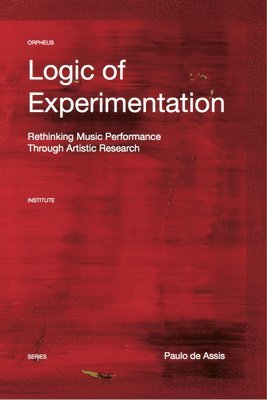
    Logic of Experimentation

    Reshaping Music Performance in and through Artistic Research

    AvPaulo de Assis

    Häftad, Engelska, 2018

    Del i serien Orpheus Institute Series

    562 kr

    Beställningsvara. Skickas inom 5-8 vardagar. Fri frakt över 249 kr.

    Beskrivning

    Logic of Experimentation offers several innovative and ground-breaking perspectives on music performance, music ontology, research methodologies and ethics of performance. It proposes new modes of thinking and exposing past musical works to contemporary audiences, arguing for a new kind of performer, emancipated from authoritative texts and traditions, whose creativity is propelled by intensive research and inventive imagination. Moving beyond the work-concept, Logic of Experimentation presents a new image of musical works, based upon the notions of strata, assemblage and diagram, advancing innovative practice-based methodologies that integrate archival and musicological research into the creative process leading to a performance. Beyond representational modes of performance--be it mainstream or historically informed performance practices--Logic of Experimentation creates an ontological, methodological and ethical space for experimental performance practices, arguing for a new mode of performance. Written in an experimental style, its eight chapters appropriate music performance concepts from post-structural philosophy, psychoanalysis, science and technology studies, epistemology, and semiotics, displaying how transdisciplinarity is central to artistic research. An indispensable contribution to artistic research in music, Logic of Experimentation is compelling reading for music performers, composers, musicologists, philosophers and artist researchers alike.

    Produktinformation

    • Utgivningsdatum:2018-10-29
    • Mått:190 x 285 x 15 mm
    • Vikt:745 g
    • Format:Häftad
    • Språk:Engelska
    • Serie:Orpheus Institute Series
    • Antal sidor:260
    • Förlag:Leuven University Press
    • ISBN:9789462701380

    Utforska kategorier

    • Musikvetenskap inom Kultur

    Mer om författaren

    Paulo de Assis is a researcher affiliated with the Orpheus Institute of Ghent. He is an experimental performer, pianist and music philosopher, with transdisciplinary interests in composition, philosophy, psychoanalysis and epistemology.

    Recensioner i media

    This is a remarkable work, rich in ideas and provocative in its conclusions. Assis offers a transformative approach to music performance, which serves as a paradigmatic instance of artistic research. But he also provides the conceptual framework for a general ontology and epistemology of art, one that has implications well beyond the domain of music. This is a book that deserves the attention of researchers throughout the disciplines of the arts, humanities and social sciences.Bogue, Ronald, jar-online.net. 19/12/2019. https://doi.org/10.22501/jarnet.0023

    Innehållsförteckning

    • Preface: A Transdisciplinary ConjunctureIntroduction: Experimentation versus InterpretationPart 1. Assemblage Theory for MusicChapter 1: Virtual Works—Actual ThingsRasch — The limits of music philosophy and the role of artisticresearch — Music ontologies: some problems — Beyondtranscendence: approaching a Deleuzian ontology — Virtualworks, actual things: towards a new image of musical work —Strata — Rasch25: . . . vers la nuitChapter 2: Assemblage, Strata, DiagramMusical works as assemblages — Agencement, logic of assemblage,assemblage theory — Intermezzo: a note on translation —From structure to assemblage — Strata — Diagram — Logic ofassemblagePart 2: Experimental Systems in MusicChapter 3: Experimental Systems and Artistic ResearchAn epistemology for artistic research? — A methodology forartistic research — Hans-Jörg Rheinberger’s experimental systems— Thought collective and ensembles of experimental systems:MusicExperiment21 — Series of experiments and modules ofresearchChapter 4: Epistemic Complexity in Music PerformanceComplexity and epistemic complexity — Epistemic complexityin biology — Epistemic complexity in technology — Epistemiccomplexity in music — Experimentation in music performance:how to make the future?Part 3. Beyond Interpretation: Bodies-in-ActionChapter 5: Transduction and the Body as a TransducerTransduction in music performance: relaying f lows of intensities;— Gilbert Simondon’s various definitions of transduction —Discharge (potentiality); — Passage (time and temporality);— Energy (thermodynamics): potential, scales, entropy— Information theory: structural germs and singularities(structuration) — Haecceity: from haecceitas (Duns Scotus) toeccéité (Simondon) to heccéité (Deleuze and Guattari) to microhaecceity— Topology: in-formation — Corporeality: somatictransduction — Permanent transduction: being-in-the-world andfluctuatio animi; 11. ConclusionChapter 6: Rasch26: The SomathemeThe somatheme — Roland Barthes at the piano: musica practica —The impact of Julia Kristeva: phenotext and genotext —New musical concepts: geno-song, pheno-song, somatheme —Intermezzo: fourteen somathemes — The impact of JacquesLacan: signifier and jouissance — Lacan’s desire — Situating thesomatheme within Lacan’s graphs of desire — Conclusion: artisticresearch and transdisciplinarityPart 4. A New Ethics of PerformanceChapter 7: The Emancipated Performer:Musical Renderings and Power RelationsMusic performance and power relations — The dominant imageof work and the problem of interpretation — The tacit authorities:Deleuze’s “Postscript on the Societies of Control” — Nietzsche’sthree modes of relation to history: monumental, antiquarian,critical — A new image of work — The emancipated performerChapter 8. . . . at the borders of time that surround our presence . . .What is the contemporary? — Agamben’s contemporary: Barthesreading Nietzsche — Nietzsche’s untimely: lost in translation —. . . at the border of time that surrounds our presence . . . — Artisticresearch as the carrier of the contemporaryAppendix 1: Beyond Urtext: A Dynamic Conception of Musical EditingOn notation and time — The urtext era — Urtext editions: anepistemological obstacle — Critical editing of music and differenttypes of editions — Music editing and performance practice: adynamic conceptionAppendix 2: The Conditions of Creation and the Haecceity of Musical Material: Philosophical-Aesthetic Convergences between Helmut Lachenmann and Gilles DeleuzeHelmut Lachenmann and Gilles Deleuze: an unconnectedconnection — Helmut Lachenmann: toward an aestheticostructuralmethodology — Helmut Lachenmann’s three “theses”on composing — Gilles Deleuze’s diagnostic function of art, captureof forces, and body without organs: first convergences with HelmutLachenmann — Helmut Lachenmann’s four conditions of themusical material — Gilles Deleuze’s opinion, corporeity, fold, andlatitude: further convergences with Helmut Lachenmann — Theconditions of creation and the haecceity of musical material: aphilosophical-aesthetic ErewhonAcknowledgementsIndex