• Fri frakt över 249 kr
  • •
  • Snabba leveranser
  • •
  • Billiga böcker
Kundservice

Du är på sajten för privatpersoner.

Företag, bibliotek eller offentlig verksamhet?

Du handlar på classic.bokus.com, där alla dina funktioner finns intakta.
Till classic.bokus.com
Bokus logotyp. Gå till startsidan.
  • Erbjudanden
  • Nyheter
  • Student
  • Topplistor
  • Barn & ungdom
  • Bokus Play
  • E-böcker
  • Pocketböcker
  • Spel & pussel

10% rabatt på allt med kod NYSTART10 →

Sidfot

Mina sidor

    Hjälp

    • Kundservice
    • Vanliga frågor och svar
    • Frakt och leverans
    • Retur vid ångerrätt
    • Reklamera vara
    • Betalning
    • Köpvillkor
    • Allmänna villkor
    • Information om webbplatsens tillgänglighet

    Om Bokus

    • Om oss
    • Pressrum
    • För studenter
    • För företag
    • För bibliotek och offentlig verksamhet
    • För leverantörer
    • Hållbarhet

    Populärt

    • Aktuella erbjudanden
    • Presentkort
    • Studentlitteratur
    • Nya böcker
    • Topplistor
    • Signerade böcker
    • Engelska böcker

    Inspiration

    • Boktips
    • BookTok
    • Populära bokserier
    • Barnbokskaraktärer
    • Populära författare
    Logotyp för Bokus
    Följ oss på Facebook (extern länk)Följ oss på Instagram (extern länk)Följ oss på YouTube (extern länk)Följ oss på TikTok (extern länk)
    bokus @ CookiesAnpassa cookiesIntegritetspolicyKöpvillkor
    Till Citymail hemsida (extern länk)Till Budbee hemsida (extern länk)Till Postnord hemsida (extern länk)Till Schenker hemsida (extern länk)Till Early Bird hemsida (extern länk)Till Walleys hemsida (extern länk)
    1. Psykologi och pedagogik
    2. Psykologi

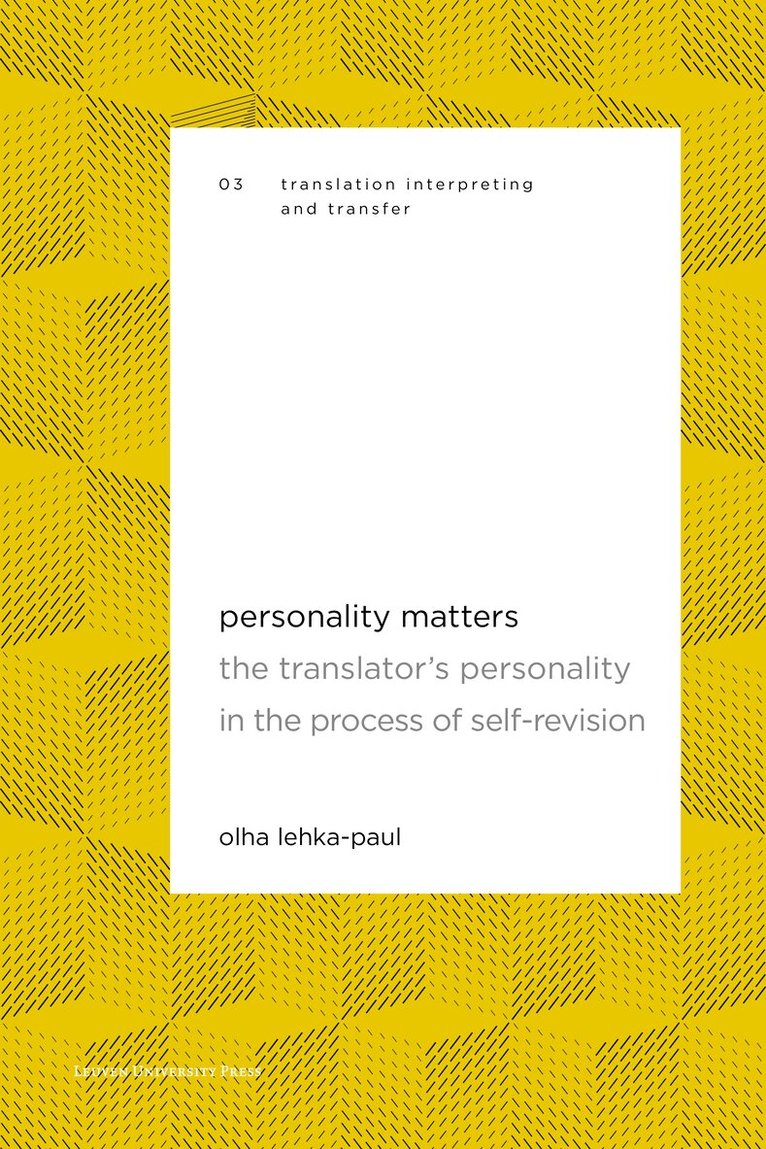
    Personality Matters

    The Translator's Personality in the Process of Self-Revision

    AvOlha Lehka-Paul Lehka-Paul

    Häftad, Engelska, 2020

    Del i serien Translation, Interpreting and Transfer

    842 kr

    Beställningsvara. Skickas inom 5-8 vardagar. Fri frakt över 249 kr.

    Beskrivning

    The analysis of translated texts and investigations into the cognitive mechanisms involved in the process of translation have been at the core of translation studies so far. Yet Personality Matters ventures into the previously uncharted territories by bringing the translator's inherent psychological and cognitive features into the limelight. Combining psychology and translation studies, this monograph looks into the role of the translator's psychological features in self-revision, the main decision-making activity in translation. This groundbreaking study succeeds in laying bare certain traits in the translator's personality that distinguish him or her from non-translators, and shows that the translator's personality matters in the process of translation, making it an individual journey of trial and error for each translator. The book is of particular topical importance within the burgeoning field of translation studies, for while translation may be ubiquitous in the modern globalised world, the person behind it very often remains unnoticed.

    Produktinformation

    • Utgivningsdatum:2020-11-26
    • Mått:156 x 234 x 15 mm
    • Vikt:415 g
    • Format:Häftad
    • Språk:Engelska
    • Serie:Translation, Interpreting and Transfer
    • Antal sidor:277
    • Förlag:Leuven University Press
    • ISBN:9789462702394

    Utforska kategorier

    • Psykologi inom Psykologi och pedagogik
    • Språkvetenskap och lingvistik inom Språk och ordböcker

    Mer om författaren

    Olha Lehka-Paul is Senior Lecturer at the Faculty of English, Adam Mickiewicz University in Poznan, Poland.

    Innehållsförteckning

    • List of tablesList of figures Acknowledgements Introduction Chapter 1: Personality perspectives: From psychology to Translation Studies 1.1. Introduction 1.2. The concept of personality in psychology 1.3. The trait approach: the quantitative studies of personality 1.3.1. Allport’s pioneering study of traits 1.3.2. Cattell’s application of factor analysis to trait studies1.3.3. Eysenck’s three personality dimensions 1.3.4. Costa and McCrae’s Big Fivefactors 1.3.5. Ashton and Lee’s six personality dimensions 1.4. Jung’s personality typology: the qualitative studies of personality 1.5. Combining quantitative and qualitative approaches to the description of personality 1.6. Personality stability and change 1.7. From pure to applied psychology: relevant implementations of personality research 1.7.1. The impact of personality on academic performance 1.7.2. The role of personality in industrial and organizational psychology 1.7.3. The impact of personality on occupational performance 1.8. Review of research into the psychological aspects of the translator’s personality 1.8.1. Early conceptual views on the translator’s personality: 1960s–1970s 1.8.2. First empirical insights into the translator’s personality: 1980s–1990s 1.8.3. Interdisciplinary studies into the translator’s personality using the multi-method approach: since 2000 1.9. Conclusions Chapter 2: The translator’s personality in translation process research2.1. Introduction2.2. Major research orientations in Translation Studies 2.3. The translator as the main agent in the translation process 2.4. Selected models of the translation process 2.4.1. Bell’s translation process model 2.4.2. Hönig’s translation process model 2.4.3. Kiraly’s translation process model 2.4.4. Wilss’s translation process model 2.4.5. Hansen’s translation process model 2.5. Evolution of methodology in translation process research 2.5.1. The first phase: explorations with think-aloud protocols 2.5.2. The second phase: narrowing the focus with keylogging and triangulation 2.5.3. The third phase: methodological integration and the introduction of eye-tracking 2.5.4. The fourth phase: embodied cognition and further dialogue between disciplines and methodologies 2.6. The role of the translator’s personality in translation competence and expertise development 2.6.1. The PACTE project: holistic research into translation competence and its acquisition 2.6.2. The TransComp project: longitudinal study into translation competence and its acquisition 2.6.3. Muñoz Martín’s situated construct of translation expertise 2.7. Conclusions Chapter 3: Self-revision as a product-shaping stage of the translation process 3.1. Introduction3.2. The concept of revision in writing process research 3.3. The concept of self-revision in translation process research3.3.1. Why does self-revision occur? 3.3.2. How does self-revision occur? 3.3.3. When does self-revision occur? 3.3.4. What type of self-revision occurs? 3.4. The role of self-revision in translator profiling Conclusions Chapter 4: Relationship between the translator’s personality, translation process and product4.1. Introduction 4.2. The aims of the study 4.3. Hypotheses 4.4. Methodological basis 4.5. Research design 4.6. Variables 4.6.1. Independent variables 4.6.2. Dependent variables 4.7. Participants 4.8. Tools and materials 4.8.1. Tools and materials related to the translation task 4.8.2. Tools and materials related to personality measurement 4.8.3. Self-report questionnaires 4.9. Experimental procedure 4.10. Data analysis 4.10.1. Translation process data analysis 4.10.2. Translation quality assessment 4.10.3. Personality data analysis 4.10.4. Statistical data analyses 4.11. Results of the experiment 4.11.1. Hypothesis 1 4.11.2. Hypothesis 2 4.11.3. Hypothesis 3 4.11.4. Hypothesis 4 4.11.5. Hypothesis 5 4.12. Results of the self-report questionnaires 4.12.1. Questions related to Hypothesis 1 4.12.2. Questions related to Hypotheses 2–4 4.12.3. Questions related to Hypothesis 5 4.13. General discussion of results 4.13.1. Limitations of the study and further research avenues 4.13.2. Didactic implications Concluding remarks Appendix A Appendix B Appendix C Appendix D Appendix E Appendix F Abstract References Index