• Fri frakt över 249 kr
  • •
  • Snabba leveranser
  • •
  • Billiga böcker
Kundservice

Du är på sajten för privatpersoner.

Företag, bibliotek eller offentlig verksamhet?

Du handlar på classic.bokus.com, där alla dina funktioner finns intakta.
Till classic.bokus.com
Bokus logotyp. Gå till startsidan.
  • Erbjudanden
  • Nyheter
  • Student
  • Topplistor
  • Barn & ungdom
  • Bokus Play
  • E-böcker
  • Pocketböcker
  • Spel & pussel

10% rabatt på allt med kod NYSTART10 →

Sidfot

Mina sidor

    Hjälp

    • Kundservice
    • Vanliga frågor och svar
    • Frakt och leverans
    • Retur vid ångerrätt
    • Reklamera vara
    • Betalning
    • Köpvillkor
    • Allmänna villkor
    • Information om webbplatsens tillgänglighet

    Om Bokus

    • Om oss
    • Pressrum
    • För studenter
    • För företag
    • För bibliotek och offentlig verksamhet
    • För leverantörer
    • Hållbarhet

    Populärt

    • Aktuella erbjudanden
    • Presentkort
    • Studentlitteratur
    • Nya böcker
    • Topplistor
    • Signerade böcker
    • Engelska böcker

    Inspiration

    • Boktips
    • BookTok
    • Populära bokserier
    • Barnbokskaraktärer
    • Populära författare
    Logotyp för Bokus
    Följ oss på Facebook (extern länk)Följ oss på Instagram (extern länk)Följ oss på YouTube (extern länk)Följ oss på TikTok (extern länk)
    bokus @ CookiesAnpassa cookiesIntegritetspolicyKöpvillkor
    Till Citymail hemsida (extern länk)Till Budbee hemsida (extern länk)Till Postnord hemsida (extern länk)Till Schenker hemsida (extern länk)Till Early Bird hemsida (extern länk)Till Walleys hemsida (extern länk)
    1. Skönlitteratur
    2. Dramatik

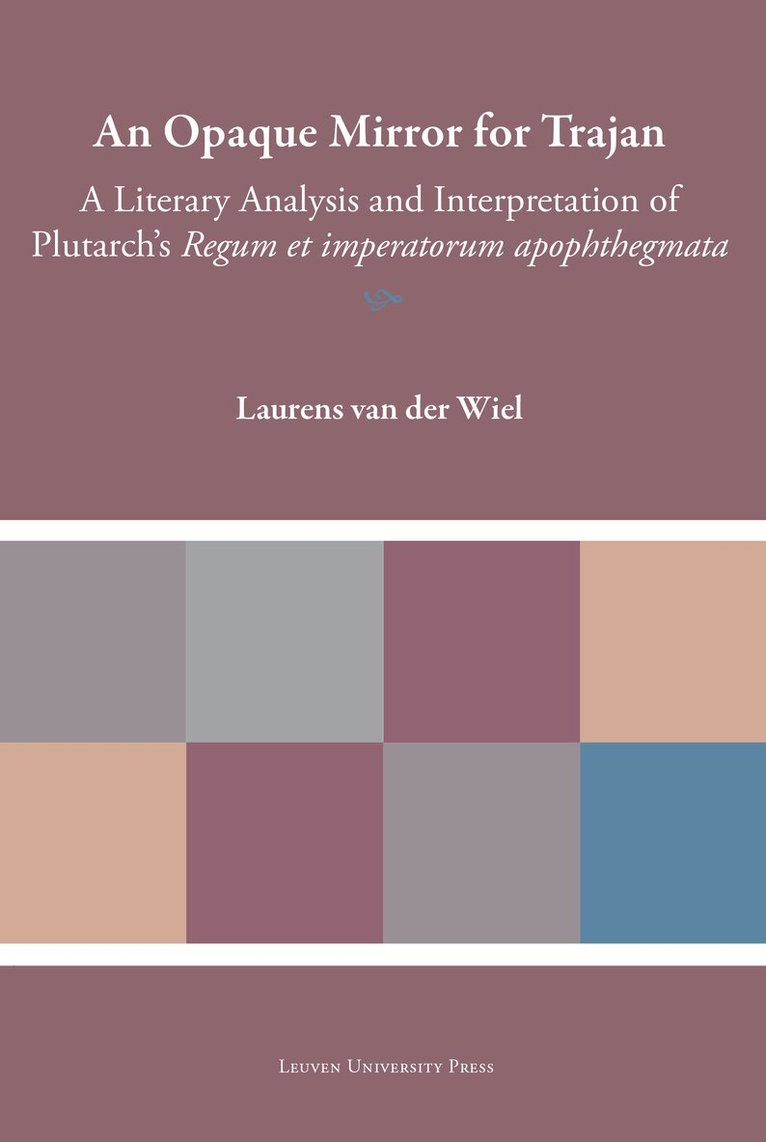
    Opaque Mirror For Trajan

    A Literary Analysis and Interpretation of Plutarch's 'Regum et Imperatorum Apophthegmata'

    AvLaurens van der Wiel

    Inbunden, Engelska, 2024

    Del i serien Plutarchea Hypomnemata

    1 221 kr

    Beställningsvara. Skickas inom 5-8 vardagar. Fri frakt över 249 kr.

    Beskrivning

    The first full in-depth analysis and interpretation of Plutarch’s Regum et imperatorum apophthegmata in its entirety as a literary piece of art.Plutarch’s Regum et imperatorum apophthegmata (Sayings of Kings and Commanders) holds a peculiar position in his oeuvre. This collection of almost 500 anecdotes of barbarian, Greek, and Roman rulers and generals is introduced by a dedicatory letter to Trajan as a summary of the author’s well-known and widely read Parallel Lives. The work is therefore Plutarch’s only text that explicitly addresses a Roman emperor and is likely to shed light on his biographical technique. Yet the collection has been understudied, because its authenticity has been generally rejected since the nineteenth century. Recent scholarship defends Plutarch's authorship of the text, but some remain sceptical. This book restores its reputation and provides a first full literary analysis of the letter and collection as a genuine work of Plutarch, wherein he attempts to educate his ruler by means of great role models of the past. Plutarch’s thinking about the function of role models (exempla) is not only relevant for Plutarchan research, but also for our knowledge of exemplarity, a key feature both in Greek and Latin literature in the early imperial period in general. Therefore An Opaque Mirror for Trajan is also of interest for literary and historical scholars who study the broader context of ancient literature of the first centuries CE.Ebook available in Open Access. This publication is GPRC-labeled (Guaranteed Peer-Reviewed Content).

    Produktinformation

    • Utgivningsdatum:2024-01-15
    • Mått:156 x 234 x 35 mm
    • Vikt:942 g
    • Format:Inbunden
    • Språk:Engelska
    • Serie:Plutarchea Hypomnemata
    • Antal sidor:500
    • Förlag:Leuven University Press
    • ISBN:9789462703902

    Utforska kategorier

    • Dramatik inom Skönlitteratur
    • Filosofiska discipliner inom Filosofi och religion

    Mer om författaren

    Laurens van der Wiel is a postdoctoral researcher at the University of Warsaw.

    Recensioner i media

    Van der Wiel’s thoughtful, detailed, and meticulous study breaks new ground, and greatly enhances our understanding of the relationship between Plutarch’s dedication letter to Trajan and the 'Regum et imperatorum apophthegmata' collection. He forcefully and persuasively argues for the authenticity of both the letter and the collection. This is unquestionably the most important interpretation of this somewhat neglected aspect of Plutarch’s oeuvre yet published. Mark A. Beck, University of South Carolina

    Innehållsförteckning

    • AcknowledgementsText Editions, Translations, and AbbreviationsIntroductionPart I. Preliminaries1 Authenticity 1.1 The Dedicatory Letter 1.1.1 Writing Style and Content 1.1.2 Plutarch and Trajan 1.1.3 Conclusion 1.2 The Collection 1.2.1 Hiatus1.2.2 The Origins of the Apophthegms 1.3 Conclusion2 Dating 2.1 Absolute Dating 2.2 Relative Dating: The Collection and the Parallel Lives 2.2.1 The Connection Between the Works 2.2.2 Romans Absent From the Collection 2.2.3 The Relative Chronology 2.3 Conclusion3 Early Imperial Anecdote Collections 3.1 Plutarch’s View on Collections of Sayings and Anecdotes 3.1.1 Gnome, apophthegma, apomnemoneuma, and chreia 3.1.2 Anecdote Collections3.2 Plutarch and Valerius Maximus 3.2.1 The Prefaces 3.2.2 The Structure of the Collections 3.3 ConclusionPart II. A Literary AnalysisIntroduction1 The Dedicatory Letter (172B–E) 1.1 The Dedication (172BC) 1.2 The Apologetic Part (172C–E) 1.3 A Clash between the Two Parts 1.4 Conclusion2 The Letter and the Structure of the Collection 2.1 Apophthegms 2.2 Sections on Historical Figures2.3 Sections on Peoples and Types of Government 2.4 A World History 2.5 Overview3 The Monarchical Sections (172E–184F) 3.1 Persian Despotism (172E–174B) 3.1.1 Cyrus (172EF) 3.1.2 Darius (172F–173B) 3.1.3 Xerxes (173BC) 3.1.4 Four Sections on Artaxerxes Mnemon (173D–174B) 3.1.5 Memnon (174B) 3.2 The Egyptian Kings (174C) 3.3 Barbarian Disarray (174C–F) 3.4 Sicilian Tyranny (175A–177A) 3.4.1 Gelon and Hiero (175A–C) 3.4.2 The Dionysii (175C–176E) 3.4.3 Dion and Agathocles (176E–177A)3.5 Macedonian Monarchy (177A–184F) 3.5.1 Archelaus (177AB) 3.5.2 Philippus (177C–179C) 3.5.3 Alexander (179D–181F) 3.5.4 The Diadochi (181F–184F)4 The Greeks of the Core Mainland (184F–194E) 4.1 The Athenians (184F–189D) 4.1.1 Love of Honour and Justice (184F–186F) 4.1.2 Four Generals, Two Orators (186F–187E) 4.1.3 Phocion (187E–189B) 4.1.4 Peisistratus and Demetrius of Phalerum (189B–D) 4.2 The Spartans (189D–192C) 4.2.1 Early Sparta (189D–190A) 4.2.2 A Period of Wars (190A–D) 4.2.3 Lysander (190D–F) 4.2.4 Agesilaus (190F–191D) 4.2.5 Nine Short Sections (191D–192C) 4.3 The Thebans (192C–194E) 4.3.1 Epameinondas (192C–194C) 4.3.2 Pelopidas (194C–E)5 The Roman Sections (194E–208A) 5.1 The Conquerors of the Roman Republic (194E–202E) 5.1.1 Manius Curius and Gaius Fabricius (194E–195C) 5.1.2 Fabius Maximus and Scipio Maior (195C–197A) 5.1.3 Titus Quintius Flamininus (197A–D) 5.1.4 A General’s Experience: Three Sections (197D–198D) 5.1.5 Cato Maior (198D–199E)5.1.6 Scipio Minor (199F–201F) 5.1.7 Caecilius Metellus (201F–202A) 5.1.8 Marius, Sulla, and the Civil War (202A–E) 5.2 Gaius Popillius (202E–203A) 5.3 The End of the Roman Republic (203A–206F)5.3.1 Lucullus and Pompeius (203A–204E) 5.3.2 Cicero (204E–205E) 5.3.3 Caesar (205E–206F) 5.4 The Roman Principate: Augustus (206F–208A)Concluding RemarksPart III. A Guide for the EmperorIntroduction1 The Individual Characters 1.1 Moralism and Characterization 1.1.1 Moralism 1.1.2 Characterization 1.1.3 Conclusion: A Collection of Problematic Heroes? 1.2 Negative Exempla 1.2.1 The Prologue to Demetrius–Antonius 1.2.2 Negative Exempla in Regum et imperatorum apophthegmata 1.3 ‘Perfect’ Exempla 1.3.1 The Comparison of Aristeides and Cato Maior 1.3.2 Perfect Exempla in Regum et imperatorum apophthegmata 1.4 Positive Exempla 1.4.1 The Prologue to Pericles–Fabius Maximus 1.4.2 The Prologue to Aemilius–Timoleon 1.4.3 De profectibus in virtute 84B–85C 1.4.4 Positive Exempla in Regum et imperatorum apophthegmata 1.5 Conclusion2 Peoples and Their Rulers 2.1 Three Types of Barbarians2.2 Sicilian Tyranny 2.3 True Monarchy2.4 Other Types of Government 2.5 Conclusion3 A World History 3.1 Plutarch’s ‘End of History’3.2 World History in Regum et imperatorum apophthegmata 3.2.1 Two Paralleled Chronologies 3.2.2 The Driving Force Behind History: φιλοτιμία 3.3 Conclusion: A Warning for the EmperorConcluding RemarksGeneral ConclusionAppendices Appendix I: A Restructuring of the Collection Appendix II: The Collection and the Plutarchan Oeuvre 1 List of Parallel Passages 2 Regum et imperatorum apophthegmata and the Parallel Lives 3 Apophthegms Occurring in Two Other Plutarchan Works Appendix III: The Relative Chronology of the Parallel Lives 1 Methodology 2 The Cross-References: Jones (1966) Revisited 3 Content-Related Criteria 4 ConclusionBibliography Primary Literature Secondary LiteratureIndex locorum