• Fri frakt över 249 kr
  • •
  • Snabba leveranser
  • •
  • Billiga böcker
Kundservice

Du är på sajten för privatpersoner.

Företag, bibliotek eller offentlig verksamhet?

Du handlar på classic.bokus.com, där alla dina funktioner finns intakta.
Till classic.bokus.com
Bokus logotyp. Gå till startsidan.
  • Erbjudanden
  • Nyheter
  • Student
  • Topplistor
  • Barn & ungdom
  • Bokus Play
  • E-böcker
  • Pocketböcker
  • Spel & pussel

10% rabatt på allt med kod NYSTART10 →

Sidfot

Mina sidor

    Hjälp

    • Kundservice
    • Vanliga frågor och svar
    • Frakt och leverans
    • Retur vid ångerrätt
    • Reklamera vara
    • Betalning
    • Köpvillkor
    • Allmänna villkor
    • Information om webbplatsens tillgänglighet

    Om Bokus

    • Om oss
    • Pressrum
    • För studenter
    • För företag
    • För bibliotek och offentlig verksamhet
    • För leverantörer
    • Hållbarhet

    Populärt

    • Aktuella erbjudanden
    • Presentkort
    • Studentlitteratur
    • Nya böcker
    • Topplistor
    • Signerade böcker
    • Engelska böcker

    Inspiration

    • Boktips
    • BookTok
    • Populära bokserier
    • Barnbokskaraktärer
    • Populära författare
    Logotyp för Bokus
    Följ oss på Facebook (extern länk)Följ oss på Instagram (extern länk)Följ oss på YouTube (extern länk)Följ oss på TikTok (extern länk)
    bokus @ CookiesAnpassa cookiesIntegritetspolicyKöpvillkor
    Till Citymail hemsida (extern länk)Till Budbee hemsida (extern länk)Till Postnord hemsida (extern länk)Till Schenker hemsida (extern länk)Till Early Bird hemsida (extern länk)Till Walleys hemsida (extern länk)
    1. Historia och arkeologi
    2. Arkeologi
    3. Arkeologiska perioder och områden

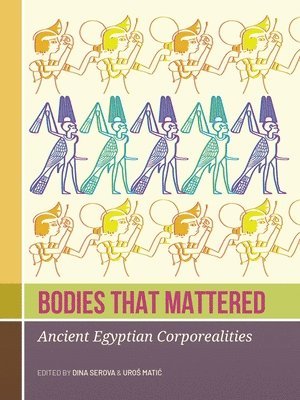
    Bodies that Mattered

    Ancient Egyptian Corporealities

    AvDina Serova,Uroš Matić

    Häftad, Engelska, 2025

    991 kr

    Beställningsvara. Skickas inom 3-6 vardagar. Fri frakt över 249 kr.

    Beskrivning

    Bodies are immanent element of socio-cultural negotiation. Since the 19th century, Egyptology has produced vast knowledge on the ancient Egyptian bodies (human, divine, animal), however, mainly by focusing on funerary aspects of ancient Egyptian culture. Different paradigm shifts and turns of the last few decades (hermeneutics, semiotics, social-constructivism, ontology etc.), echo through Egyptology, but are still not part of the dominant discourse. This is also the case for the so-called “body turn”, an important epistemological turning point, that came largely unnoticed in Egyptology. Previous body centred Egyptological publications are either too specific in their focus or too broad in their presentation of Ancient Egyptian corporealities.To balance this out and reflect the latest state of research, this volume brings together selected contributions from the fields of Egyptology and Northeast African Archaeology. The focus is on both conceptualizations of the bodies by ancient Egyptians and Egyptologists. The topics of the contributions cover familiar but also new aspects. They range from division of labour, disability, gender roles, erotic, magic, fragmented and narrated bodies, other-than-human corporealities, to questions of ethics and the place of Egyptology in current approaches to past bodies. Various textual, pictorial, and archaeological sources, as well as human remains, are analyzed both from synchronic and diachronic perspectives.From the theoretical and methodological point of view, the publication provides deeper insights into a number of different approaches and their application to the ancient material (among others: osteoarchaeology, socio-cultural anthropology, semiotics, new materialism, ontology, etc.), which makes the book an important reading for all career stage Egyptologists (students to professionals) and the broader interested public.

    Produktinformation

    • Utgivningsdatum:2025-11-04
    • Mått:210 x 279 x 17 mm
    • Vikt:930 g
    • Format:Häftad
    • Språk:Engelska
    • Antal sidor:250
    • Upplaga:25001
    • Förlag:Sidestone Press
    • ISBN:9789464271294

    Utforska kategorier

    • Arkeologiska perioder och områden inom Historia och arkeologi

    Mer om författaren

    Dina Serova completed her PhD in Northeast African Archaeology and Cultural Studies at Humboldt-Universität zu Berlin in 2021. Her doctoral thesis Nakedness and Nudity in Ancient Egypt: Epistemes, Lexemes and (Re-)Constructions explores body conceptualizations through texts, images, and archaeological remains, analyzing these primary sources within archaeological discourses from a diachronic perspective.Currently, Dina is a postdoctoral researcher at Humboldt-Universität zu Berlin and teaches classes on Ancient Egyptian languages and written culture as well as their interpretation by means of theories and methods derived from sociolinguistics, cultural studies, and sociology.Since 2024, Dina is a Junior PI of the project Asymmetric Communication in Ancient Egypt within the Collaborative Research Center 1412 “Register” where she investigates register knowledge and variation in Ancient Egyptian narrative and mortuary texts from a linguistic perspective. She is an active member of several international research groups and projects, such as Multimodal Communication in Ancient Egypt with Silvia Kutscher and the Middle Kingdom Theban Project led by Antonio J. Morales, which emphasize her academic diversity and broad research interests. Uroš Matić has obtained his PhD from the University of Münster (Germany) in 2017 and has since lectured at the Universities of Münster, Vienna, Graz and Innsbruck. He directed several stand-alone postdoctoral projects from 2018 to 2025 and participated on archaeological excavations and in museum studies in Egypt, Sudan and Lebanon. He received two prizes for his doctoral dissertation Body and Frames of War in New Kingdom Egypt: Violent Treatment of Enemies and Prisoners (Harrassowitz, 2019): the Philippika Prize of Harrassowitz in 2018 and Best Publication Award of the Austrian Academy of Sciences in 2020.Since 2009 he is a member of the European Association of Archaeologists and the community Archaeology and Gender in Europe, which he co-chaired from 2016 to 2019. He extensively published on archaeology of the body, war, violence, gender and sexuality, with most recent publications including Violence and Gender in Ancient Egypt (Routledge, 2021), Beautiful Bodies. Gender and Corporeal Aesthetics in the Past (Oxbow, 2022) and Current Archaeological Debates from a Gender Perspective (Springer, 2024, co-edited with Bisserka Gaydarska, Laura Coltofean and Marta Diaz Guardamino).He is co-editing the Element series Archaeology and Gender of the Cambridge University Press together with Katharina Rebay-Salisbury. He is also co-editing the series Hot Academia of Sidestone Press, together with Laura Coltofean and Bisserka Gaydarska.

    Innehållsförteckning

    • 1. Introduction to Ancient Egyptian CorporealitiesUroš Matić & Dina SerovaSOMATIC EXPERIENCES2. Corporealities of Physical Labor and the Origins of the Nile Valley States: Engendered Differences in Predynastic Egypt and the Kingdom of KermaJared Carballo-Perez & Sarah A. Schrader3. Human Body Parts in Ancient Egyptian Rock ArtPaweł Lech Polkowski4. Failing in being “proper men”: Disabled, maimed and injured bodies through ancient Egyptian frames of warUroš MatićGENDER NORMS AND AMBIGUITIES5. Sex, Gender and Queerness in Ancient EgyptAlexandra von Lieven6. Interpreting Hatshepsut’s (Fe)Male bodyFilip Taterka7. “I Put a Spell on You”. The Body as Subject, Object and Medium in Graeco-Egyptian Erotic MagicSvenja NagelTEXTUAL BODIES: NARRATION AND BEYOND8. Bodies Narrated: The Depiction of Human Bodies in Ancient Egyptian StorytellingNikolaos Lazaridis9. Objects of Desire: Naked Goddesses in Two Ancient Egyptian Narrative TextsDina Serova10. Corporeality and Bodies in Ancient Egyptian DemonologyGabriele Mario ConteTHE FUTURE FOR BODIES THAT MATTERED11. Collecting, Studying, and Exhibiting Human Bodies. Considerations on the Ethics of Scholarship and EducationRainer Brömer & Tanja Pommerening12. Approaching Ancient Egyptian Bodies: Cognition, Phenomenology, Ontology, and Beyond?Rune Nyord