• Fri frakt över 249 kr
  • •
  • Snabba leveranser
  • •
  • Billiga böcker
Kundservice

Du är på sajten för privatpersoner.

Företag, bibliotek eller offentlig verksamhet?

Du handlar på classic.bokus.com, där alla dina funktioner finns intakta.
Till classic.bokus.com
Bokus logotyp. Gå till startsidan.
  • Erbjudanden
  • Student
  • Topplistor
  • Barn & ungdom
  • Bokus Play
  • E-böcker
  • Ljudböcker
  • Pocketböcker
  • Spel & pussel

10% rabatt på allt med kod NYSTART10 →

Sidfot

Mina sidor

    Hjälp

    • Kundservice
    • Vanliga frågor och svar
    • Frakt och leverans
    • Retur vid ångerrätt
    • Reklamera vara
    • Betalning
    • Köpvillkor
    • Allmänna villkor
    • Information om webbplatsens tillgänglighet

    Om Bokus

    • Om oss
    • Pressrum
    • För studenter
    • För företag
    • För bibliotek och offentlig verksamhet
    • För leverantörer
    • Hållbarhet

    Populärt

    • Aktuella erbjudanden
    • Presentkort
    • Studentlitteratur
    • Nya böcker
    • Topplistor
    • Signerade böcker
    • Engelska böcker

    Inspiration

    • Boktips
    • BookTok
    • Populära bokserier
    • Barnbokskaraktärer
    • Populära författare
    Logotyp för Bokus
    Följ oss på Facebook (extern länk)Följ oss på Instagram (extern länk)Följ oss på YouTube (extern länk)Följ oss på TikTok (extern länk)
    bokus @ CookiesAnpassa cookiesIntegritetspolicyKöpvillkor
    Till Citymail hemsida (extern länk)Till Budbee hemsida (extern länk)Till Postnord hemsida (extern länk)Till Schenker hemsida (extern länk)Till Early Bird hemsida (extern länk)Till Walleys hemsida (extern länk)
    1. Historia och arkeologi
    2. Arkeologi

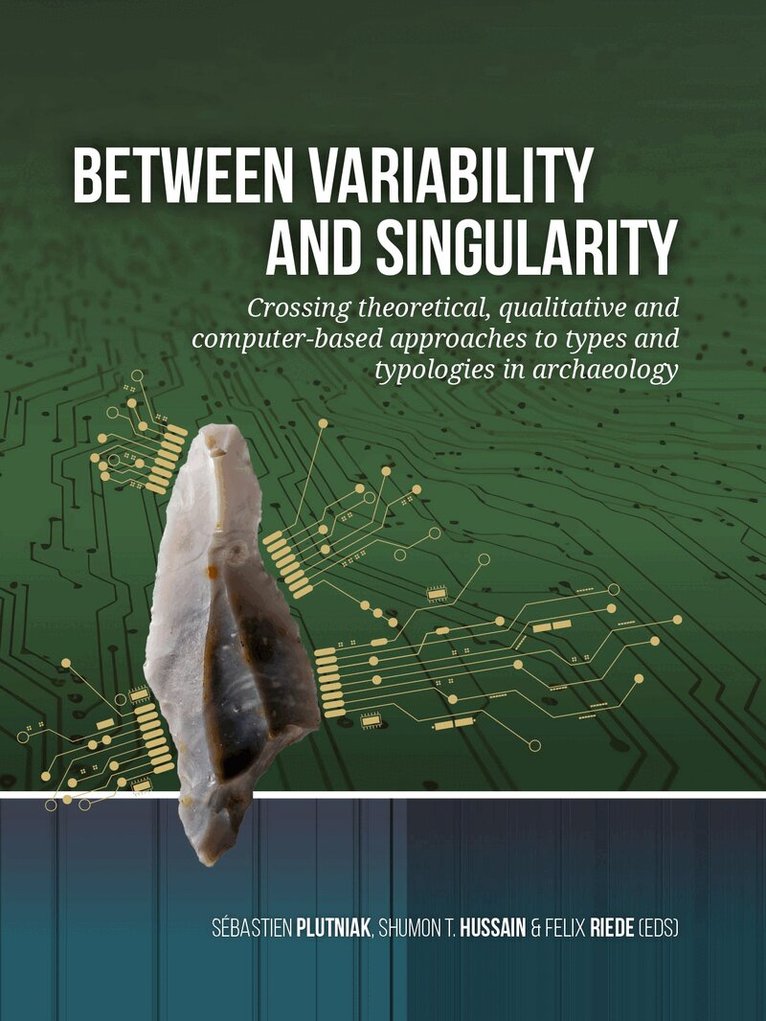
    Between variability and singularity

    Crossing theoretical, qualitative and computer-based approaches to types and typologies in archaeology

    AvSébastien Plutniak,Shumon T. Hussain

    Inbunden, Engelska, 2026

    1 931 kr

    Kommande

    Beskrivning

    Typology is a core method and practice in archaeology. As a particular form of classification first developed during the infancy of the discipline itself, typology has remained an archaeological staple despite countless twists and turns. Rarely taught explicitly, and often critiqued, typology refuses to loosen its grip on archaeological practice. In 14 chapters, this book explores how typology as a method and typologies as specific practices have developed, how typology is situated in contemporary theoretical thinking, and how typologies relate to the rapidly unfolding computational revolution that is reshaping the discipline. The volume offers state-of-the-art perspectives on typology grounded in all periods and across numerous artefact classes – ceramics, lithics, coins – as well as experimental articulations between typological thinking and mapping practices. Together, the chapters making up this volume challenge naïve typologizing and bring the topic of what we call things and how we classify them to the fore of archaeological debates. The volume is essential reading for graduate students and professionals alike; it offers critical perspectives on core principles of archaeological classification but also provides visionary signposts for how theory and computational methods engage with classification practices now and in the years to come. Notably, this book is not only experimental in its content but also in its form: All chapters contained in it have been peer-assessed in their preprint forms such that earlier versions, all peer reviews and editorial recommendations are available as rich metadata. In this way, the volume sets new standards for bibliodiverse scholarly publishing at the interface between the digital and the physical.

    Produktinformation

    • Utgivningsdatum:2026-09-29
    • Mått:210 x 280 x undefined mm
    • Format:Inbunden
    • Språk:Engelska
    • Antal sidor:260
    • Förlag:Sidestone Press
    • ISBN:9789464271607

    Utforska kategorier

    • Arkeologi inom Historia och arkeologi

    Mer om författaren

    Sébastien Plutniak is a researcher at the French National Centre for Scientific Research (CNRS), working at the CITERES-LAT laboratory (Tours, France), and a former fellow of the École française de Rome. Trained as a prehistoric archaeologist and a sociologist and historian of science, his research focuses on contemporary and past uses of formal and computer-based methods in the humanities and social sciences –and archaeology in particular–, studied from practical, socio-historical, and epistemological perspectives.As a field archaeologist he worked intensively in Borneo (2009-2016) and in New Guinea (2018-2024). Besides, he serves as a board member of the French Chapter of the “Computer Applications and Quantitative Methods in Archaeology” organisation, the “French Prehistoric Society”, and the “History of Archaeology” commission of the “International Union for Prehistoric and Protohistoric Sciences”. Shumon T. Hussain is a cross-disciplinary archaeologist with a research focus on Late Pleistocene and Early Holocene hunter-gatherer societies, in particular their stone artefact technologies and animal relationships. He is broadly interested in theoretical innovation and synthesis beyond archaeology as a disciplinary specialism, to better integrate data and perspectives across the humanities and sciences vis-à-vis questions of the human deep past, and the epistemology and practice of science. He is currently based at the University of Cologne, Germany, where he is Junior Research Group Leader at the Department for Prehistoric Archaeology and the newly established research hub MESH – Multidisciplinary Environmental Studies in the Humanities.Shumon is the author of “Contested Deep Pasts: Negotiating the French-Anglophone Divide in Pleistocene Lithic Studies” (Sidestone, 2026) and has published widely on archaeological theory and multispecies archaeology, including “What is Animal Prehistory?” (Animal History, 2025) and the “Paleolithic and Human-Animal Relations” entry in the Oxford Bibliography of Environmental History (Oxford University Press, 2025). Felix Riede is professor of archaeology at Aarhus University in Denmark. He holds a PhD from the University of Cambridge and has been visiting scholar at Harvard University’s Department of Anthropology, the Department of Geography in Cambridge, and the Oeschger Center for Climate Change Research at Bern University.Felix works within an extended evolutionary synthesis framework to understand human biocultural evolution, its cognitive, social, climatic and environmental correlates, causes, and consequences. Felix is an astute interdisciplinarian and his work integrates across scales from individual artefacts to global patterns, across methods from qualitative to quantitative, from the laboratory to the field, from the archive to abstract models, and across scientific fields. In addition to many scientific and popular journal articles and book chapters,Felix is the author of “Splendid isolation. The eruption of the Laacher See volcano and southern Scandinavian Late Glacial hunter-gatherers” (AUP, 2017) and co-editor, with Payson Sheets, of “Going Forward by Looking Back: Archaeological Perspectives on Socio-Ecological Crisis, Response, and Collapse” (Berhahn, 2020).

    Innehållsförteckning

    • PrefaceTypologising archaeological typologies: Motivation, structure and the making of a digitally augmented edited volumeSébastien Plutniak, Shumon T. Hussain & Felix RiedePart I: The epistemology and theory of types and typologiesResearch perspectives and their influence on typologiesEnrico GiannicheddaOn the physics and metaphysics of classification in archaeologyMercedes Okumura & Astolfo G.M. AraujoThe loss of typological innocence: Pluralism in the epistemology and ontology of archaeological typo-praxisShumon T. HussainArchaeology, typology and machine epistemologyGavin LucasPart II: Research legacies, digital infrastructures and computer-based approachesTool types and the establishment of the Late Palaeolithic (Later Stone Age) cultural taxonomic system in the Nile ValleyAlice LeplongeonThe role of heritage databases in typological reification: A case study from the Final Palaeolithic of southern ScandinaviaFelix RiedeFrom paper to byte: An interim report on the digital transformation of two thing editionsFrederic Auth, Katja Rösler, Wenke Domscheit & Kerstin P. HofmannThe density of types and the dignity of the fragment: A website approach to archaeological typologyGiorgio Buccellati & Marilyn Kelly-BuccellatiIT- and machine learning-based methods of classification: The cooperative project ClaReNet (Classification and Representation for Networks)Chrisowalandis Deligio, Caroline von Nicolai, Markus Möller, Katja Rösler, Julia Tietz, Robin Krause, Kerstin P. Hofmann, Karsten Tolle & David Wigg-WolfPart III: New perspectives and themes in type-thinkingWhat is a form? On the classification of archaeological potteryPhilippe BoissinotA return to function as the basis of lithic classificationRadu IovitaSpeaking types into being: Language acts, typological persistence and performing archaeological spacePiraye HacıgüzellerHypercultural types: Archaeological objects in fast timeArtur S.P. RibeiroPostscriptDo we need (more) humble typologies?Shumon T. Hussain