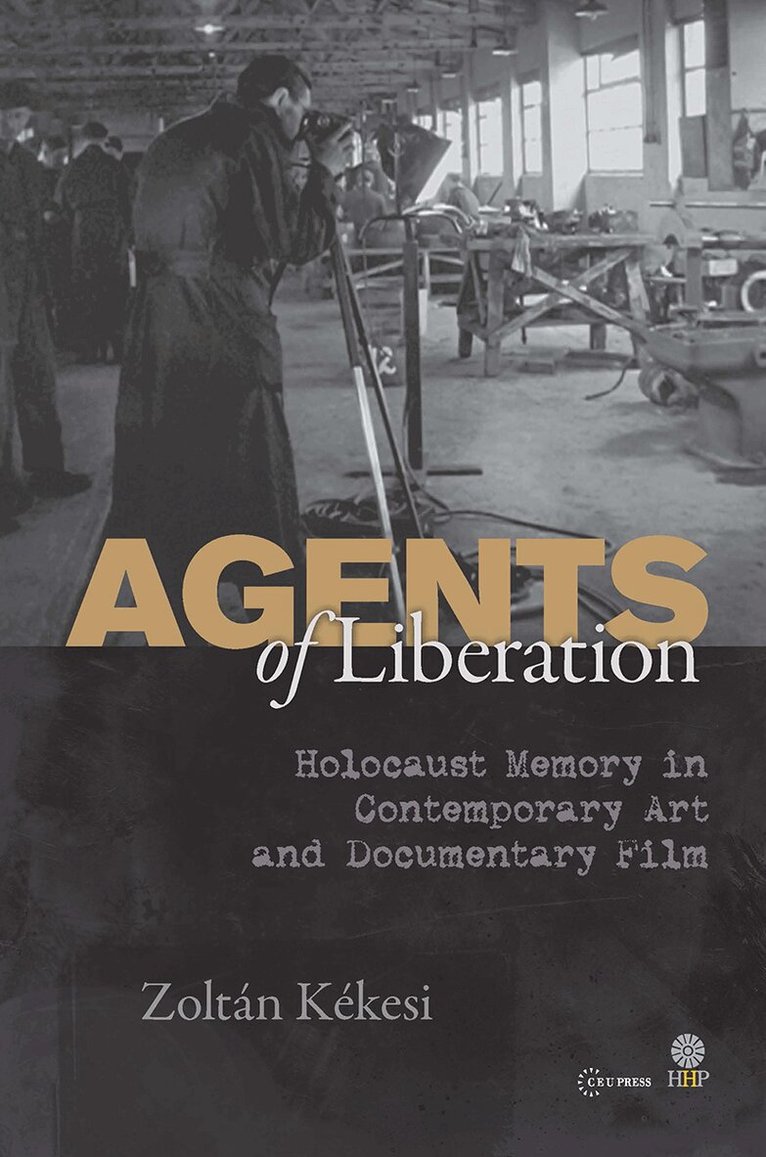
Agents of Liberations
Holocaust Memory in Contemporary Art and Documentary Film
599 kr
Beställningsvara. Skickas inom 10-15 vardagar. Fri frakt över 249 kr.
Du är på sajten för privatpersoner.
599 kr
Beställningsvara. Skickas inom 10-15 vardagar. Fri frakt över 249 kr.
Zoltán Kékesi is associate professor at the Department of Art Theory and Curatorial Studies at the Hungarian University of Fine Arts, Budapest.
"In this powerful volume, the Hungarian-born scholar and researcher Zoltán Kékesi examines selected artworks produced over the past three decades that transform or reframe social memory of the Shoah. the author contends persuasively that paradigms and concepts of Holocaust memory have in fact shifted significantly from the era in which survivor testimony and trauma were the dominant tropes, beginning in the aftermath of the war, when recordings of survivor accounts were first made. The identity of survivor and witness began to emerge as a result of the Eichmann trial of 1961 and of psychological research into the sequelae of trauma, as practices of remembrance and 'memorial culture' developed in the West in the late 1970s and 1980s and valorized public accounts of personal experience. Persuasively elaborating the concern of contemporary artists and filmmakers to mobilize an interactive approach that engages with the present, Zoltán Kékesi's major study makes a vibrant, provocative and necessary contribution to the literature on Holocaust memory, representation and transmission."
Magdolna Orosz, Pál Deréky, Zoltán Kékesi, Pál Kelemen
Häftad, 2006
631 kr
Magdolna Orosz, Pál Deréky, Zoltán Kékesi, Pál Kelemen
Häftad, 2006
631 kr
Du är på sajten för privatpersoner.
599 kr
Beställningsvara. Skickas inom 10-15 vardagar. Fri frakt över 249 kr.
Zoltán Kékesi is associate professor at the Department of Art Theory and Curatorial Studies at the Hungarian University of Fine Arts, Budapest.
"In this powerful volume, the Hungarian-born scholar and researcher Zoltán Kékesi examines selected artworks produced over the past three decades that transform or reframe social memory of the Shoah. the author contends persuasively that paradigms and concepts of Holocaust memory have in fact shifted significantly from the era in which survivor testimony and trauma were the dominant tropes, beginning in the aftermath of the war, when recordings of survivor accounts were first made. The identity of survivor and witness began to emerge as a result of the Eichmann trial of 1961 and of psychological research into the sequelae of trauma, as practices of remembrance and 'memorial culture' developed in the West in the late 1970s and 1980s and valorized public accounts of personal experience. Persuasively elaborating the concern of contemporary artists and filmmakers to mobilize an interactive approach that engages with the present, Zoltán Kékesi's major study makes a vibrant, provocative and necessary contribution to the literature on Holocaust memory, representation and transmission."
Magdolna Orosz, Pál Deréky, Zoltán Kékesi, Pál Kelemen
Häftad, 2006
631 kr
Magdolna Orosz, Pál Deréky, Zoltán Kékesi, Pál Kelemen
Häftad, 2006
631 kr