• Fri frakt över 249 kr
  • •
  • Snabba leveranser
  • •
  • Billiga böcker
Kundservice

Du är på sajten för privatpersoner.

Företag, bibliotek eller offentlig verksamhet?

Du handlar på classic.bokus.com, där alla dina funktioner finns intakta.
Till classic.bokus.com
Bokus logotyp. Gå till startsidan.
  • Erbjudanden
  • Nyheter
  • Student
  • Topplistor
  • Barn & ungdom
  • Bokus Play
  • E-böcker
  • Pocketböcker
  • Spel & pussel

10% rabatt på allt med kod NYSTART10 →

Sidfot

Mina sidor

    Hjälp

    • Kundservice
    • Vanliga frågor och svar
    • Frakt och leverans
    • Retur vid ångerrätt
    • Reklamera vara
    • Betalning
    • Köpvillkor
    • Allmänna villkor
    • Information om webbplatsens tillgänglighet

    Om Bokus

    • Om oss
    • Pressrum
    • För studenter
    • För företag
    • För bibliotek och offentlig verksamhet
    • För leverantörer
    • Hållbarhet

    Populärt

    • Aktuella erbjudanden
    • Presentkort
    • Studentlitteratur
    • Nya böcker
    • Topplistor
    • Signerade böcker
    • Engelska böcker

    Inspiration

    • Boktips
    • BookTok
    • Populära bokserier
    • Barnbokskaraktärer
    • Populära författare
    Logotyp för Bokus
    Följ oss på Facebook (extern länk)Följ oss på Instagram (extern länk)Följ oss på YouTube (extern länk)Följ oss på TikTok (extern länk)
    bokus @ CookiesAnpassa cookiesIntegritetspolicyKöpvillkor
    Till Citymail hemsida (extern länk)Till Budbee hemsida (extern länk)Till Postnord hemsida (extern länk)Till Schenker hemsida (extern länk)Till Early Bird hemsida (extern länk)Till Walleys hemsida (extern länk)
    1. Historia och arkeologi
    2. Arkeologi
    3. Arkeologiska perioder och områden

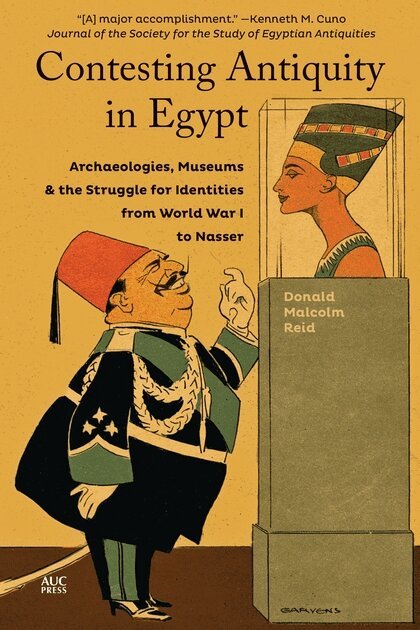
    Contesting Antiquity in Egypt

    Archaeologies, Museums, and the Struggle for Identities from World War I to Nasser

    AvDonald Malcolm Reid

    Häftad, Engelska, 2019

    367 kr

    Beställningsvara. Skickas inom 5-8 vardagar. Fri frakt över 249 kr.

    Fler format och utgåvor

    Inbunden

    Tillf. slut

    Beskrivning

    The sensational discovery in 1922 of Tutankhamun’s tomb, close on the heels of Britain’s declaration of Egyptian independence, accelerated the growth in Egypt of both Egyptology as a formal discipline and of ‘pharaonism'—popular interest in ancient Egypt—as an inspiration in the struggle for full independence. Emphasizing the three decades from 1922 until Nasser’s revolution in 1952, this compelling follow-up to Whose Pharaohs? looks at the ways in which Egypt developed its own archaeologies—Islamic, Coptic, and Greco-Roman, as well as the more dominant ancient Egyptian. Each of these four archaeologies had given birth to, and grown up around, a major antiquities museum in Egypt. Later, Cairo, Alexandria, and Ain Shams universities joined in shaping these fields. Contesting Antiquity in Egypt brings all four disciplines, as well as the closely related history of tourism, together in a single engaging framework. Throughout this semi-colonial era, the British fought a prolonged rearguard action to retain control of the country while the French continued to dominate the Antiquities Service, as they had since 1858. Traditional accounts highlight the role of European and American archaeologists in discovering and interpreting Egypt’s long past. Donald Reid redresses the balance by also paying close attention to the lives and careers of often-neglected Egyptian specialists. He draws attention not only to the contests between westerners and Egyptians over the control of antiquities, but also to passionate debates among Egyptians themselves over pharaonism in relation to Islam and Arabism during a critical period of nascent nationalism.Drawing on rich archival and published sources, extensive interviews, and material objects ranging from statues and murals to photographs and postage stamps, this comprehensive study by one of the leading scholars in the field will make fascinating reading for scholars and students of Middle East history, archaeology, politics, and museum and heritage studies, as well as for the interested lay reader.

    Produktinformation

    • Utgivningsdatum:2019-08-20
    • Mått:150 x 230 x 27 mm
    • Vikt:690 g
    • Format:Häftad
    • Språk:Engelska
    • Antal sidor:516
    • Förlag:The American University in Cairo Press
    • ISBN:9789774169380

    Utforska kategorier

    • Arkeologiska perioder och områden inom Historia och arkeologi
    • Mellanösterns historia inom Historia och arkeologi

    Mer om författaren

    Donald Malcolm Reid is author of Whose Pharaohs? Archaeologies, Museums, and Egyptian National Identity from Napoleon to World War I and Cairo University and the Making of Modern Egypt, among other works. He is professor emeritus, Georgia State University, and affiliate professor, Department of Near Eastern Languages and Civilization, University of Washington.

    Recensioner i media

    "[A] major accomplishment."—Kenneth M. Cuno, Journal for the Study of Egyptian Antiquities“An important work for Egyptologists all around the world . . . it stands out as a major contribution to the history of Egyptology in a wider, political context.”—Dan Deac, Journal of Ancient History and Archaeology“Professor Donald Malcolm Reid is one of the most prolific scholars in the field of modern Egyptian history. This work fills in a major lacuna, the role of Egyptians in archaeology and the museum world during the first half of the 20th century.” —Jere Bacharach, University of Washington“A very important contribution to the development of, and changes in, the perception of our national culture as viewed by the West and how this vision affected Egyptians and Egyptian archaeology. . . promises to be as important in its field as Whose Pharaohs? has been.” —Fayza Haikal, The American University in Cairo“Contesting Antiquity in Egypt would be of interest to scholars across humanistic disciplines. It will act as a valuable reference to those studying symbols of national ideology as well as ones scavenging for minute bibliographical information on a great many twentieth-century Egyptian cultural movers.”—Arab Studies Quarterly“A valuable piece of scholarship: not only in terms of the history of archaeology and museums in Egypt, but also concerning how we think about the making of the past in formerly colonized countries.”—William Carruthers, Public Archaeology“Highly recommended. . . . Of particular importance is Reid’s emphasis on Egyptian scholars who pioneered the study of the above fields and the role they played in wresting control of Egyptology from earlier French, British, German, and US colonial dominance. Of equal interest is the constant tension and rivalry between French and British archaeologists for control of Egyptology and their role in subordinating indigenous scholarship. Intrigues to control the news related to the discovery of Tutankhamen, controversies regarding the division of archaeological remains, and personal hostilities between famed archaeologists all make for an interesting read.”—Choice“Reid, who always has a good eye for an anecdote, shows how impossible it is to separate culture from the imperial machinations and rivalries of the time. . . . The really important thing about Reid’s new book is that he brings the often neglected contributions of Egyptian scholars into this narrative.”—Raphael Cormack, Apollo“A fascinating history of historians.”—AramcoWorld"Reid’s groundbreaking study on the interrelationship of ancient Egyptian archaeology or heritage and modern Egyptian national identity . . . is rendered easily accessible to the reader."—Bibliotheca Orientalis

    Innehållsförteckning

    • Introduction Part ICh. 1 Egyptology and Pharaonism in Egypt before TutankhamunCh. 2 Nationalizing TutankhamunCh. 3 Western Egyptology in Egypt in the Wake of TutankhamunCh. 4 Egyptian Egyptology and Pharaonism in the Wake of TutankhamunPart IICh. 5 Consuming Antiquity: Tourism between Two Revolutions, 1919-1952Ch. 6 In the Shadow of Egyptology: Islamic Art and Archaeology to 1952Ch. 7 Copts and Archaeology: Sons of St. Mark/ Sons of the PharaohsCh. 8 Alexandria, Egypt, and the Greco-Roman HeritagePart IIICh. 9 Contesting Egyptology in the 1930sCh. 10 Pharaonism and Its Challengers in the 1930s and 1940sCh. 11 Egyptology in the Twilight of Empire and Monarchy, 1939-1952Ch. 12 ConclusionBibliography