• Fri frakt över 249 kr
  • •
  • Snabba leveranser
  • •
  • Billiga böcker
Kundservice

Du är på sajten för privatpersoner.

Företag, bibliotek eller offentlig verksamhet?

Du handlar på classic.bokus.com, där alla dina funktioner finns intakta.
Till classic.bokus.com
Bokus logotyp. Gå till startsidan.
  • Erbjudanden
  • Nyheter
  • Student
  • Topplistor
  • Barn & ungdom
  • Bokus Play
  • E-böcker
  • Pocketböcker
  • Spel & pussel

10% studentrabatt med kod TERM26

Sidfot

Mina sidor

    Hjälp

    • Kundservice
    • Vanliga frågor och svar
    • Frakt och leverans
    • Retur vid ångerrätt
    • Reklamera vara
    • Betalning
    • Köpvillkor
    • Allmänna villkor
    • Information om webbplatsens tillgänglighet

    Om Bokus

    • Om oss
    • Pressrum
    • För studenter
    • För företag
    • För bibliotek och offentlig verksamhet
    • För leverantörer
    • Hållbarhet

    Populärt

    • Aktuella erbjudanden
    • Presentkort
    • Studentlitteratur
    • Nya böcker
    • Topplistor
    • Signerade böcker
    • Engelska böcker

    Inspiration

    • Boktips
    • BookTok
    • Populära bokserier
    • Barnbokskaraktärer
    • Populära författare
    Logotyp för Bokus
    Följ oss på Facebook (extern länk)Följ oss på Instagram (extern länk)Följ oss på YouTube (extern länk)Följ oss på TikTok (extern länk)
    bokus @ CookiesAnpassa cookiesIntegritetspolicyKöpvillkor
    Till Citymail hemsida (extern länk)Till Budbee hemsida (extern länk)Till Postnord hemsida (extern länk)Till Schenker hemsida (extern länk)Till Early Bird hemsida (extern länk)Till Walleys hemsida (extern länk)
    1. Naturvetenskap och teknik
    2. Matematik och naturvetenskap
    3. Biologi
    4. Cellbiologi

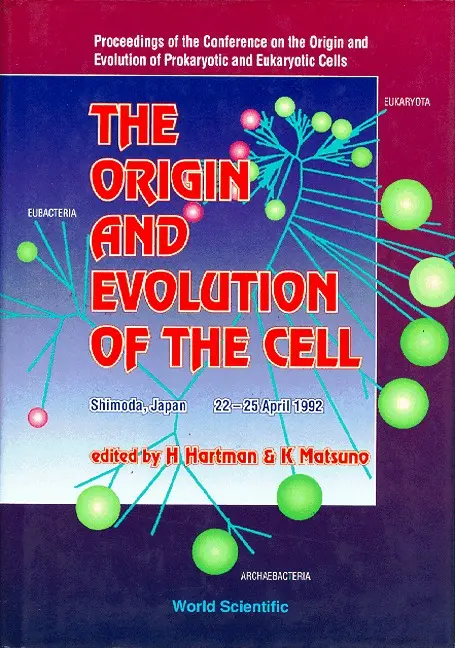
    ORIGIN AND EVOLUTION OF THE CELL, THE - PROCEEDINGS OF THE CONFERENCE ON THE ORIGIN AND EVOLUTION OF PROKARYOTIC AND EUKARYOTIC CELLS

    AvARTMAN HARTMAN K MATSUNO,H Hartman

    Inbunden, Engelska, 1993

    2 472 kr

    Tillfälligt slut

    Beskrivning

    This volume examines the origin of eukaryotic cells both phylogenetically and morphogenetically. The evolutionary relationship between prokaryotic and eukaryotic organizations is emphasized. The difference of inferences from ribosomal RNA and protein phylogenetic trees suggests a new possibility of synthesizing an evolutionary origin of eukaryotic cells as integrating morphogenetic contributions.

    Produktinformation

    • Utgivningsdatum:1993-02-01
    • Format:Inbunden
    • Språk:Engelska
    • Antal sidor:444
    • Förlag:World Scientific Publishing Co Pte Ltd
    • ISBN:9789810212629

    Utforska kategorier

    • Cellbiologi inom Naturvetenskap och teknik
    • Biovetenskap inom Naturvetenskap och teknik

    Innehållsförteckning

    • Bioenergetics of the last common ancestor and the origin of the eukaryotic endomembrane system, J.P. Gogarten; origin and evolution of eukaryotes, M. Hasegawa; emerging structural characteristic of a diverse collection of 16S (and 16S-like) and 23S (and 23S-like) ribosomal RNAs, R. Gutell; ribosomal protein structure - a probe into the evolution of the cell, A.T. Matheson; module structure of prokaryotic and eukaryotic proteins, M. Goh; fragmented ribosomal RNAs - functional and evolutionary significance, M.W. Gray; cellular evolution leading to generation of eukaryotic cell, H. Nakamura; a chimeric model for the invention of eukaryotes, M.L. Sogin; the nature of the common ancestor of archaea, bacteria and eucarya and the origin of eucarya, W. Zillig; cellular and molecular evolution of intracellular symbiont, H. Ishikawa; the diversity of the protists - description and cause, D. Patterson; evolutionary relationships between eubacteria, archaebacteria and eukaryotes - are eukaryotes evolved from archaebacteria?, T. Oshima; evolutionary consequences of the ancient sulfide biome, D.G. Searcy; continuous culture as a model of evolving systems and its application to evolutionary molecular engineering, Y. Hushimi; symmetry breaking of molecules and the origin of life, S. Yuasa; the origin and organization of possible protocellular structures, H. Yanagawa.