• Fri frakt över 249 kr
  • •
  • Snabba leveranser
  • •
  • Billiga böcker
Kundservice

Du är på sajten för privatpersoner.

Företag, bibliotek eller offentlig verksamhet?

Du handlar på classic.bokus.com, där alla dina funktioner finns intakta.
Till classic.bokus.com
Bokus logotyp. Gå till startsidan.
  • Erbjudanden
  • Nyheter
  • Student
  • Topplistor
  • Barn & ungdom
  • Bokus Play
  • E-böcker
  • Pocketböcker
  • Spel & pussel

10% rabatt på allt med kod: NYSTART10 →

Sidfot

Mina sidor

    Hjälp

    • Kundservice
    • Vanliga frågor och svar
    • Frakt och leverans
    • Retur vid ångerrätt
    • Reklamera vara
    • Betalning
    • Köpvillkor
    • Allmänna villkor
    • Information om webbplatsens tillgänglighet

    Om Bokus

    • Om oss
    • Pressrum
    • För studenter
    • För företag
    • För bibliotek och offentlig verksamhet
    • För leverantörer
    • Hållbarhet

    Populärt

    • Aktuella erbjudanden
    • Presentkort
    • Studentlitteratur
    • Nya böcker
    • Topplistor
    • Signerade böcker
    • Engelska böcker

    Inspiration

    • Boktips
    • BookTok
    • Populära bokserier
    • Barnbokskaraktärer
    • Populära författare
    Logotyp för Bokus
    Följ oss på Facebook (extern länk)Följ oss på Instagram (extern länk)Följ oss på YouTube (extern länk)Följ oss på TikTok (extern länk)
    bokus @ CookiesAnpassa cookiesIntegritetspolicyKöpvillkor
    Till Citymail hemsida (extern länk)Till Budbee hemsida (extern länk)Till Postnord hemsida (extern länk)Till Schenker hemsida (extern länk)Till Early Bird hemsida (extern länk)Till Walleys hemsida (extern länk)
    1. Språk och ordböcker
    2. Språkvetenskap och lingvistik

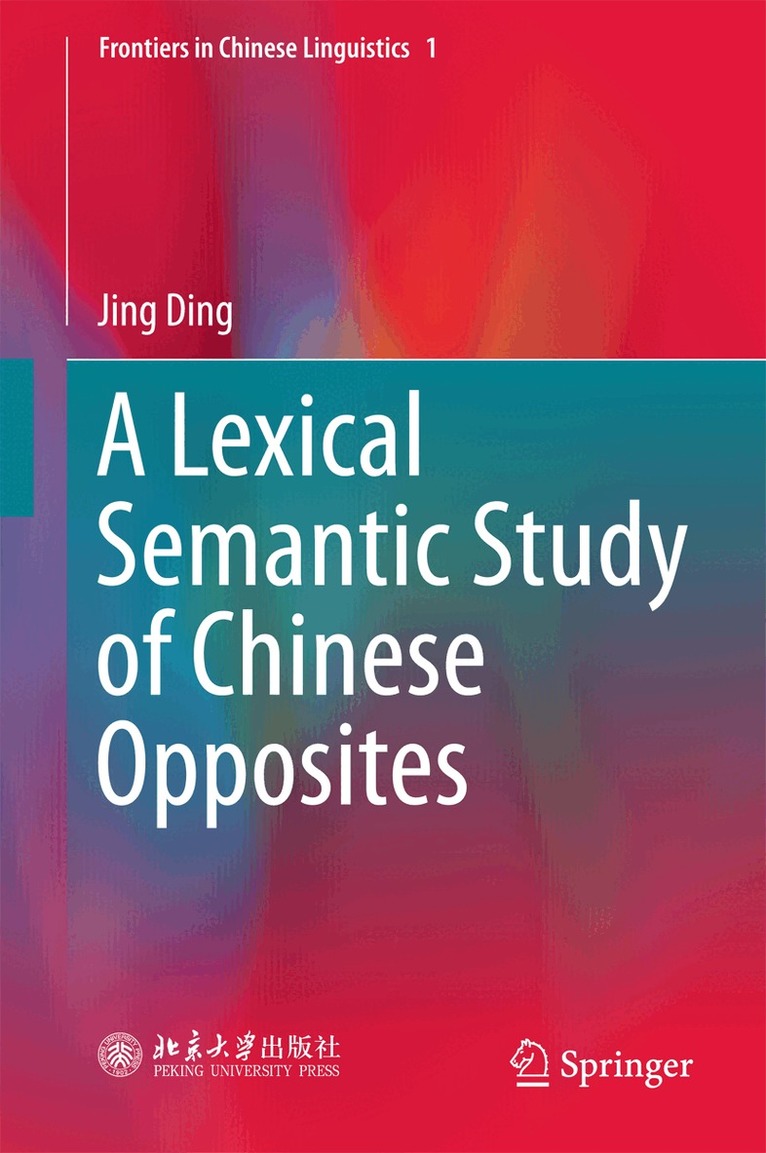
    Lexical Semantic Study of Chinese Opposites

    AvJing Ding

    Inbunden, Engelska, 2017

    Del 1 i serien Frontiers in Chinese Linguistics

    547 kr

    Beställningsvara. Skickas inom 10-15 vardagar. Fri frakt över 249 kr.

    Fler format och utgåvor

    E-bok

    710 kr

    Häftad

    547 kr

    Beskrivning

    This book studies Chinese opposites. It uses a large corpus (GigaWord) to trace the behavior of opposite pairings’ co-occurrence, focusing on the following questions: In what types of constructions, from window-size restricted and bi-syllabic to quad-syllabic, will the opposite pairings appear together? And, on a larger scale, i.e. in constrained-free contexts, in which syntactic frames will the opposite pairings appear together? The data suggests aspects that have been ignored by previous theoretical studies, such as the ordering rules in co-occurrent pairings, the differences between the three main sub-types of opposites (that is, antonym, complementary, converse) in discourse function distributions. The author also considers the features of this Chinese study and compares it to similar studies of English and Japanese. In all, it offers a practical view of how opposites are used in a certain language as a response to the puzzles lingering in theoretical fields.This study appeals to linguists, computational linguists and language-lovers. With numerous tables, illustrations and examples, it is easy to read but also encourages readers to link their personal instincts with the results from a large corpus to experience the beauty of language as a shared human resource.

    Produktinformation

    • Utgivningsdatum:2017-12-05
    • Mått:155 x 235 x 14 mm
    • Vikt:435 g
    • Format:Inbunden
    • Språk:Engelska
    • Serie:Frontiers in Chinese Linguistics
    • Antal sidor:135
    • Upplaga:17001
    • Förlag:Springer Verlag, Singapore
    • ISBN:9789811061837

    Utforska kategorier

    • Språkvetenskap och lingvistik inom Språk och ordböcker
    • Filosofiska discipliner inom Filosofi och religion

    Mer om författaren

    Dr. Jing Ding is presently a research fellow at the School of International Education, South China University of Technology. She received her PhD from The Hong Kong Polytechnic University, Hong Kong SAR, in 2015. Her main research interests are lexical semantics and computational linguistics. She has published papers in the Proceedings of the Chinese Lexical Semantics Workshop.

    Innehållsförteckning

    • 1. Introduction.- 1.1 Motivations.- 1.2 Research Questions.- 1.3 Organization of Chapters.- 2. Literature Review.- 2.1 Definition and Categorization.- 2.2 Some Properties of Being Opposites.- 3. Opposites in Constructions.- 3.1 Research Question.- 3.2 Methodology, Candidate List and Corpus.- 3. 3 Results.- 3. 4 Discussion.- 3.5 Summary.- 4. Opposites in Discourse.- 4.1 Research Question and Previous Experiments.- 4.2 Methodology, Candidate List and Corpus.- 4.3 Result.- 4.4 Discussion.- 4.5 Summary.- 5. Opposites and Negation.- 5.1 Research Question.- 5.2 Methodology, Candidate List and Corpus.- 5.3 Result.- 5.4 Discussion.- 5.5 Summary.- 6. Conclusion.