• Fri frakt över 249 kr
  • •
  • Snabba leveranser
  • •
  • Billiga böcker
Kundservice

Du är på sajten för privatpersoner.

Företag, bibliotek eller offentlig verksamhet?

Du handlar på classic.bokus.com, där alla dina funktioner finns intakta.
Till classic.bokus.com
Bokus logotyp. Gå till startsidan.
  • Erbjudanden
  • Nyheter
  • Student
  • Topplistor
  • Barn & ungdom
  • Bokus Play
  • E-böcker
  • Pocketböcker
  • Spel & pussel

10% studentrabatt med kod TERM26

Sidfot

Mina sidor

    Hjälp

    • Kundservice
    • Vanliga frågor och svar
    • Frakt och leverans
    • Retur vid ångerrätt
    • Reklamera vara
    • Betalning
    • Köpvillkor
    • Allmänna villkor
    • Information om webbplatsens tillgänglighet

    Om Bokus

    • Om oss
    • Pressrum
    • För studenter
    • För företag
    • För bibliotek och offentlig verksamhet
    • För leverantörer
    • Hållbarhet

    Populärt

    • Aktuella erbjudanden
    • Presentkort
    • Studentlitteratur
    • Nya böcker
    • Topplistor
    • Signerade böcker
    • Engelska böcker

    Inspiration

    • Boktips
    • BookTok
    • Populära bokserier
    • Barnbokskaraktärer
    • Populära författare
    Logotyp för Bokus
    Följ oss på Facebook (extern länk)Följ oss på Instagram (extern länk)Följ oss på YouTube (extern länk)Följ oss på TikTok (extern länk)
    bokus @ CookiesAnpassa cookiesIntegritetspolicyKöpvillkor
    Till Citymail hemsida (extern länk)Till Budbee hemsida (extern länk)Till Postnord hemsida (extern länk)Till Schenker hemsida (extern länk)Till Early Bird hemsida (extern länk)Till Walleys hemsida (extern länk)
    1. Naturvetenskap och teknik
    2. Matematik och naturvetenskap
    3. Fysik
    4. Tillämpad fysik

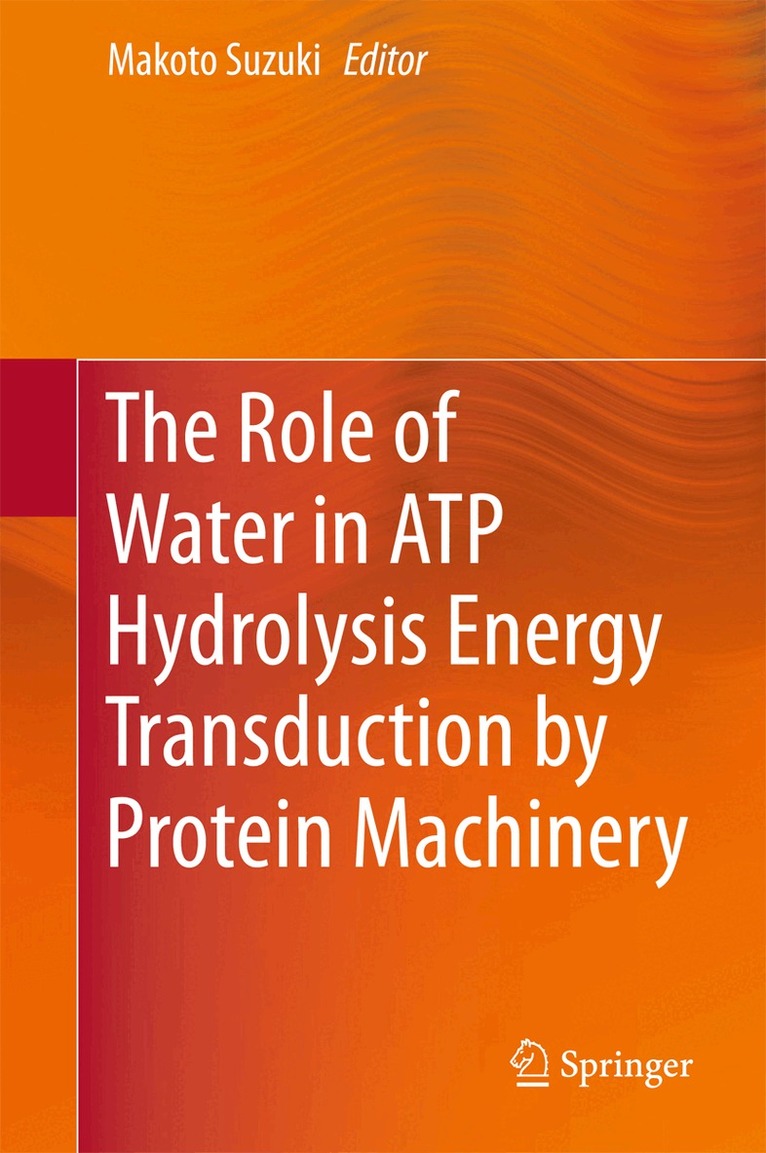
    Role of Water in ATP Hydrolysis Energy Transduction by Protein Machinery

    AvMakoto Suzuki

    Inbunden, Engelska, 2018

    1 743 kr

    Beställningsvara. Skickas inom 10-15 vardagar. Fri frakt över 249 kr.

    Beskrivning

    This book introduces recent progress in biological energetics from ATP hydrolysis to molecular machineries. The role of water is now recognized to be essential in biological molecular energetics. Although energetics is a rather distant field to many biologists, any working models for protein machineries such as protein motors, transporters, and other enzymes must be consistent with their energetics. Therefore, the book is intended to help scientists build systematic models of biomolecular functions based on three categories: (1) ATP hydrolysis reactions including ionic hydration and protonation–deprotonation of biomolecules, (2) protein–ligand/protein–protein interactions including hydration–dehydration processes, and (3) functioning mechanisms of protein machineries based on water functions.

    Produktinformation

    • Utgivningsdatum:2018-05-24
    • Mått:155 x 235 x 26 mm
    • Vikt:711 g
    • Format:Inbunden
    • Språk:Engelska
    • Antal sidor:353
    • Upplaga:18001
    • Förlag:Springer Verlag, Singapore
    • ISBN:9789811084584

    Utforska kategorier

    • Tillämpad fysik inom Naturvetenskap och teknik
    • Biokemi inom Naturvetenskap och teknik
    • Fysikalisk kemi inom Naturvetenskap och teknik

    Mer om författaren

    Makoto Suzuki graduated from Yamagata University in 1974 and received his Doctor of Engineering degree from Tohoku University in 1981. Following his studies, he worked at the Mechanical Engineering Laboratory (MEL/AIST) for eleven years, and at the National Institute for Advanced Interdisciplinary Research (NAIR/AIST) for five years. He moved from NAIR to Tohoku University as a professor in 1996. Using his improved-high-precision system of dielectric spectroscopy, he discovered hyper-mobile water (HMW) in the hydration layer of actin filaments, one of the contractile muscle proteins, in 2003. He organized "Water Plays the Main Role in ATP Energy Transfer" (2008-2012) as an Innovative Scientific Research Area, an interdisciplinary project focused on the energetics of protein machineries.

    Innehållsförteckning

    • ​Part I: Basis of ATP Hydrolysis Reaction.- 1.  Free Energy Analyses for the ATP Hydrolysis in Aqueous Solution by Large-Scale QM/MM Simulations Combined with a Theory of Solutions.- 2. Role of Metal Ion Binding and Protonation in ATP Hydrolysis Energetics.- 3. Spatial Distribution of Ionic Hydration Energy and Hyper-mobile Water.- 4. Theoretical studies of strong attractive interaction between macro-anions mediated by multivalent metal cations and related association behavior: Effective interaction between ATP binding proteins can be regulated by hydrolysis.- 5. Statistical mechanical integral equation approach to reveal the solvation effect on hydrolysis free energy of ATP and its analogue.- 6. A Solvent Model of Nucleotide–protein interaction - Partition coefficients of phosphates in solvent-water mixtures- .- Part II: Basis of Protein-Ligand and Protein-Protein Interactions.- 7. Energetics of myosin-ATP hydrolysis by calorimetry.- 8. Orchestrated electrostatic interactions among myosin, actin, ATP, and water.- 9. Protonation/deprotonation of proteins by neutron diffraction structure analysis.- 10. All-atom analysis of free energy of protein solvation through molecular simulation and solution theory.- 11. Uni-directional propagation of structural changes in actin filaments.- 12. Functional mechanisms of ABC transporters as revealed by molecular simulations.- 13.  Statistical thermodynamics on the binding of biomolecules.- Part III: Functioning Mechanisms of Protein Machinery.- 14. Ratchet model of motor proteins and its energetics.- 15. Single Molecule Analysis of Actomyosin in the Presence of Osmolyte.- 16. Novel intermolecular surface force unveils the driving force of actomyosin system.- 17. Extremophilic enzymes related to energy conversion.- 18. Functioning mechanism of ATP-driven proteins inferred on the basis of water-entropy effect.- 19. Controlling the motility of ATP-driven molecular motors using high hydrostatic pressure.- 20. Modulation of the sliding movement of myosin-driven actin filaments associated with their distortion: The effect of ATP, ADP, and inorganic phosphate.