• Fri frakt över 249 kr
  • •
  • Snabba leveranser
  • •
  • Billiga böcker
Kundservice

Du är på sajten för privatpersoner.

Företag, bibliotek eller offentlig verksamhet?

Du handlar på classic.bokus.com, där alla dina funktioner finns intakta.
Till classic.bokus.com
Bokus logotyp. Gå till startsidan.
  • Erbjudanden
  • Nyheter
  • Student
  • Topplistor
  • Barn & ungdom
  • Bokus Play
  • E-böcker
  • Pocketböcker
  • Spel & pussel

10% rabatt på allt med kod NYSTART10 →

Sidfot

Mina sidor

    Hjälp

    • Kundservice
    • Vanliga frågor och svar
    • Frakt och leverans
    • Retur vid ångerrätt
    • Reklamera vara
    • Betalning
    • Köpvillkor
    • Allmänna villkor
    • Information om webbplatsens tillgänglighet

    Om Bokus

    • Om oss
    • Pressrum
    • För studenter
    • För företag
    • För bibliotek och offentlig verksamhet
    • För leverantörer
    • Hållbarhet

    Populärt

    • Aktuella erbjudanden
    • Presentkort
    • Studentlitteratur
    • Nya böcker
    • Topplistor
    • Signerade böcker
    • Engelska böcker

    Inspiration

    • Boktips
    • BookTok
    • Populära bokserier
    • Barnbokskaraktärer
    • Populära författare
    Logotyp för Bokus
    Följ oss på Facebook (extern länk)Följ oss på Instagram (extern länk)Följ oss på YouTube (extern länk)Följ oss på TikTok (extern länk)
    bokus @ CookiesAnpassa cookiesIntegritetspolicyKöpvillkor
    Till Citymail hemsida (extern länk)Till Budbee hemsida (extern länk)Till Postnord hemsida (extern länk)Till Schenker hemsida (extern länk)Till Early Bird hemsida (extern länk)Till Walleys hemsida (extern länk)
    1. Ekonomi och Ledarskap
    2. Nationalekonomi
    3. Internationell ekonomi

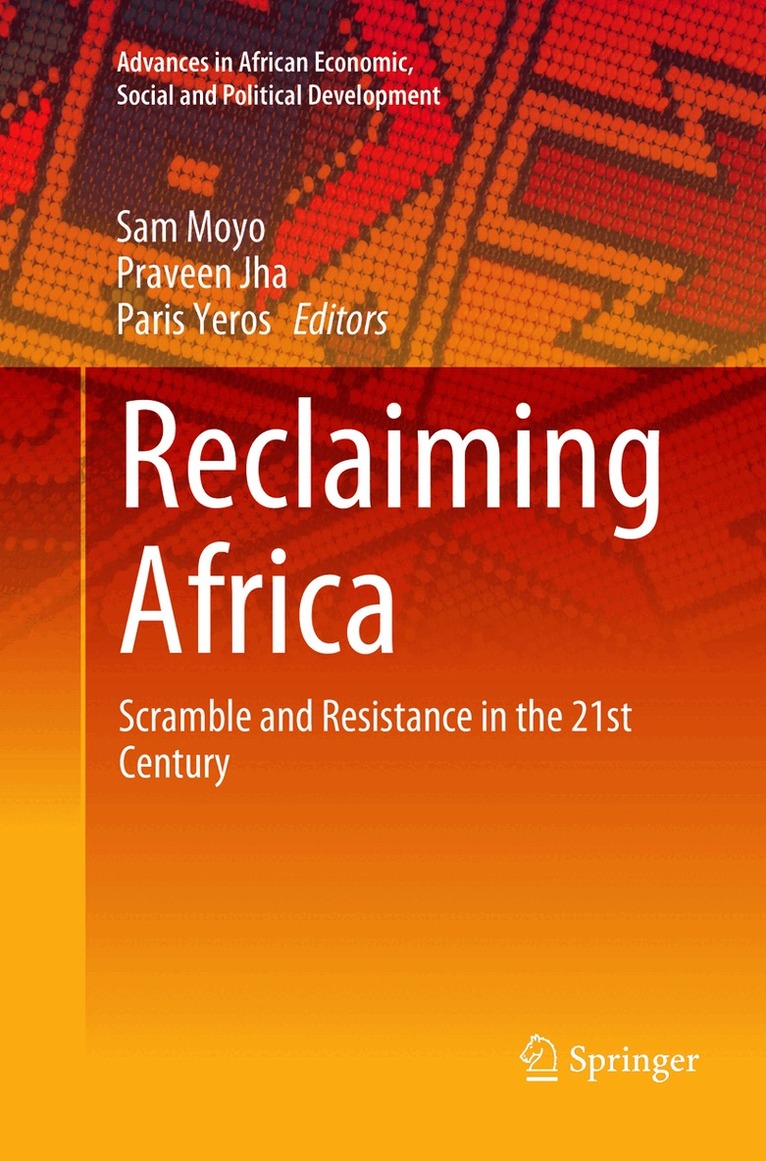
    Reclaiming Africa

    Scramble and Resistance in the 21st Century

    AvSam Moyo,Praveen Jha

    Häftad, Engelska, 2019

    Del i serien Advances in African Economic, Social and Political Development

    978 kr

    Beställningsvara. Skickas inom 10-15 vardagar. Fri frakt över 249 kr.

    Beskrivning

    This book presents the findings of research conducted by scholars and activists associated with the Agrarian South Network, based mainly in Africa, Asia and Latina America. The research articulates a Southern perspective on the “new scramble” for Africa, with a view to strengthen tri-continental solidarities. The book explains the significance of the new scramble in terms of the economic structures inherited from the late-nineteenth-century scramble and the subsequent post-independence period. The renewed competition for Africa’s land and natural resources and the resumption of economic growth at the turn of the millennium have revived concerns regarding the continent’s position in the world economy and the prospects for its development in the twenty-first century. In this regard, the book addresses two related issues: the character of the expansion of Southern competitors in relation to the more established Western strategies; and the impact of the renewed influx of investments inland, minerals, and associated infrastructure. The findings are presented with empirical rigor and conceptual clarity, to enable the reader to grasp what really is at stake in the twenty-first century – an epic struggle to reclaim Africa from the monopolies that exercise control over its land, minerals, labour, and destiny.

    Produktinformation

    • Utgivningsdatum:2019-02-05
    • Mått:155 x 235 x 23 mm
    • Vikt:552 g
    • Format:Häftad
    • Språk:Engelska
    • Serie:Advances in African Economic, Social and Political Development
    • Antal sidor:269
    • Förlag:Springer Verlag, Singapore
    • ISBN:9789811338632

    Utforska kategorier

    • Internationell ekonomi inom Ekonomi och Ledarskap
    • Ekonomisk politik inom Ekonomi och Ledarskap
    • Politik och statsskick inom Samhälle och politik

    Mer om författaren

    Sam Moyo (1954–2015) was Executive Director of the African Institute for Agrarian Studies (AIAS, 2002–15), Harare, Zimbabwe, President of the Council for the Development of Social Science Research in Africa (CODESRIA, 2009–11), and Founding Editor-in-Chief of Agrarian South: Journal of Political Economy (2012–15). An eminent scholar of land and agrarian studies, he published widely in academic journals and authored several books, including, among the most recent, The Agrarian Question in the Neoliberal Era (Pambazuka, 2011), Land and Agrarian Reform in Zimbabwe: Beyond White-Settler Capitalism (CODESRIA, 2013), and Land in the Struggles for Citizenship in Africa (CODESRIA, 2015).Praveen K. Jha is Professor of Economics at the Centre for Economic Studies and Planning (CESP) and adjunct at the Centre for Informal Sector and Labour Studies (CISLS), School of Social Sciences, Jawaharlal Nehru University (JNU), New Delhi, India. He has been a visiting fellow at a number of universities and institutions in Germany, China, Switzerland, South Africa, and Zimbabwe, and has collaborated in research programmes with UN agencies, including the ILO, UNICEF, UNDP, and FAO. He has published widely on labour and agrarian relations, the economics of education, and public finance. He is a co-editor of Agrarian South: Journal of Political Economy. Paris Yeros is Professor of International Economics at the Federal University of ABC (UFABC), São Paulo, Brazil, and co-editor of Agrarian South: Journal of Political Economy. He has been a visiting fellow at universities and institutes in Brazil, South Africa, and Zimbabwe, and has published widely on labour and agrarian relations, social movements, and nationalism. He is a co-editor of Agrarian South: Journal of Political Economy.

    Innehållsförteckning

    • 1.   Introduction.- 1.1  Overview: Scramble, Primitive Accumulation and Resistance.- 1.2  Trajectories of Gender Relations.- 1.3  Trajectories of Agrarian Transformation.- 2.  The Scramblers: Sources and Strategies.- 2.1 USA.- 2.2 China.- 2.3 India.- 2.4 Brazil.- 2.5 South Africa.- 3. National Experiences of Primitive Accumulation and Resistance.- 3.1 Angola.- 3.2 Botswana.- 3.3 Ghana.- 3.4 Mali.- 3.5 Senegal and Mauritania.- 3.6 Tanzania.- 3.7 Uganda.- 3.8 Kenya.- 3.9 Zambia.- 3.10 Zimbabwe.- 4. Resistance, Pan-Africanism and Non-Alignment.- 5. Conclusion.